
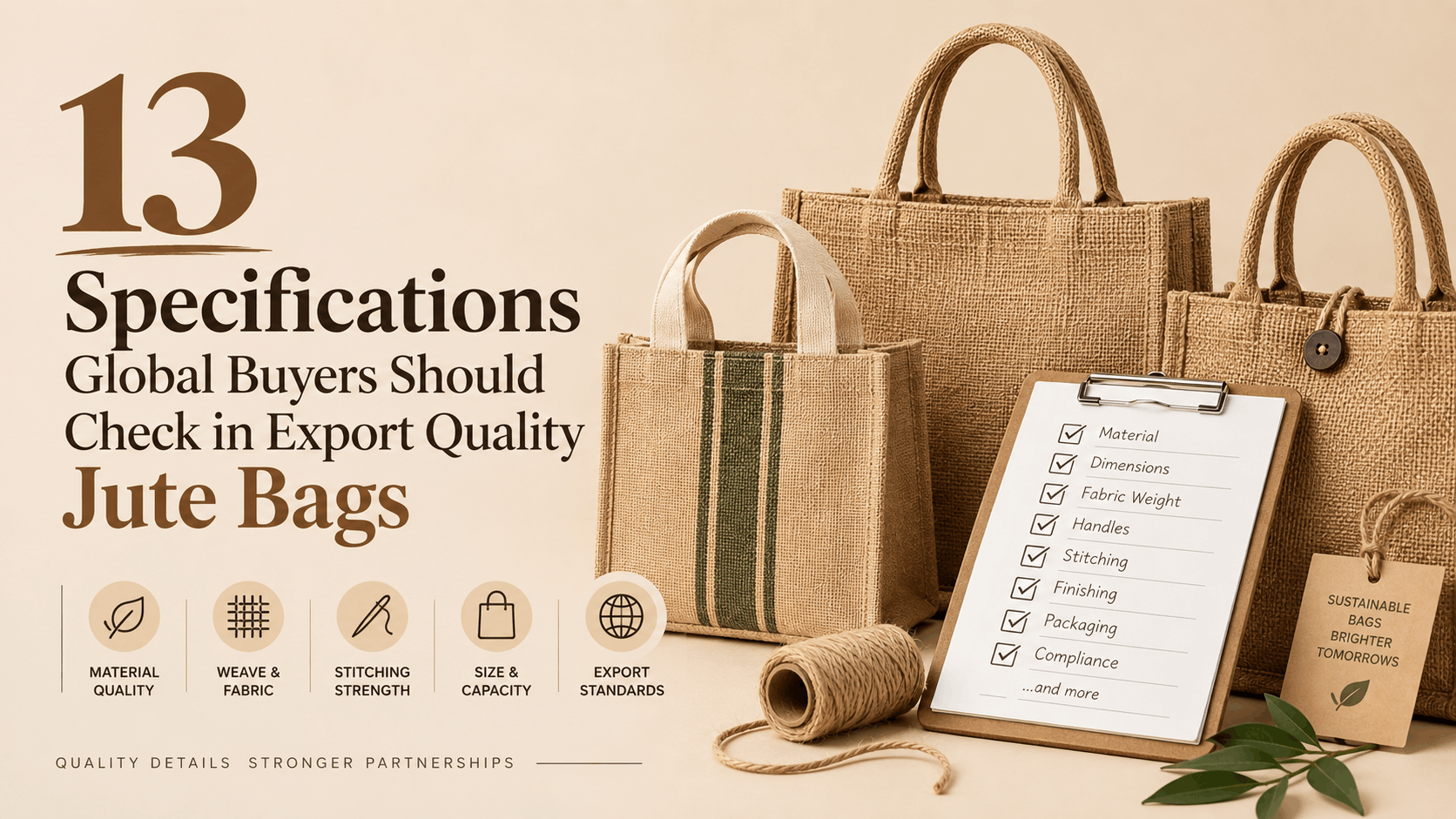
Export quality jute bags are not defined by a clean sample alone. The real test is whether the same fabric, construction, printing, packing, and measurements survive bulk production and international transit.
What should you check before importing jute bags from India? What GSM should you specify? How should the bags be packed?
The following jute bag specifications focus on the details that buyers can actually control before approving production.
13 Specifications Global Buyers Should Check in Export Quality Jute Bags
1. Fabric Construction
Start with the construction. “Jute fabric” is too broad for an RFQ.
Specify:
- Weave type
- Fabric construction
- Target GSM
- Lamination, if required
- Intended application
Plain, herringbone, and twill fabrics do not behave identically during cutting, sewing, or printing.
The National Jute Board itself documents bag designs with specific fabric types, dimensions, and component requirements.
2. GSM
What GSM is suitable for jute bags? There is no single correct number.
A promotional pouch, retail jute shopping bag, and structured jute tote bag may need different fabric weights.
Specify:
- Target GSM
- Acceptable tolerance
- Fabric construction
- Intended load or application
Do not approve GSM separately from construction. A number without context is not much of a specification.
3. Weave Consistency
Two rolls can meet the same GSM and still look different.
Check for:
- Uneven yarn spacing
- Open or tight areas
- Slubs
- Streaking
- Distortion around printed areas
For bulk jute bags, compare fabric from different production lots. One attractive roll proves very little about the rest of the shipment.
4. Lamination
Lamination needs its own specification.
State:
- Lamination type
- One-side or two-side application
- Coverage
- Required stiffness
- Finish
- Folding requirement
It can change how the bag folds, holds its shape, and accepts printing. Do not use “laminated” as the entire instruction.
5. Handle Attachment
The jute bag handle itself is only half the equation.
For jute bags for export, specify:
- Handle material
- Width or diameter
- Finished drop
- Attachment position
- Stitch pattern
- Reinforcement
- Intended load
Inspect the underside of the attachment too. That is where weak construction can hide nicely.
6. Stitching
“Double stitched” is not enough for a serious production file.
Specify, where relevant:
- Stitch type
- Stitch length or density
- Seam allowance
- Reinforcement at stress points
- Thread type
- Finishing of loose ends
Indian standards for certain jute bag categories specify stitch construction and even stitch counts, showing how detailed construction requirements can become.
7. Dimensions
Write dimensions as a fixed format:
Width × Height × Gusset
Then state how they are measured.
Is the measurement taken flat? Finished? Outside? Inside? Before or after folding?
That one clarification can prevent a surprising amount of back-and-forth during inspection.
8. Printing
For printed custom jute bags, approve more than the artwork.
Lock:
- Print method
- Number of colors
- Pantone or physical color reference
- Print size
- Position
- Registration tolerance
- Ink or finish
Jute has a visible fabric texture. Your final print can therefore look different from the digital artwork even when the file itself is correct.
9. Color Consistency
Natural jute can show some shade variation. That does not automatically mean defective fabric.
For dyed bags, specify the color reference and acceptable tolerance.
For natural fabric, keep an approved physical shade reference where color consistency matters across a retail program.
Jute bag quality is often judged against the first approved sample. Make sure everyone knows what variation is acceptable before production starts.
10. Moisture Protection
Moisture deserves attention before the bags reach the port.
For export production, define:
- Dryness requirement before packing
- Inner protection, where needed
- Moisture-resistant outer packing
- Storage conditions before loading
Certain Indian jute-bag standards also specify moisture-related requirements for defined bag categories.
For commercial jute bags for export, the practical question is simple: how will the shipment remain dry between factory packing and destination unloading?
11. Folding and Packing
Agree on the folding method with the sample.
Specify whether:
- Handles go inside or outside
- Bags are nested
- Printed faces are protected
- Individual polybags are used
- Creasing is acceptable
- Moisture protection is required
This becomes particularly important for retail-ready orders, where the buyer does not want to iron out the manufacturer’s packing decisions at the warehouse.
12. Carton Configuration
Your carton is part of the export specification.
Define:
- Pieces per carton
- Carton dimensions
- Net and gross weight
- Inner packing
- Stacking requirements
- Palletization, if required
A poor carton configuration can waste container space even when the bags themselves are perfectly produced.
13. Shipping Marks
Agree the carton marks before production packing starts.
Typically include:
- Buyer or consignee reference
- PO number
- Style or SKU
- Carton number
- Quantity
- Country of origin
- Gross and net weight
Do not simply copy marks from the last shipment. Destination-specific marking requirements can differ, and certain Indian jute regulations include prescribed marking requirements for specified products.
What Makes Export Quality Jute Bags Ready for Shipment?
For an importer, the final check is not simply “Does the bag look right?”
It is:
fabric → construction → dimensions → printing → packing → carton → marks
Every one should match the approved specification.
That is what separates a nice sample from export quality jute bags ready for a commercial shipment.
When evaluating a jute bag manufacturer in India or a jute bag exporter in India, ask to see the production specification and packing configuration. Not just the finished sample.
How SMPC NAVSETU Supports Jute Bag Production for Export
SMPC Navsetu LLP is an FIEO-registered Indian export business working with global buyers on wholesale, private-label and custom jute programs.
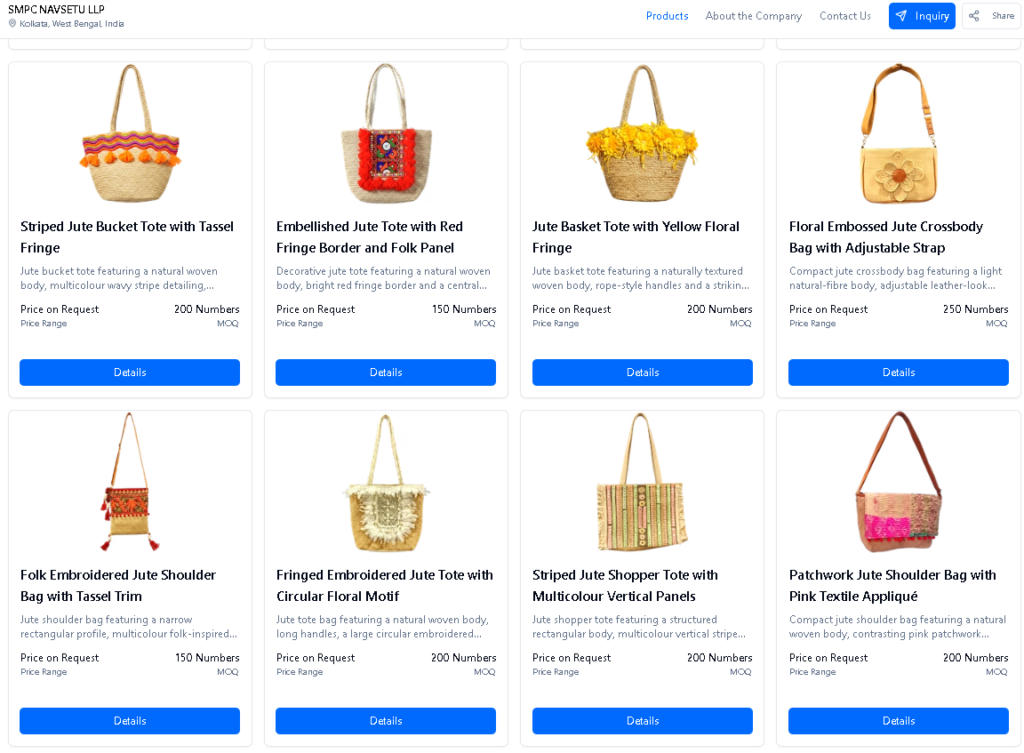
We can take a buyer requirement from an existing product or sample through to a production-ready order, with the commercial details kept under one roof:
- Custom development: sizes, fabrics, weaves, handles, printing and finishes
- Contract manufacturing: production against the approved specification and quantity
- Quality control: checks covering fabric, construction, dimensions, printing and packing
- Private-label execution: branding, labelling and buyer-specific packaging
- Export preparation: carton configuration, shipping marks and dispatch requirements
For buyers sourcing wholesale jute bags from India, that means you are not left stitching together separate vendors for development, manufacturing and export.
Got a jute bag spec in hand? Send it to info@smpcnavsetu.com, and we’ll see what it takes to get it export-ready.
Frequently Asked Questions
1. What makes a jute bag export quality?
Consistent fabric, controlled GSM, accurate dimensions, sound stitching, secure handles, reliable printing and export-suitable packing.
2. What is the MOQ for jute bags at SMPC Navsetu?
Our MOQ generally starts from 150 pieces for designer jute handbags and 300-500 pieces for other custom jute bag programs, depending on the design and production requirements.
3. Can SMPC Navsetu produce designer jute handbags for export?
Yes. We develop designer jute handbags for overseas buyers, with buyer-specific fabrics, handles, prints, dimensions, branding and packaging.
4. Does SMPC Navsetu supply export-quality jute bags?
Yes. Production is developed against agreed specifications and export-quality requirements, covering construction, finishing, packaging and shipment preparation.
5. What GSM is suitable for jute bags?
It depends on the application. Retail jute shopping bags usually need a different weight from heavy-duty jute tote bags.
6. What should I check before importing jute bags?
Check the approved sample, tolerances, packing method, carton details, shipping marks and required documentation before production.
7. How are jute bags packed for export?
Packing normally covers folding, inner protection, carton quantity, carton dimensions, weights and moisture control.
8. What specifications should I give a jute bag manufacturer?
Give the fabric, GSM, weave, dimensions, handles, stitching, printing, colour, packing and carton requirements.
9. What should a buyer approve before custom jute bags enter production?
Approve the physical sample, fabric reference, artwork, dimensions, handle construction and packing configuration.
10. What should buyers ask a jute bag exporter in India?
Ask what they can manufacture, how specifications are controlled, how goods are packed, and what export requirements they routinely handle.