Launching a new jute bag collection? Sourcing bags for your retail brand? Then don’t start with the design. Start with the fabric.
Many buyers focus on colors, logos, and packaging. Then they choose the wrong jute fabric for bags. The result? Weak bags. Poor print quality. Higher shipping costs. Customer complaints.
The demand for quality jute products continues to grow worldwide
| During 2025–26, India exported 171.3 thousand metric tonnes of jute goods worth ₹3.16 billion (approximately US$32.9 million). |
Buyers are clearly investing in better materials and sustainable packaging solutions. The question is: which fabric is right for your product?
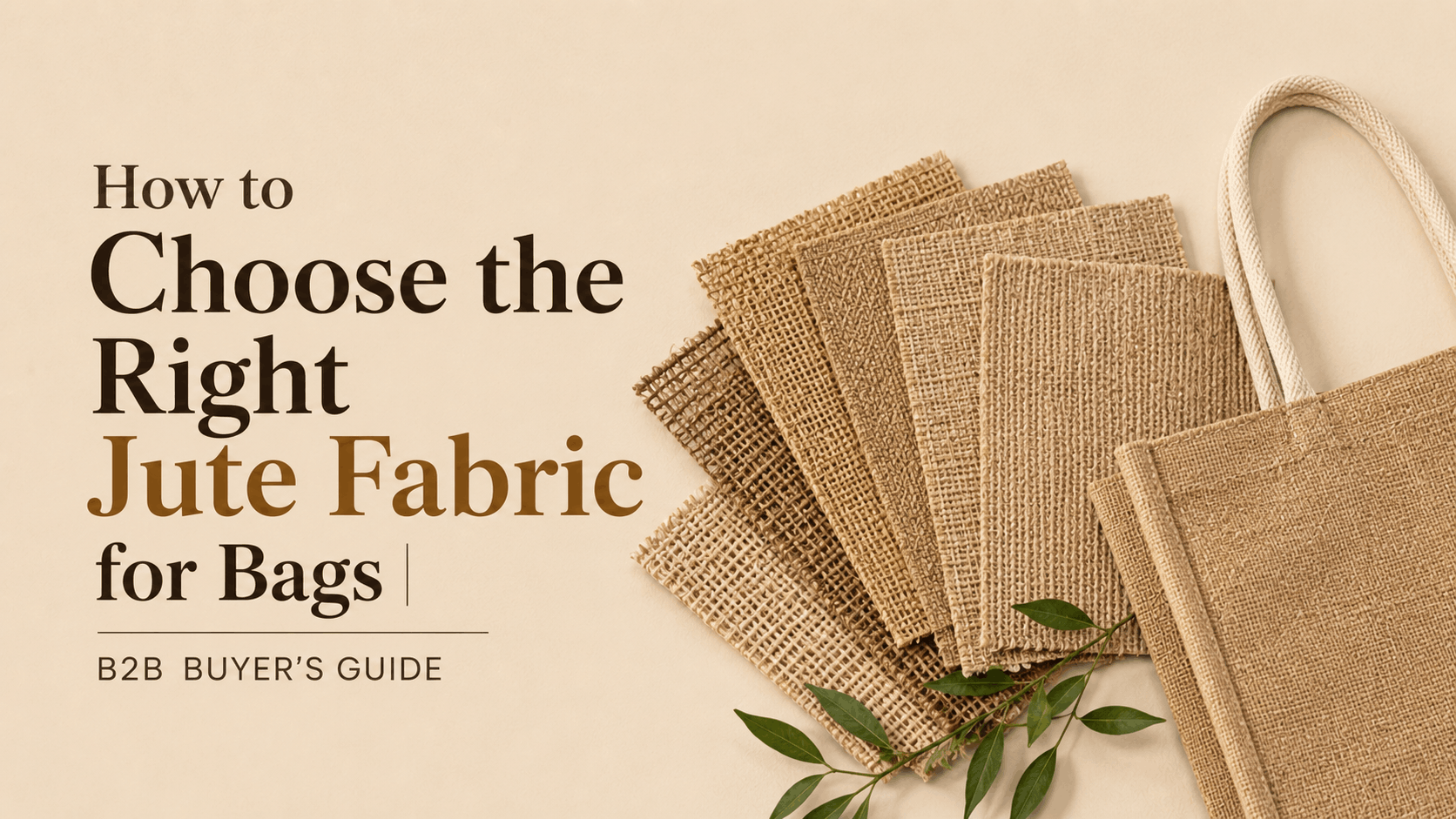
This guide compares the most widely used jute fabrics, explains where each performs best, and helps you choose the jute fabric for bags before production begins.
Which Jute Fabric Is Right for Your Business?
A grocery bag doesn’t need the same material as a luxury gift bag. Likewise, a promotional tote has very different requirements from a wine carrier or a premium retail bag.
Here’s a quick comparison to help you shortlist the best jute fabric for bags based on your application.
| Product | Recommended Fabric | Why It Works |
| Grocery Bags | Canvas Jute | High strength and excellent reusability |
| Promotional Bags | Plain Jute | Cost-effective and suitable for bulk branding |
| Fashion Retail Bags | Oxford Jute | Smooth finish with a structured appearance |
| Luxury Retail Bags | Herringbone Jute | Premium texture and distinctive weave |
| Wine Bottle Bags | Laminated Jute | Better moisture resistance and durability |
| Corporate Gift Bags | Herringbone / Oxford | Ideal for premium branding and presentation |
| Trade Show Bags | Plain Jute | Lightweight and economical for large quantities |
| Home Décor & Gift Packaging | Braided / Chenille Jute | Decorative texture with a premium look |
Also Read: Jute Bag Manufacturer in India: The Complete Guide for Importers and Retail Brands
Understanding the Different Types of Jute Fabrics
Not every jute fabric is designed for the same purpose. Some prioritize strength, while others focus on structure, printability, or premium presentation.
Here’s how experienced buyers evaluate the most common types of jute fabric before selecting one for their products.
1. Plain Jute: When Cost and Scale Matter
Plain jute remains the preferred option for large-volume production because it’s widely available, economical, and easy to source consistently across suppliers.
Key strengths:
- Competitive for bulk orders
- Reliable material availability
- Suitable for basic screen printing
Ideal applications:
Promotional bags, supermarket bags, trade show giveaways, and budget retail programs.
Watch out:
Its open weave doesn’t reproduce intricate logos or fine artwork as cleanly as tighter fabrics.
2. Canvas Jute: When Strength Comes First
Canvas jute features a tighter, heavier weave that handles higher working loads and repeated use. It’s one of the most practical choices for reusable shopping bags.
Key strengths:
- High load-bearing capacity
- Better shape retention
- Longer service life
Ideal applications:
Grocery bags, utility totes, bookstore bags, and reusable shopping bags.
Watch out:
Higher GSM increases bag weight, which can affect freight costs for export shipments.
3. Oxford Jute: When Branding Needs a Cleaner Finish
Oxford jute offers a smoother surface than plain weaves. That improves logo definition and gives finished bags a more structured retail appearance.
Key strengths:
- Better print definition
- Uniform surface
- Professional presentation
Ideal applications:
Corporate gifting, retail shopping bags, conference bags, and private-label collections.
Watch out:
It costs more than plain jute, so it may not suit price-sensitive promotional campaigns.
4. Herringbone Jute: When Presentation Adds Value
Herringbone’s signature diagonal weave creates a premium look without relying on additional decoration. Brands often choose it when shelf appeal influences purchasing decisions.
Key strengths:
- Distinctive woven texture
- Strong retail presentation
- Good dimensional stability
Ideal applications:
Luxury retail bags, boutique packaging, fashion brands, and premium corporate gifts.
Watch out:
Choose it only when premium presentation supports your product positioning and retail price.
5. Twill Jute: When You Need Balance
Twill jute bridges the gap between plain and premium fabrics. Its diagonal weave improves flexibility while maintaining a cleaner finish for everyday retail products.
Key strengths:
- Better flexibility
- Improved crease resistance
- Balanced cost-to-performance
Ideal applications:
Retail shopping bags, lifestyle brands, fashion accessories, and custom jute bags.
Watch out:
It isn’t the strongest option for heavy-duty bags or the best choice for luxury merchandising.
6. Laminated Jute: When Moisture Protection Matters
Laminated jute adds a protective inner coating that improves moisture resistance and keeps bags cleaner during regular use. It also provides a smoother surface for printed branding.
Key strengths:
- Moisture resistance
- Easier maintenance
- Better print consistency
Ideal applications:
Grocery bags, wine bags, food retail, and export quality jute bags.
Watch out:
Confirm the lamination type if your market has specific recycling or sustainability requirements.
7. Braided & Chenille Jute: When Design Takes Priority
These fabrics are selected for appearance rather than carrying capacity. Their textured finish helps brands create distinctive products for niche retail markets.
Key strengths:
- Decorative textures
- Premium handcrafted appeal
- Strong visual differentiation
Ideal applications:
Gift packaging, home décor, boutique collections, and seasonal retail products.
Watch out:
They’re not designed for heavy-duty shopping bags or cost-driven bulk promotions.
| Looking for honest advice before sourcing jute bags from India? Let’s discuss your requirements first. There’s no obligation to place an order. Just practical answers from an experienced export team. |
How Procurement Teams Select the Right Jute Fabric Before Sampling?
Experienced buyers rarely begin by comparing fabrics. They begin by eliminating the wrong ones.
Before requesting samples, they define the product requirements, production constraints, and commercial targets. Only then do they shortlist the best jute fabric for bags.
1. Define the Performance Requirements First
Don’t ask how the bag should look. Ask how it should perform.
Create a specification that includes:
- Maximum working load
- Expected reuse cycles
- Required bag structure (soft, semi-rigid, or rigid)
- Moisture exposure
- Indoor or outdoor use
For example, a grocery bag expected to carry 12 kg requires a very different fabric from that of a promotional tote distributed at a trade show.
2. Standardize the Fabric Specification
Many buyers request “canvas jute.” That’s not enough.
A complete specification should include:
- Fabric weave
- GSM range
- Lamination requirement
- Colour
- Surface finish
- Printing side
- Yarn quality, where applicable
Without these details, two suppliers can quote the same fabric name while supplying completely different materials.
3. Match the Fabric to the Branding Method
Your artwork should influence the fabric, not the other way around. Before finalizing the jute fabric guide for your project, confirm how the branding will be applied.
Different weaves respond differently to:
- Screen printing
- Digital printing
- Heat transfer
- Foil printing
Open weaves may absorb more ink, while tighter constructions usually produce sharper edges and better logo definition.
4. Evaluate Total Cost, Not Just Fabric Cost
Experienced importers don’t compare price per meter alone. They calculate the total landed cost.
A lower-cost fabric may:
- Increase freight because of added reinforcement.
- Require additional quality checks.
- Reduce the product’s usable life.
- Increase replacement or return costs.
The right specification often delivers better value than the lowest quotation.
5. Confirm Manufacturing Consistency
A sample proves capability. It doesn’t prove consistency.
Ask your supplier:
- Can this weave be maintained across bulk production?
- Can the same GSM be supplied for repeat orders?
- Will color remain consistent between dye lots?
- Is the same construction available year-round?
These questions become even more important for custom jute bags produced in multiple batches.
6. Validate the Material Before Approving Production
Never approve fabric from a catalog image.
Request:
- Fabric swatches
- GSM verification
- Print strike-offs
- Lamination samples, if applicable
- Color approvals under natural light
Many experienced sourcing teams compare swatches from multiple suppliers before approving materials for export quality jute bags.
| Procurement Insight: Don’t compare fabric names. Compare measurable specifications. A “canvas jute” bag without an agreed GSM, weave, and finish is only a product description. Not a production standard. |
Before You Finalize Your Jute Fabric, Check These Boxes
You’ve shortlisted the jute fabric for bags. Great. Before approving it for sampling or production, make sure you can confidently tick every box below.
These small checks often prevent the biggest sourcing problems later.
1. Product Specification Checklist
| Checkpoint | Status |
| Bag application is clearly defined | ☐ |
| Required GSM has been approved | ☐ |
| Fabric weave has been finalized | ☐ |
| Expected load capacity has been specified | ☐ |
| Required reuse cycles have been considered | ☐ |
2. Branding & Design Checklist
| Checkpoint | Status |
| Printing method has been confirmed | ☐ |
| Logo placement has been approved | ☐ |
| Fabric color matches the approved sample | ☐ |
| Print quality has been tested on the selected fabric | ☐ |
| Branding meets retail requirements | ☐ |
3. Production & Quality Checklist
| Checkpoint | Status |
| Fabric swatch has been approved | ☐ |
| Weave and finish match the specification | ☐ |
| Material substitutions are not permitted without approval | ☐ |
| Repeat-order consistency has been confirmed | ☐ |
| Quality inspection requirements have been documented | ☐ |
4. Export & Commercial Checklist
| Checkpoint | Status |
| Freight impact has been reviewed | ☐ |
| Packaging specifications have been approved | ☐ |
| Destination market requirements have been verified | ☐ |
| Purchase order matches the approved specification | ☐ |
| Production timeline has been confirmed | ☐ |
Source Jute Bags with Greater Confidence With SMPC Navsetu
Choosing the right jute fabric for bags is only the first step. The real challenge is ensuring that the same material, workmanship, and specifications are applied to every shipment.
That’s where SMPC Navsetu adds value.
We help global brands, importers, wholesalers, and private-label businesses reduce sourcing risks that often slow production or compromise product consistency.
How We Help:
- Recommend the right fabric based on your product, budget, and retail application—not what’s easiest to manufacture.
- Standardize material specifications to minimize differences between samples, bulk production, and repeat orders.
- Coordinate production and quality inspections so approved specifications are followed throughout manufacturing.
- Monitor packaging and export readiness to reduce delays during dispatch and international shipping.
- Provide a single point of coordination, eliminating the need to manage multiple manufacturers, quality inspectors, and export partners separately.
Whether you’re developing custom jute bags for a new retail collection or scaling existing product lines, our focus remains the same: consistent quality, transparent communication, and reliable execution from sampling to export.
Looking for a dependable jute manufacturing and export partner? Let’s discuss your product requirements and build a sourcing solution that fits your business, not just your order quantity. Email us with your queries at info@smpcnavsetu.com.
Frequently Asked Questions
1. Which jute fabric is best for shopping bags?
There’s no single best option. Canvas suits heavy-duty shopping bags, while Plain Jute works well for budget retail. Choose the fabric based on load capacity, branding, expected reuse, and your target market.
2. How do I choose the right jute fabric for my product?
Start with the application, not the fabric. Define product weight, printing method, expected lifespan, and budget first. Then shortlist the fabric that best matches those requirements.
3. Which jute fabric offers the best printing quality?
Oxford and Laminated Jute usually produce sharper logos and cleaner graphics because of their smoother surfaces. If detailed branding matters, always test the artwork on the actual production fabric before approval.
4. Which jute fabric is strongest for heavy-duty bags?
Canvas Jute is commonly preferred for heavy-duty applications. Its dense weave supports higher loads and repeated use. However, always specify the required GSM and construction instead of relying on the fabric name alone.
5. Should I request fabric swatches before approving production?
Absolutely. A swatch helps you verify color, texture, weave, and print compatibility. Never approve bulk production based only on catalog images or digital photographs.
6. Can different jute fabrics be combined in one bag?
Yes. Many brands combine fabrics to improve performance or reduce cost. For example, one fabric may be used for the body, while another is selected for pockets, gussets, or decorative panels.
7. Which jute fabric is best for private-label brands?
It depends on your brand positioning. Premium collections often prefer Oxford or Herringbone, while promotional ranges usually select Plain or Canvas Jute for better cost efficiency and production scalability.
8. Is laminated jute suitable for food and grocery bags?
Yes. Laminated Jute offers better moisture resistance and is easier to clean. That’s why it’s widely used for grocery bags, reusable shopping bags, and food retail applications.
9. Does fabric GSM matter when sourcing jute bags?
Very much. GSM affects strength, structure, weight, and freight cost. Two bags made from the same fabric can perform very differently if their GSM specifications are not identical.
10. Can the same jute fabric be used across different bag styles?
Sometimes. However, one fabric rarely suits every application. A material that performs well for promotional totes may not provide the structure or durability needed for grocery or premium retail bags.