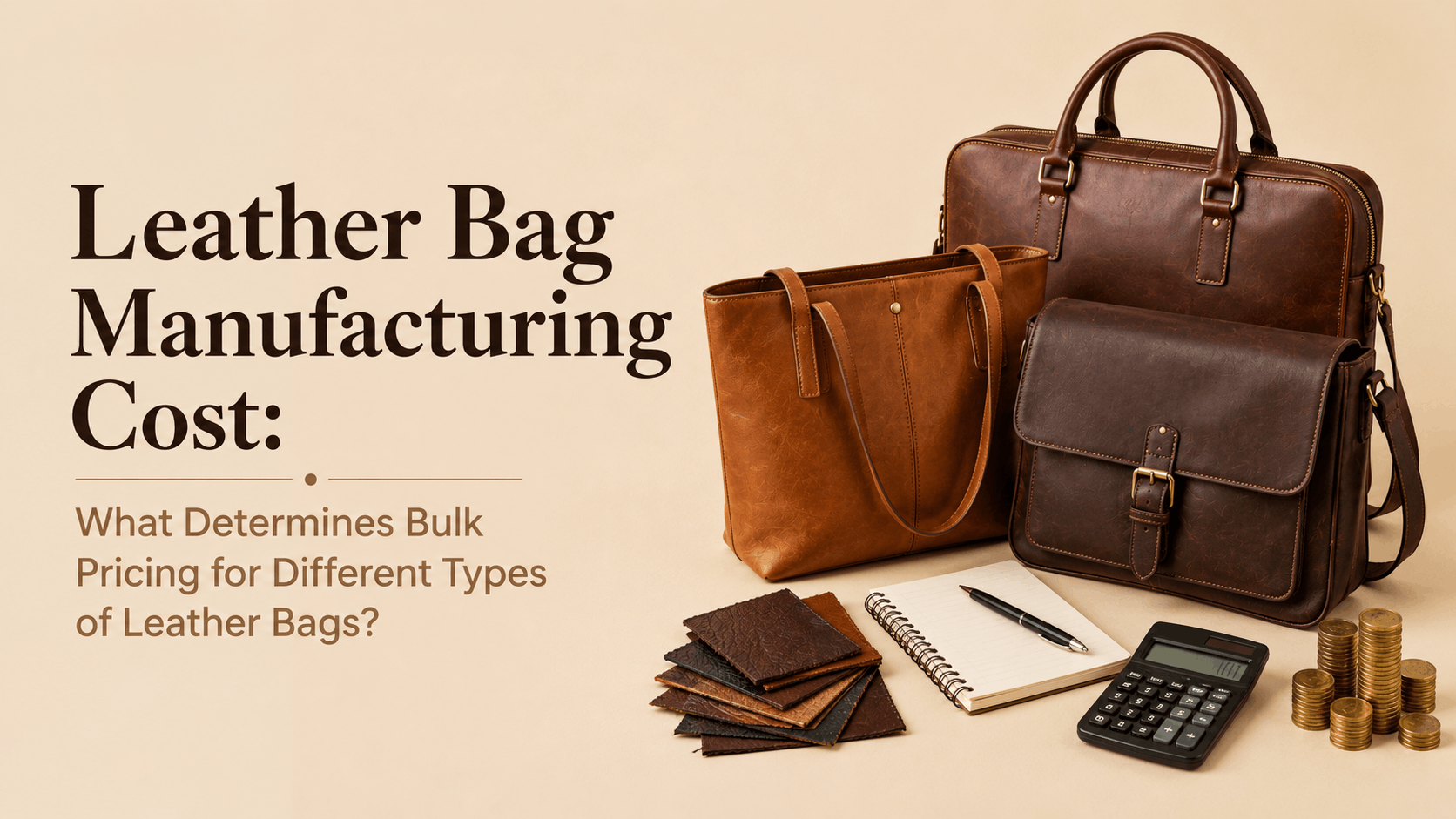
You’ve finalized the design, shared your specifications, and requested quotations. A few days later, the replies arrive. One supplier quotes US$18 per bag. Another quotes US$31. A third lands somewhere in between. So, who’s right?
The truth is, leather bag manufacturing cost isn’t determined by leather alone. Construction, hardware, customization, production volume, and even the assumptions a manufacturer makes while preparing your quotation can significantly change the final price.
If you’re sourcing bulk leather bags for your brand, understanding these variables will help you compare quotations with confidence and negotiate from a position of knowledge.
Why Do Similar Leather Bags Have Different Prices?
Let’s start with an uncomfortable truth.
Most buying teams don’t compare quotations. They compare numbers.
That’s a problem.
A quotation is more than a price. It’s a manufacturer’s interpretation of your requirements. If your RFQ leaves room for assumptions, don’t be surprised when every leather supplier fills in the blanks differently.
Before deciding which quotation offers the best value, ask yourself:
- Are all suppliers quoting the exact same bag specification?
- Has the leather grade been clearly defined, or is each factory making its own assumption?
- Are branding, packaging, and sampling included, or will they appear as additional charges later?
- Is the quotation based on your actual order quantity or a different production volume?
- Have quality expectations been documented, or are they simply assumed?
| Here’s a simple rule that experienced procurement managers follow: If two quotations look very different, look for what’s different in the specification, not just the price. The goal isn’t to find the cheapest leather bag supplier in Kolkata, Delhi, or anywhere. It’s to find the supplier that’s quoting the product you actually want to manufacture. |
That’s where the real answers usually are.
Once that becomes your benchmark, evaluating leather bag manufacturing cost becomes far more logical. Plus, the negotiations become far more productive.
Also Read: 10 Mistakes Importers Make When Sourcing Leather Goods from India (And How to Avoid Them)
Different Types of Leather Bags and Why They Cost Differently
Not all leather bags are built with the same production requirements. Some are designed for everyday use with simple construction. Others demand additional materials, longer production time, and more detailed craftsmanship.
Understanding these differences helps you estimate leather bag manufacturing cost long before the first quotation lands in your inbox.
Everyday Retail Bags
This category includes:
- Leather tote bags
- Leather shoulder bags
- Leather crossbody bags
- Leather sling bags
What do they feature?
These bags usually feature fewer panels, simpler silhouettes, and minimal internal organization. That keeps production efficient and makes them well-suited for larger retail collections where consistency and competitive pricing matter.
Business Bags
Business-focused products include:
- Leather laptop bags
- Leather office bags
- Leather messenger bags
- Leather briefcases
- Leather document bags
- Leather portfolio bags
These bags do much more than carry belongings. They need to organize them.
What do they feature?
Dedicated laptop sleeves, document compartments, reinforced handles, padded sections, luggage straps, and structured interiors all increase production steps. More components also mean more precision during assembly. This naturally pushes leather bag manufacturing costs upward.
Travel Bags
This category covers:
- Leather travel bags
- Leather duffel bags
- Leather weekender bags
- Leather backpacks
Larger bags don’t just consume more leather. They also need stronger construction to withstand heavier loads and repeated use.
What do they feature?
Reinforced handles, stronger shoulder straps, base supports, and additional stress-point stitching become essential rather than optional. Those upgrades improve durability, but they also increase manufacturing time and material consumption.
Fashion Bags
Products such as leather handbags and leather satchels often compete on design rather than capacity.
Buyers in this segment usually expect cleaner silhouettes, sharper finishing, refined detailing, and consistent aesthetics across every production batch.
Even small variations become noticeable, which is why these products often demand greater manufacturing precision than their simpler counterparts.
Here’s a quick comparison:
| Bag Category | Typical Manufacturing Complexity | Relative Cost Level |
| Tote, Shoulder, Sling & Crossbody Bags | Low | $$ |
| Laptop, Office, Messenger & Briefcases | Medium–High | $$$ |
| Travel, Duffel, Weekender & Backpacks | High | $$$$ |
| Handbags & Satchels | High | $$$$ |
Buyer Insight: The final price depends on how the bag is engineered, not just how large or small it is or how it looks. That’s why two products with similar dimensions can require very different levels of labor, materials, and manufacturing expertise.
Also Read: How to Choose the Best Leather for Bags, Wallets & Accessories: A Complete Buyer’s Guide
What Actually Drives Leather Bag Manufacturing Cost?
When buyers ask why one quotation is higher than another, the answer is rarely just “better leather.”
The leather bag manufacturing costs are built layer by layer. Some decisions have a major impact on pricing, while others barely move the needle.
Here’s where the biggest differences usually come from.
1. Leather Consumption
Leather is one of the largest cost components, but it isn’t just about quality; it’s about quantity.
A leather handbag with larger panels may require bigger hide sections and generate more cutting waste. Even a small design change can affect material utilization, especially in bulk leather manufacturing in Kolkata or anywhere in India.
2. Construction Complexity
Every additional feature adds another production step.
Think about it:
- More compartments
- More internal dividers
- More zippered pockets
- More reinforced sections
- More handles and attachment points
Individually, they seem minor. Together, they add hours across a production run.
3. Hardware Selection
Hardware is often underestimated during product development.
A standard zipper and buckle keep costs predictable. Switch to premium components, custom logo hardware, or specialty finishes, and the quotation changes almost immediately.
Many experienced buyers standardize hardware across multiple collections. It simplifies leather sourcing, improves consistency, and often reduces procurement costs.
4. Lining and Interior Features
The inside of the leather handbag matters just as much as the outside.
Padded laptop sleeves, zippered organizers, key holders, pen loops, RFID pockets, and premium linings all increase material usage and assembly time. They’re valuable features but only if your target market is willing to pay for them.
5. Finishing and Branding
The final touches often separate an ordinary leather handbag from a retail-ready product.
Common additions include:
- Embossed or debossed logos
- Foil stamping
- Edge painting
- Decorative stitching
- Custom labels
- Premium dust bags and gift packaging
None of these changes the bag’s primary function. They change how customers perceive it and influence leather bag manufacturing cost accordingly.
Quotations shouldn’t leave you with more questions than answers. If they do, we’ll help you decode them. Contact our team today.
5 Costly Decisions Buyers Make Before Leather Handbag Production Begins
Even if you are sourcing from the most trusted leather handbag manufacturer in Kolkata, a few well-intentioned decisions can complicate sourcing. They may also extend lead times and increase unit costs before production even begins.
The key is knowing which customizations add genuine value. And which simply make the project harder to execute.
1. Treating Every SKU as a Completely New Product
Launching multiple leather handbag designs doesn’t mean every component has to be different.
Changing handles, zipper finishes, linings, labels, and trims for every SKU creates a new bill of materials (BOM), new sourcing requirements, and additional quality checkpoints.
Many successful brands maintain a consistent hardware and material platform across an entire collection while allowing the design itself to stand out.
2. Approving Too Many Colorways Too Soon
A broader color range looks impressive in a catalog.
In production, it often means separate leather matching, additional material inspections, shorter production runs, and more complex planning. The best leather handbag manufacturers in India recommend launching with proven colorways first, then expanding based on actual sales data rather than assumptions.
3. Revising the Design After Sample Approval
Sampling is where ideas should evolve. Once a sample is approved, every design revision can trigger a chain reaction:
- Pattern adjustments
- Updated cutting markers
- Revised leather consumption
- New sample approvals
- Production schedule changes
Small revisions rarely stay small once production planning has begun.
4. Ordering Below the Economic Production Quantity
Every production run includes fixed manufacturing activities.
Pattern preparation, machine setup, operator training, and leather quality inspections happen whether you’re producing 100 bags or 5,000. Lower order volumes spread those fixed costs across fewer units, making the price per bag naturally higher.
That doesn’t mean you should always order more. It means your MOQ should match your business goals. Not simply chase the lowest possible unit price.
5. Over-Specifying Features That Customers Never Notice
This is one of the easiest ways to inflate a quotation.
Extra compartments, decorative details, premium packaging, or highly customized finishes all have their place. But only if they support your product’s market positioning.
Before adding another feature, ask a simple question: “Will this influence my customer’s buying decision, or only my manufacturing cost?”
That question alone can prevent unnecessary spending.
| Buyer Insight: The most efficient buying teams don’t focus on reducing leather bag manufacturing cost at every opportunity. They focus on reducing unnecessary complexity. Simpler specifications lead to clearer quotations. They also lead to smoother production planning, more predictable lead times, and easier repeat orders. |
Also Read: How to Choose an OEM Leather Goods Manufacturer for Your Brand
RFQ Preparation Checklist: What it Should Look Like?
One of the fastest ways to receive inconsistent quotations is to send an incomplete RFQ.
When important details are missing, every leather handbag manufacturer fills in the gaps differently. One supplier may assume premium hardware, another may cost standard fittings, while a third may exclude packaging altogether. Suddenly, you’re comparing three different products instead of three quotations.
Here’s the difference.
| A Weak RFQ: “Please quote for a leather laptop bag. We need 500 pieces.” |
Looks simple, doesn’t it?
Unfortunately, it leaves almost every costing variable open to interpretation. Each manufacturer will make different assumptions, resulting in quotations that are impossible to compare fairly.
| A Strong RFQ: Product: Leather laptop bag Dimensions: 15.6″ laptop compartment, 42 × 30 × 10 cm Leather: Top-grain leather, black Lining: Cotton twill, grey Hardware: Antique brass finish with YKK zippers Branding: Embossed logo on front panel Packaging: Dust bag, tissue wrap, export master carton Quantity: 500 pieces Delivery: FOB Kolkata Reference: Product drawings and artwork attached |
Now every leather handbag manufacturer is costing the same product, not making educated guesses.
The more precise your RFQ, the more predictable your leather bag manufacturing cost becomes
Choosing the Right Leather Handbag Manufacturing Partner Matters More Than Finding the Lowest Price
By now, you’ve probably noticed a pattern. The best sourcing decisions rarely come from choosing the lowest quotation. They come from choosing the best leather handbag manufacturer who asks the right questions before production begins.
A dependable leather manufacturing partner in India should help you reduce uncertainty, not create more of it.
Here’s what experienced buyers typically expect.
They Challenge Incomplete RFQs
A professional manufacturer won’t guess missing specifications just to send a faster quotation. They’ll clarify dimensions, materials, construction details, and commercial requirements first, ensuring the price reflects the product you actually intend to manufacture.
They Explain Quotations Clearly
A quotation should answer questions, not create them.
Whether it’s sampling charges, branding, packaging, or production assumptions, every major cost should be transparent. That makes supplier comparisons far more meaningful and prevents unexpected revisions later.
They Recommend Practical Alternatives
Not every design idea improves the final product.
An experienced manufacturer should point out where a simpler construction, standardized component, or alternative material can achieve the same result more efficiently. Good advice saves far more money than aggressive negotiation.
They Prioritize Consistency, Not Just the First Shipment
Producing one successful order is important. Producing the same quality six months later is what builds a reliable supply chain.
That means maintaining approved specifications, following documented production standards, and delivering the same product across repeat orders, not something that merely looks similar.
They Communicate Before Problems Become Delays
Production challenges happen.
Raw material availability changes. Shipping schedules move. Development takes longer than expected.
The difference is how quickly your manufacturing partner communicates those changes and works with you to find practical solutions.
How We Approach Every Project?
At SMPC Navsetu, we believe manufacturing starts long before production begins. It starts with asking the right questions.
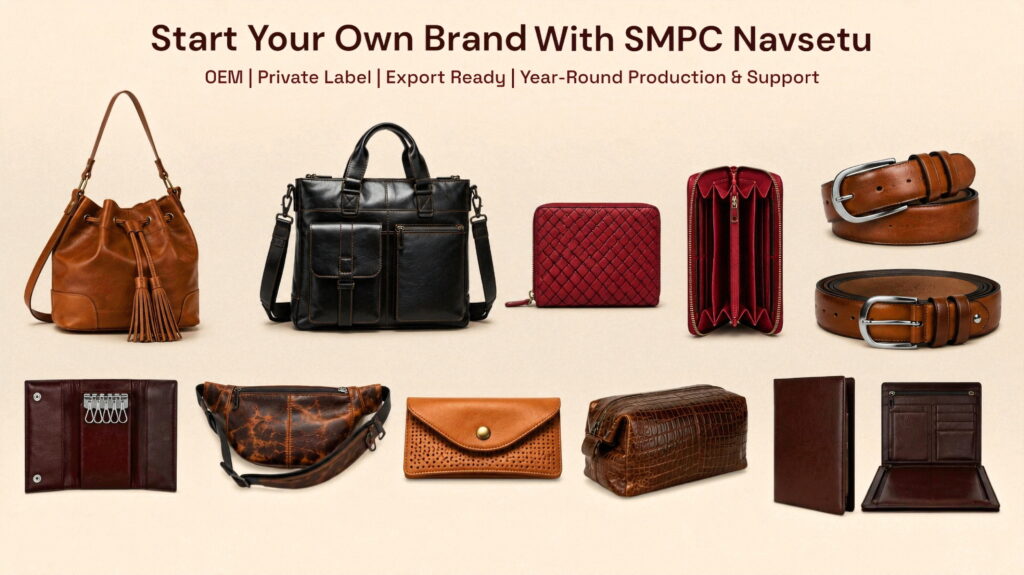
Whether you’re developing custom leather bags, expanding a private label collection, or sourcing wholesale leather bags, our focus is on understanding your requirements before preparing a quotation. That means clearer specifications, transparent communication, consistent quality, and fewer surprises during sampling, production, and export.
We don’t believe the best partnerships are built on the lowest price. We believe they’re built on clarity, consistency, and confidence in every order.
The smartest way to reduce leather bag manufacturing costs is to eliminate assumptions before production begins. Let’s help you do that. Email us with all your queries at info@smpcnavsetu.com
Frequently Asked Questions
1. Why do similar leather bags receive different quotations?
Suppliers often quote different specifications, not different prices. Leather grade, hardware, construction, packaging, and quality standards can all vary. Compare the scope before comparing the quotation.
2. How does MOQ affect leather bag manufacturing cost?
Higher MOQs improve production efficiency and spread fixed costs across more units. However, ordering more than you can sell may increase inventory costs and reduce cash flow.
3. Should I negotiate the price before finalizing specifications?
No. Finalize the product first. Then negotiate the price. Otherwise, each supplier may revise the quotation based on different assumptions, making comparisons unreliable.
4. What information helps manufacturers prepare accurate quotations?
Share dimensions, leather type, hardware, branding, packaging, MOQ, and reference images. The more complete your RFQ, the fewer assumptions a manufacturer needs to make.
5. What question should every buyer ask before accepting a quotation?
Ask, “What assumptions have you made while preparing this quotation?” The answer often reveals differences in materials, construction, packaging, or quality standards that aren’t immediately obvious from the price alone.
6. How can I compare quotations from different manufacturers fairly?
Provide every supplier with the same RFQ and specification sheet. This reduces assumptions and helps you compare pricing, lead times, and capabilities on equal terms.
7. Which customizations increase manufacturing costs the most?
Custom hardware, exclusive molds, bespoke packaging, and multiple color variants usually cost more than logo embossing or standard branding. Focus on features that strengthen your product, not just your quotation.
8. What’s the biggest mistake buyers make before approving production?
Approving the sample without freezing the specifications. Small changes after approval often increase costs, delay production, and create inconsistencies in future repeat orders.