You’ve probably shortlisted a few leather wallets already. They look similar. The quotations don’t.
One supplier recommends an RFID wallet. Another suggests full-grain leather. A third insists a slim wallet will sell better than a bifold wallet.
So, which one fits your market?
The answer depends on more than price. It depends on customer expectations, retail positioning, and product specifications. That’s exactly why buyers across more than 50 countries source from India.
| India’s leather industry serves leading markets such as the USA, Germany, the UK, Italy, and France. Together, the top 15 destinations imported US$947.46 million, or 78.72%, of India’s leather and leather product exports during April to June 2025. |
So, if you want to buy leather wallets from India, read this article until the end.
Different Types of Leather Wallets and Where They Perform Best
A leather wallet that performs well in a fashion boutique may struggle in a corporate gifting program. The smartest buyers don’t build the biggest collection. They build the right one.
Here’s how experienced importers and retail brands usually evaluate each category.
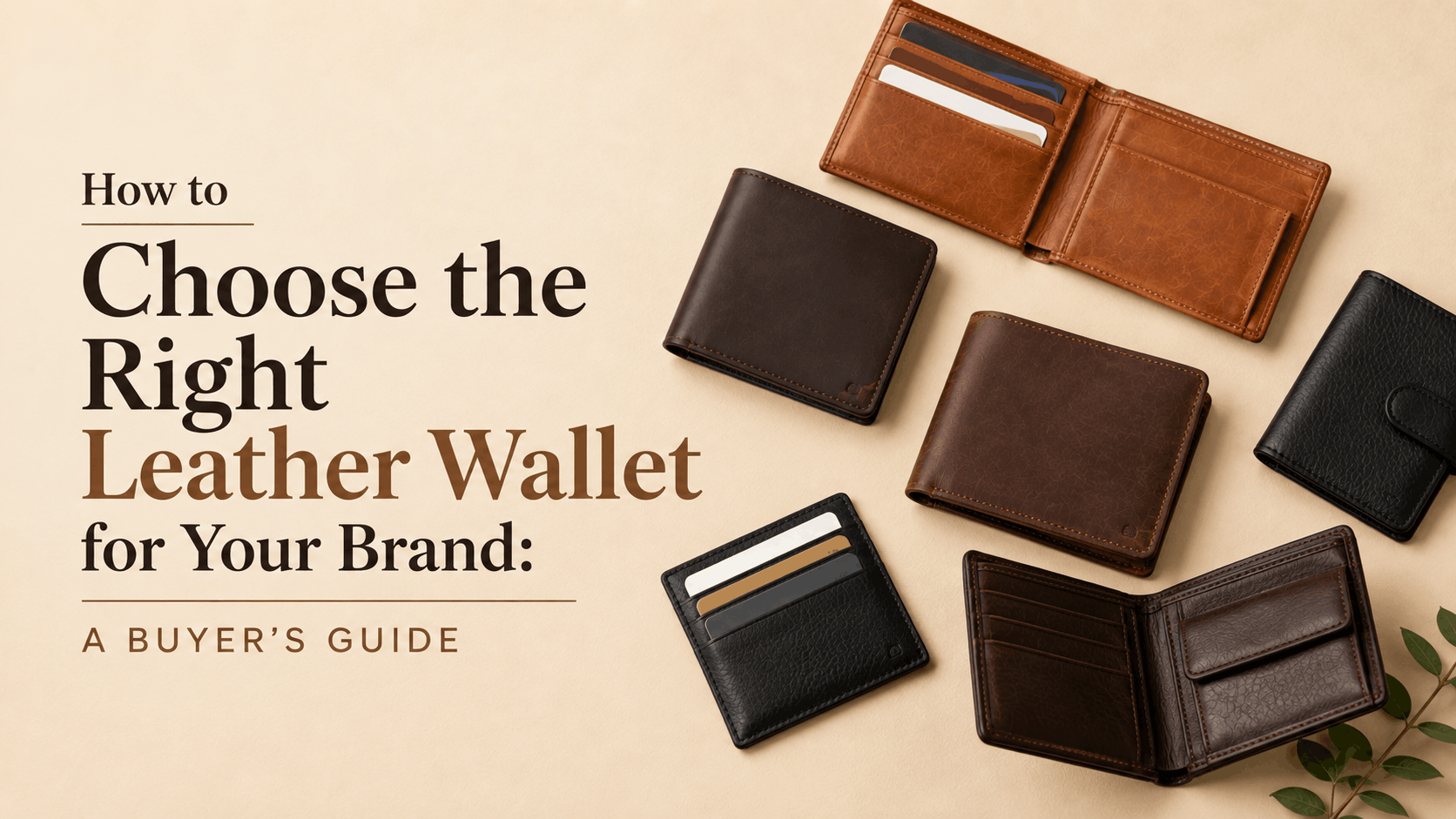
1. Bifold Leather Wallet
If you’re launching a new collection, start here.
The bifold leather wallet appeals to the widest customer base. It balances storage, size, and price, making it a safe choice for department stores, retailers, and private label collections. Buyers looking for custom leather wallets often begin with bifolds because they’re easier to position across different markets.
Best suited for: Everyday retail, wholesalers, private label brands.
2. Slim Leather Wallet
Minimalism continues to influence buying decisions, especially in urban and premium markets.
A slim leather wallet targets customers who carry fewer cards and prefer a cleaner profile. It isn’t designed to replace the bifold. It complements it by attracting a different audience with a different buying preference.
Best suited for: Fashion brands, lifestyle retailers, premium collections.
3. RFID Leather Wallet
Some features need explaining. RFID isn’t one of them.
Many buyers ask, “Should I include RFID wallets in my collection?”
If your audience includes business professionals or frequent travellers, the answer is often yes. RFID protection creates an immediate value proposition and helps differentiate your product without changing its overall design.
Best suited for: Corporate gifting, travel brands, executive collections.
4. Card Holders, Passport Wallets and Long Wallets
Don’t add these styles just to grow your catalogue. Add them because they serve a different customer.
Card holders work well for promotional campaigns and corporate gifting. Passport wallets naturally fit travel and lifestyle brands. Long wallets appeal to fashion retailers looking for a premium accessory with greater storage and stronger visual appeal.
Each style broadens your collection without competing directly with your core products.
Best Suited For: Travel brands and airport retail
5. Money Clip Wallet
The money clip wallet isn’t a volume product. It’s a specialist product.
Buyers usually add it to target executives and customers who prefer carrying cash and a few essential cards. It won’t replace your bestselling bifold, but it can strengthen a premium collection by serving a specific customer segment.
Best Suited For: Executive and minimalist collections
Also Read: How to Compare Leather Samples Before Approving Production: A Buyer’s Checklist
| Buyer Insight: Instead of asking, “Which leather wallet is the best?”, ask “Which wallet solves the biggest problem for my target customer?” |
| A Few Commercial Buying Insights Don’t assume your bestseller will be everyone else’s. A bifold leather wallet may dominate supermarket and department store shelves, while a premium boutique could sell far more slim wallets or long wallets. RFID isn’t automatically a must-have. Many buyers ask, “Should I choose RFID wallets for my collection?” The answer depends on your customer, not the technology. Business travellers often expect RFID protection. Budget retail customers may place greater value on price and design. A bigger wallet doesn’t always create a bigger margin. Passport wallets and long wallets usually command higher retail prices. They also require more materials and additional construction. Profit depends on positioning, not size alone. Every collection needs an entry point. Many successful brands pair premium wallets with card holders or classic bifolds. It broadens the price range without diluting the brand. |
| Still comparing wallet samples or supplier quotations? Share your specifications with SMPC Navsetu. We’ll review them with you. Check out our leather wallet collection for export. |
How to Choose the Right Material When Sourcing Leather Wallets From India?
One question appears in almost every sourcing discussion: “What’s the best leather for a wallet?”
The honest answer?
It depends on the customer you’re trying to impress. Not the manufacturer you’re trying to hire.
1. Full-Grain Leather Wallet
A customer paying premium prices expects more than a wallet.
They expect character.
A full-grain leather wallet develops a natural patina over time. Small variations in the hide aren’t defects. They signal authenticity. That’s why luxury brands rarely try to eliminate them.
Choose it when: You’re building a premium collection where storytelling, longevity, and craftsmanship justify a higher retail price.
2. Top-Grain Leather Wallet
Many successful retail collections rely on top-grain leather for one simple reason.
It delivers consistency.
The surface is more uniform, making colour matching easier across production batches. That’s an advantage when you’re supplying multiple stores or maintaining a private label collection over several seasons.
Choose it when: Your priority is dependable quality, repeatability, and broad retail appeal.
3. Corrected-Grain Leather Wallet
Corrected-grain leather often gets dismissed unfairly.
Used correctly, it solves a commercial problem.
It offers a consistent appearance, supports competitive retail pricing, and performs well in high-volume collections where affordability matters as much as aesthetics.
The mistake isn’t choosing corrected-grain leather. The mistake is marketing it as something it isn’t.
Choose it when: Your collection targets value-conscious retailers, promotional programs, or large-volume distribution.
Also Read: 10 Mistakes Importers Make When Sourcing Leather Goods from India
How to Choose the Right Wallet for Your Target Market?
One wallet won’t satisfy every customer.
That’s why experienced buyers don’t ask, “Which wallet should we manufacture?”
They ask, “Which wallet fits our customer and retail price?”
Your target market should decide the product. Not the other way around.
1. Fashion Brands
Fashion customers usually buy with their eyes first.
A clean silhouette, refined finishing, and contemporary colours often influence the purchase more than extra storage.
Instead of launching six wallet styles, many successful brands build a focused collection around one hero product and a few complementary designs.
Best approach: Launch a signature wallet first. Expand only after identifying your strongest seller.
2. Corporate Gifting
Corporate buyers aren’t looking for the trendiest wallet.
They’re looking for a product that appeals to hundreds or even thousands of recipients.
Simple layouts, professional colours, and branding that doesn’t overpower the design usually perform better than highly personalized products.
3. Luxury Retail
Luxury customers notice the details. More importantly, luxury retailers do too.
Consistent finishing, precise construction, and repeatable quality across every production batch often matter more than adding another feature or compartment.
Premium positioning comes from disciplined execution, not feature overload.
4. Travel and Business Collections
Many buyers ask, “Should every collection include a travel wallet?”
Not necessarily.
Travel-focused products work best when they solve a specific need, such as organizing passports, boarding passes, or multiple currencies.
If your audience doesn’t travel frequently, those features may add cost without increasing demand.
5. Launching a New Collection
Brands launch 8 or 10 wallet styles before knowing what customers actually want.
A smaller collection is easier to merchandise, forecast, and reorder. It also gives you reliable sales data before expanding into new designs or price segments.
Also Read: How to Choose the Best Leather for Bags, Wallets & Accessories
How Experienced Buyers Evaluate a Leather Wallet Sample Before Approving Bulk Production?
A leather wallet sample isn’t approved because it looks good.
It’s approved because it can be reproduced consistently across hundreds or thousands of wallets.
1 perfect sample proves craftsmanship. 5 identical samples prove manufacturing capability.
Here’s what experienced buying teams actually inspect before giving production approval.
1. Check Every Card Slot. Not Just One.
Many buyers ask, “How do I verify leather wallet quality before bulk production?”
Start with usability.
Insert cards into every slot. Remove them again. The resistance should feel consistent throughout the wallet. Loose slots reduce product life. Tight slots frustrate customers from day one.
A wallet should work naturally without forcing the leather to stretch.
2. Open and Close the Wallet Repeatedly
A wallet changes shape every time it’s used.
Open and close the sample 20 to 30 times. Watch how the fold behaves. Good construction maintains its shape. Poor construction often creates uneven creases, edge distortion, or panel misalignment long before the leather begins to age.
3. Inspect More Than One Sample
Never approve production from a single “perfect” piece.
Request multiple samples from the same specification.
Compare:
- Fold alignment
- Stitch consistency
- Edge finishing
- Logo placement
- Overall dimensions
4. Look Beyond the Leather
Check whether the lining sits flat. Ensure the pockets remain symmetrical. Inspect painted edges under bright lighting. Small finishing defects become far more visible once products reach retail shelves.
Retailers often reject inconsistency faster than material defects.
5. Evaluate the Complete Retail Presentation
Review the wallet inside its final packaging. Confirm the fit, branding, inserts, barcode placement, and presentation match your retail positioning. A premium wallet presented poorly immediately loses perceived value.
Also Read: How to Choose an OEM Leather Goods Manufacturer for Your Brand
How to Choose a Leather Manufacturing Partner in India?
If a wallet manufacturer accepts every specification without asking questions, that’s not always a good sign.
Experienced leather wallet suppliers know where products fail, where costs increase unnecessarily. And where small design changes improve production without changing your brand’s vision.
A reliable leather wallet manufacturer should –
- Question unclear specifications instead of making assumptions that lead to inconsistent quotations.
- Recommend practical improvements when a design adds cost without adding customer value.
- Explain trade-offs clearly, so you understand how materials, construction, or packaging influence the finished product.
- Maintain consistency between approved samples and every production batch.
- Communicate early if a material, finish, or timeline may affect delivery, rather than waiting until production begins.
At SMPC Navsetu LLP, we work with importers, private label brands, wholesalers, and retail buyers who expect more than competitive pricing.
We help refine specifications before production, review samples against commercial requirements, and coordinate manufacturing with trusted production partners.
The goal is simple: fewer assumptions, smoother production, and leather wallets that match the approved sample from the first shipment to the last.
Ready to source smarter? Let’s turn your leather wallet concept into an export-ready collection. Talk to our team. No pressure. Just practical guidance.
Frequently Asked Questions
1. Which leather wallet style is the most popular worldwide?
The bifold leather wallet remains the global bestseller. It balances capacity, practicality, and broad consumer appeal, making it a reliable choice for most retail brands.
2. What leather is best for premium leather wallets?
Full-grain leather suits premium collections, while top-grain leather offers better consistency for mainstream retail. Choose the leather that matches your brand positioning, not just your budget.
3. Should I include RFID wallets in my collection?
Include RFID wallets if your target markets are the USA, the UK, Germany, France, or other mature retail markets. Many buyers now expect RFID protection in premium and business collections.
4. What is the typical MOQ for custom leather wallets?
MOQ varies by design and manufacturer. Standard styles usually require lower quantities, while bespoke wallets with custom hardware or packaging often need higher production volumes. At SMPC Navsetu LLP, production starts from 300 wallets per color, per design
5. Which branding method works best for private label wallets?
Logo embossing remains the preferred choice. It delivers a premium appearance, lasts longer than printed branding, and complements most leather finishes.
6. Which wallet specifications influence pricing the most?
Leather selection, construction complexity, branding, packaging, and order quantity usually have a greater impact on pricing than cosmetic design changes.
7. How many wallet styles should a new brand launch?
Start with 2 or 3 complementary styles. A focused collection simplifies inventory planning, validates demand faster, and reduces slow-moving stock.
8. How do I know a wallet sample is ready for bulk production?
Approve multiple identical samples, not just one. Consistency across construction, finishing, dimensions, and branding demonstrates real production capability.
9. How do I compare quotations from different wallet manufacturers fairly?
Ask every supplier to quote from the same specification sheet. Comparing identical requirements reveals genuine pricing differences instead of different assumptions.
10. What’s the biggest mistake brands make when sourcing leather wallets?
Many brands over-customize their first collection. Launch proven designs first, gather market feedback, and expand only after identifying your best-performing products.