
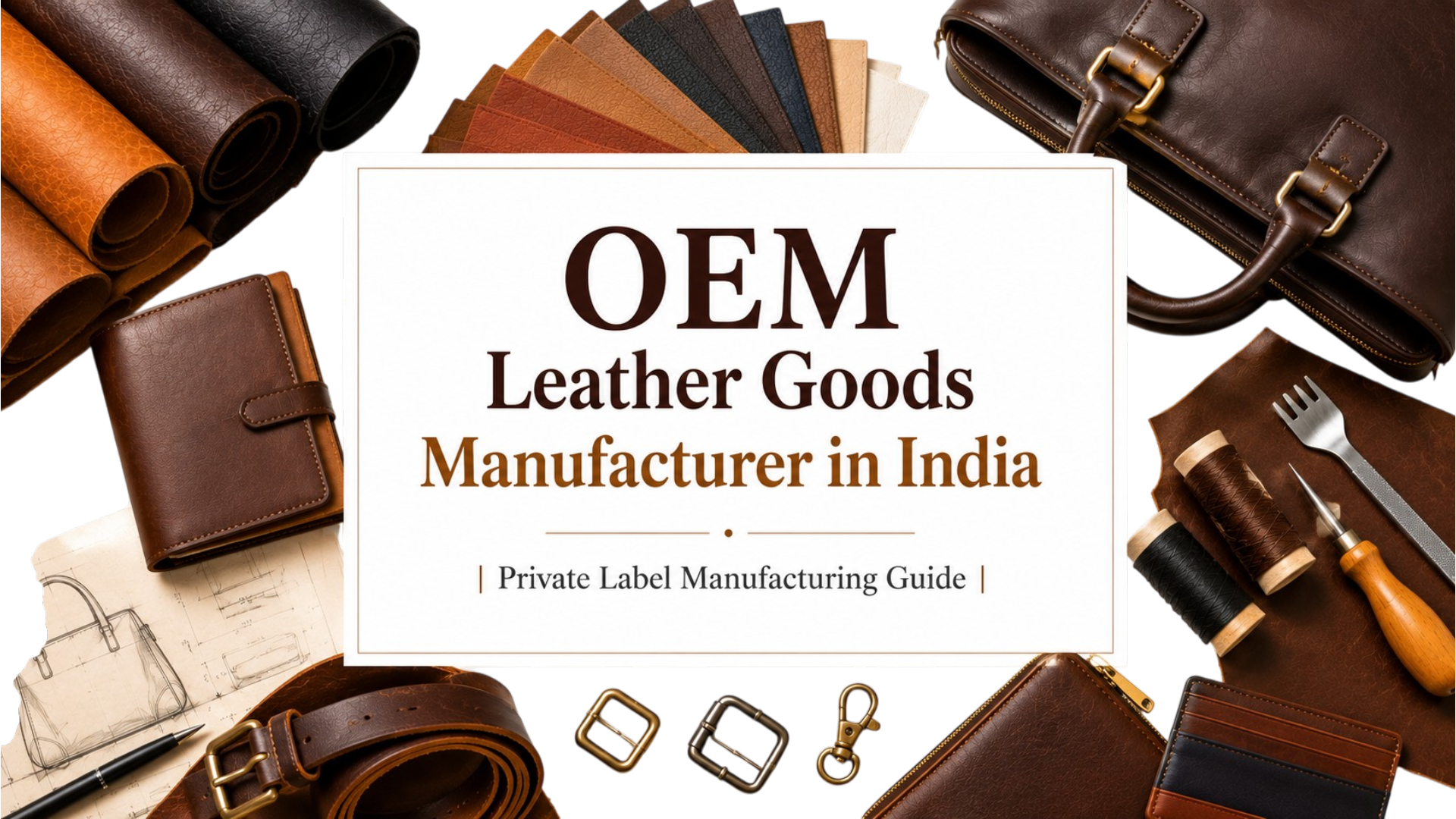
You already have a product idea. Finding the right OEM leather goods manufacturer can determine how quickly your brand reaches the market and how consistently it grows.
India has become a preferred manufacturing destination, contributing 13% of global leather production and supporting 4.42 million jobs across the industry.
During 2024–25, India’s leather exports reached US$1.152 billion, with the U.S., Germany, and the UK remaining its largest export markets. Those numbers reflect a mature manufacturing ecosystem, but choosing the right OEM partner still requires careful evaluation.
This guide will help you evaluate OEM manufacturers, avoid common sourcing mistakes, and choose a partner that can support your brand’s long-term growth.
What Is OEM Leather Goods Manufacturing?
OEM manufacturing means your products are built to your specifications, not the manufacturer’s. You decide the design, materials, dimensions, hardware, branding, and packaging. The manufacturer turns those requirements into a finished product.
For example, imagine you’re launching a premium leather backpack. You already have the design and target price. You want full grain leather, antique brass hardware, cotton lining, and your logo embossed on the front.
An OEM leather goods manufacturer develops a sample, refines it with your feedback, and produces every unit to the approved specifications.
However, many buyers use OEM, ODM, and private label interchangeably.
They aren’t the same.
Choosing the wrong model can increase development time, limit product customization, or lead to unrealistic expectations before production even begins.
The following comparison table will clear all your doubts.
| Feature | OEM | ODM | Private Label |
| Product Design | Your design | Manufacturer’s design | Manufacturer’s existing product |
| Design Ownership | Your brand | Manufacturer | Manufacturer |
| Customization | Complete | Limited | Branding and minor changes |
| Development Time | Longest | Moderate | Fastest |
| Best For | Established brands | Buyers needing faster product development | Startups, retailers, wholesalers, and distributors |
All in all, here’s the sum up:
OEM is ideal if you :
- Have your own product designs or technical drawings.
- Need exclusive products for your brand.
- Want complete control over materials, construction, and finishing.
- Need a custom leather goods manufacturer for long-term product development.
Choose ODM if you:
- Want to modify an existing design.
- Need faster product development with limited customization.
- Prefer reducing design and development costs.
Choose Private Label if you:
- Want to launch products quickly.
- Plan to sell proven designs under your own brand.
- Need a private label leather manufacturer for bags, wallets, or accessories with custom branding and packaging.
| Insider Tip: If product exclusivity is your priority, an OEM leather supplier offers the highest level of design control. If speed to market matters more, ODM or private label leather bags can be a practical alternative. |
Also Read: 10 Mistakes Importers Make When Sourcing Leather Goods from India (And How to Avoid Them)
OEM Manufacturing Workflow: Step-by-Step Guide For Global Buyers
A structured manufacturing process helps reduce errors, improve communication, and keep production on schedule. While every project is different, most OEM orders follow these stages.
1. Requirement Discussion
You share your product concept, technical drawings, reference samples, target quantity, and branding requirements. This helps the manufacturer understand your expectations before development begins.
2. Product Development
The manufacturer prepares patterns and evaluates materials, construction methods, and production feasibility. At this stage, an experienced leather OEM manufacturer in India may also recommend practical improvements that simplify production without changing your design.
3. Material & Component Sourcing
Leather, lining, thread, zippers, buckles, magnets, and other components are sourced according to the approved specifications. Material availability is confirmed before sampling begins.
4. Sample Development
A prototype is produced for your review. You can evaluate dimensions, construction, leather quality, hardware, branding, and overall functionality before approving bulk production.
5. Production Planning
After sample approval, production schedules, raw material procurement, and quality checkpoints are finalised to ensure a smooth manufacturing process.
6. Bulk Manufacturing
Production begins using the approved sample as the reference. Every stage follows the agreed specifications to maintain consistency throughout the order.
7. Final Inspection & Shipment
Completed products undergo quality inspection, export packaging, and shipment preparation before dispatch.
Sample Development: What to Check Before Approval
A sample is more than a prototype. It becomes the benchmark for your entire production run. Rushing this stage can lead to costly changes after manufacturing begins.
Before approving a sample, review these key areas:
- Dimensions: Confirm the product matches your required measurements and proportions.
- Leather Quality: Check the leather grade, texture, colour, and finish against your specifications.
- Construction: Examine stitching, edge finishing, reinforcement, and overall workmanship.
- Hardware: Test zippers, buckles, magnetic closures, rivets, and other fittings for quality and functionality.
- Branding: Verify logo placement, embossing, debossing, metal branding, or printed labels.
- Packaging: Review branded packaging, care cards, swing tags, and labels if they’re part of the order.
- Functionality: Open, close, carry, and use the product as your customers would.
Remember, the approved sample becomes the production standard for every unit that follows.
| Pro Tip: Whether you’re working with a leather bag OEM manufacturer, leather wallet OEM manufacturer, or a custom leather accessories manufacturer, don’t approve a sample until every detail meets your expectations. |
How to Select the Right Material for OEM Leather Goods?
Material affects both product durability and brand perception. Even a well-made leather product can lose value if the fittings wear out, loosen, or tarnish too quickly.
Before approving production, confirm these specifications:
- Material: Choose solid brass, stainless steel, zinc alloy, or other materials based on your product positioning and budget.
- Finish: Match the hardware finish across every component, such as antique brass, matte black, brushed nickel, or gunmetal.
- Strength: Check the load-bearing capacity of buckles, D-rings, hooks, and handle attachments for products designed to carry weight.
- Corrosion Resistance: Ask whether the hardware is suitable for humid climates or long-term storage.
- Branding: Decide if you need engraved, embossed, laser-marked, or custom moulded hardware.
- Replacement Availability: Confirm whether identical hardware can be sourced for future production runs.
| Insider Tip: Using different material suppliers across repeat orders can lead to visible colour and finish variations. Locking approved hardware specifications early helps maintain consistency as your product range grows. |
Also Read: How to Compare Leather Samples Before Approving Production: A Buyer’s Checklist
Custom Branding & Logo Options
Your logo is only one part of your brand identity. The branding method should match your product category, leather type, and target market.
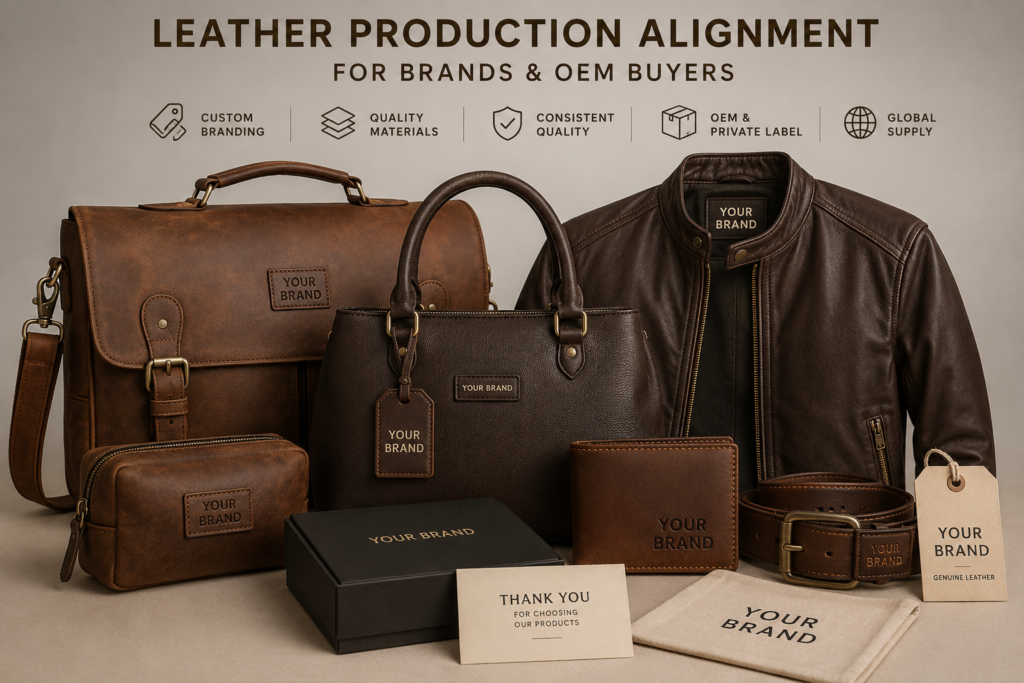
Here are the most common branding options:
| Process | Outcome |
| Embossing | Creates a raised logo for a premium, understated look. |
| Debossing | Presses the logo into the leather for a clean, long-lasting finish. |
| Foil Stamping | Adds metallic finishes, such as gold or silver, for luxury collections. |
| Metal Logo Plates | Ideal for handbags, backpacks, and premium accessories requiring high brand visibility. |
| Laser Engraving | Suitable for leather, metal hardware, or wooden components with precise detailing. |
| Woven & Printed Labels | Commonly used inside wallets, bags, jackets, and other leather products. |
| Custom Hardware Branding | Logos can also be engraved or moulded onto zippers, rivets, buckles, and buttons for a consistent brand identity. |
A “MUST DO” for all buyers: Before approving production, request a branded sample. This allows you to review logo placement, size, finish, and visibility under actual production conditions. Small branding changes are easier to correct during sampling than after bulk manufacturing begins.
How to Plan the Packaging for OEM Leather Goods?
Good packaging does more than protect a product. It also influences how customers perceive your brand from the moment they open the box.
Depending on your product and market, you can customise:
| Packaging Element | Description |
| Gift Boxes | Printed or rigid boxes with your logo and brand colours. |
| Dust Bags | Cotton or non-woven bags for added product protection and a premium presentation. |
| Care Cards | Instructions for leather care, maintenance, and warranty information. |
| Swing Tags | Custom tags displaying your brand, product details, or pricing. |
| Barcode & Product Labels | Retail-ready labels for inventory management and point-of-sale systems. |
| Thank You Cards & Brand Inserts | Simple additions that improve the unboxing experience and strengthen brand recall. |
Every successful leather brand starts with the right manufacturing conversation. Let’s have yours. Contact us anytime for any queries.
How to Ensure Quality Control Throughout OEM Manufacturing
Quality control is a shared responsibility. While your manufacturer manages production, you should also establish clear quality expectations before manufacturing begins.
Follow these best practices:
- Approve a master sample: Use one approved sample as the reference for the entire production run.
- Create detailed product specifications: Document dimensions, leather, hardware, stitching, branding, colours, tolerances, and packaging requirements.
- Define quality standards early: Agree on inspection criteria before production starts to avoid disputes later.
- Schedule inspections at key stages: Review raw materials, work-in-progress, and finished products instead of relying only on a final inspection.
- Request production updates: Photos, videos, or inspection reports help you identify issues before they affect the full order.
- Consider third-party inspections: For large or first-time orders, an independent inspection can provide additional confidence before shipment.
- Keep approval records: Save approved samples, specifications, and revision history for future repeat orders.
| Bonus Tip: Ask the manufacturer to keep a sealed “golden sample.” One approved sample should remain with you, and another should stay at the factory. If quality concerns arise later, both parties can compare production against the same reference instead of relying on memory or photos. |
Also Read: How to Choose the Best Leather for Bags, Wallets & Accessories: A Complete Buyer’s Guide
Export Documents You Should Confirm Before Shipment
Missing or incorrect export documents can delay customs clearance, increase storage charges, and disrupt delivery schedules. Before your shipment is dispatched, confirm that the required export import documents are complete and accurate.
| Document | Why It Matters? |
| Commercial Invoice | Confirms the product value, quantity, and payment details for customs clearance. |
| Packing List | Lists carton details, dimensions, weight, and packing information for shipment verification. |
| Bill of Lading / Air Waybill | Serves as the transport document issued by the shipping line or airline. |
| Certificate of Origin (if required) | Confirms the country where the products were manufactured. |
| Inspection Certificate (if applicable) | Required for certain buyers, products, or destination countries. |
Note: Document requirements can vary by country and product category. Confirm your import requirements before production is completed.
How Experienced Buyers Choose the Right OEM Leather Goods Manufacturer?
Experienced buyers rarely choose a manufacturer based on price alone. They look for signs of long-term reliability, because changing suppliers later is often more expensive than paying a little more upfront.
Here’s what they evaluate before placing an order:
- They ask technical questions, not just commercial ones. The quality of the answers often reveals the manufacturer’s expertise.
- They review similar OEM projects. A strong portfolio matters more than a long product catalogue.
- They evaluate communication speed. Slow responses during sampling often become slower during production.
- They check how changes are managed. Reliable manufacturers document every approved revision instead of relying on emails or verbal discussions.
- They place a trial order first. A smaller order reveals far more than a factory presentation or video call.
- They think beyond the first shipment. They ask how the manufacturer maintains consistency across repeat orders months or even years later.
Don’t ask, “Can you make this product?” Ask, “What challenges do you see with this design?”
Questions to Ask Before Requesting an OEM Quotation
The quality of a quotation depends on the quality of the information you provide. Asking the right questions early helps you compare manufacturers on more than just price.
Before requesting a quotation, ask:
- Can you manufacture products similar to my design?
- What information do you need before preparing a quotation?
- Which leather options would you recommend for my target market?
- What customization options are available for branding and packaging?
- How are product revisions managed after sample approval?
- What quality checks are carried out during production?
- Can you support repeat orders with the same specifications?
- What documents will you provide before shipment?
| Final Tip: Buyers who invest time in planning with the right OEM manufacturer often avoid costly surprises later. |
Why Choose SMPC NAVSETU LLP as Your OEM Manufacturing Partner in India?
West Bengal has long been one of India’s leading leather manufacturing regions. The state contributes around 55% of India’s leather exports and processes nearly 25% of the country’s raw hides.
As part of this manufacturing network, SMPC Navsetu provides end-to-end manufacturing support, helping global brands source leather goods with confidence.
Here’s what you can expect when working with us:
- OEM manufacturing tailored to your product specifications.
- Support from product development to bulk production.
- Custom branding, packaging, and private-label solutions.
- Consistent quality standards throughout production.
- Export-ready documentation and shipment coordination.
- Clear communication from enquiry to dispatch.
Whether you’re launching a new collection or expanding an existing range, we focus on delivering products that match your approved specifications, timelines, and business goals.
Have questions about your product or manufacturing plans? Send us your queries at info@smpcnavsetu.com. No sales pitch, no pressure, just honest answers to help you make the right decision.
Frequently Asked Questions (FAQs)
1. What should I prepare before contacting an OEM leather goods manufacturer?
Decide your non-negotiables first, such as leather type, branding, target price, and order quantity. An experienced manufacturer can help refine the remaining details, but changing your core requirements later often delays development.
2. Can I manufacture leather products if I only have an idea?
Yes. A sketch, reference photo, or existing product is usually enough to begin. The clearer your vision, the fewer revisions you’ll need before approving the final sample.
3. Can I make changes after approving the product sample?
Yes, but combine all revisions into one approval cycle. Frequent design changes can affect material sourcing, production planning, and delivery timelines.
4. What affects the cost of custom leather product manufacturing?
Don’t focus only on leather quality. Hardware, construction, branding, packaging, and finishing can significantly influence the final cost of your product.
5. How do I compare quotations from different OEM manufacturers?
Always compare quotations using identical specifications. Different leather grades, hardware, or construction methods can make two prices look comparable when they’re actually quoting different products.
6. What’s the biggest mistake first-time buyers make with OEM manufacturing?
Many approve samples based on appearance alone. Experienced buyers also test stitching, hardware, functionality, and overall usability before giving final approval.
7. Should I work with one manufacturer for every leather product?
Not always. Manufacturers often specialise in specific product categories. Choosing expertise over convenience usually delivers better quality and consistency.
8. How can I reduce risks before placing my first bulk order?
Ask your manufacturer to keep a sealed “golden sample.” It becomes the reference for production quality and future repeat orders if any questions arise.
9. What’s the biggest warning sign when evaluating an OEM manufacturer?
Be cautious if every request receives an immediate “yes.” Experienced manufacturers usually discuss limitations, alternatives, and production challenges before accepting an order.
10. Can an OEM manufacturer improve my product design?
Yes. Good manufacturers improve manufacturability, not creativity. Small production-friendly adjustments often improve durability and consistency without changing your original design.

Pingback: Sourcing Leather Goods from India? Avoid These 10 Mistakes