One sourcing decision can affect an entire product launch.
The wrong fabric may disappoint customers.
Weak stitching can increase product returns.
Delayed shipments may leave retail shelves empty during peak season.
That’s why experienced buyers look beyond price when choosing a manufacturing partner. The opportunity, however, continues to grow.
India exported US$229 million worth of jute products in FY25, followed by US$79 million during April–July FY26.
If you’re looking for a reliable jute bag manufacturer in India, knowing what to look for before placing an order can save you both time and money.
Why Global Buyers Continue to Source Jute Bags from India?
For most importers, the decision isn’t whether to source jute bags. It’s where to source them from. Price matters, but so do consistency, production flexibility, and the ability to scale without changing suppliers every season.
India has earned that trust over decades.
- During FY25, the United States sourced 23.88% of all Indian jute exports, followed by France (9.9%), Ghana (9.17%), and Germany (5.25%).
- In FY24, the country’s top 40 export markets accounted for 89% of total jute exports, a strong sign that global buyers continue to place repeat orders from Indian manufacturers.
If you’re looking for a reliable jute bag manufacturer in India, this established manufacturing and export network offers more than competitive pricing. It provides the consistency, production capacity, and supply chain stability needed for long-term sourcing.
Types of Jute Bags: Choosing the Right Style for Your Business
A trusted jute bag manufacturer in India can produce dozens of bag styles, but selecting the right one starts with understanding your market.
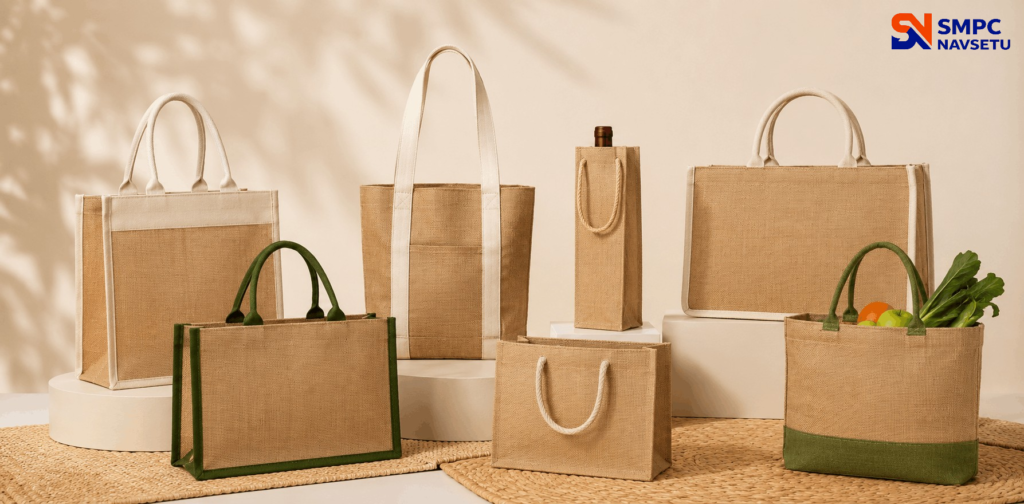
The intended application influences everything that follows, from the fabric and handle design to printing, construction, and overall cost.
1. Shopping Bags
Best suited for
- Supermarkets and retail chains
- Department stores
- Grocery retailers
Why buyers choose them
- Designed for frequent, heavy-duty use.
- Large branding area for store logos.
- Popular choice for wholesale jute bags.
What to consider
- Reinforced handles for heavier loads.
- Structured gussets for extra capacity.
- Higher GSM for better durability.
2. Tote Bags
Best suited for
- Fashion brands
- Lifestyle retailers
- Boutique stores
Why buyers choose them
- Premium look and everyday usability.
- Larger printable area for brand promotion.
- Ideal for seasonal and retail collections.
What to consider
- Comfortable handle length.
- Shape retention after repeated use.
- Fabric selection based on the desired finish.
3. Wine Bags
Best suited for
- Wineries
- Liquor retailers
- Hotels and resorts
- Corporate gifting
Why buyers choose them
- Protects bottles during transport.
- Creates a premium gifting experience.
- Available in single, double, and multi-bottle designs.
What to consider
- Divider strength for multiple bottles.
- Reinforced stitching around the base.
- Padded or laminated interiors for added protection.
4. Promotional Bags
Best suited for
- Marketing campaigns
- Product launches
- Exhibitions and trade shows
Why buyers choose them
- Cost-effective for large distributions.
- Excellent visibility for logos and campaign artwork.
- Suitable for short-term promotional use.
What to consider
- Printing method.
- Bag size based on giveaway items.
- Balance between cost and appearance.
5. Conference Bags
Best suited for
- Business conferences
- Seminars
- Corporate events
Why buyers choose them
- Carries catalogs, notebooks, and event materials.
- Extends brand visibility beyond the event.
- Offers a professional presentation.
What to consider
- Internal space for A4 documents.
- Additional pockets for accessories.
- Comfortable shoulder or hand carry.
6. Grocery Bags
Best suited for
- Organic stores
- Fresh produce retailers
- Zero-waste stores
Why buyers choose them
- Reusable alternative to plastic bags.
- Built for repeated carrying of everyday essentials.
- Suitable for environmentally conscious retail brands.
What to consider
- Load-bearing capacity.
- Moisture-resistant finishes where required.
- Strong bottom construction for daily use.
7. Gift Bags
Best suited for
- Luxury retailers
- Festive collections
- Premium corporate gifting
Why buyers choose them
- Enhances product presentation.
- Supports premium brand positioning.
- Suitable for limited-edition collections.
What to consider
- Decorative handles and finishing.
- Premium printing quality.
- Branded accessories such as hang tags or ribbons.
| Buyer’s Insight: Choose the bag based on how your customers will use it, not how it looks in a catalog. The right application almost always leads to better design decisions and a more successful final product. |
How to Choose the Right Jute Fabric?
The top jute bag manufacturer in India can vouch for a simple fact: “Two jute bags can look almost identical but perform very differently.”
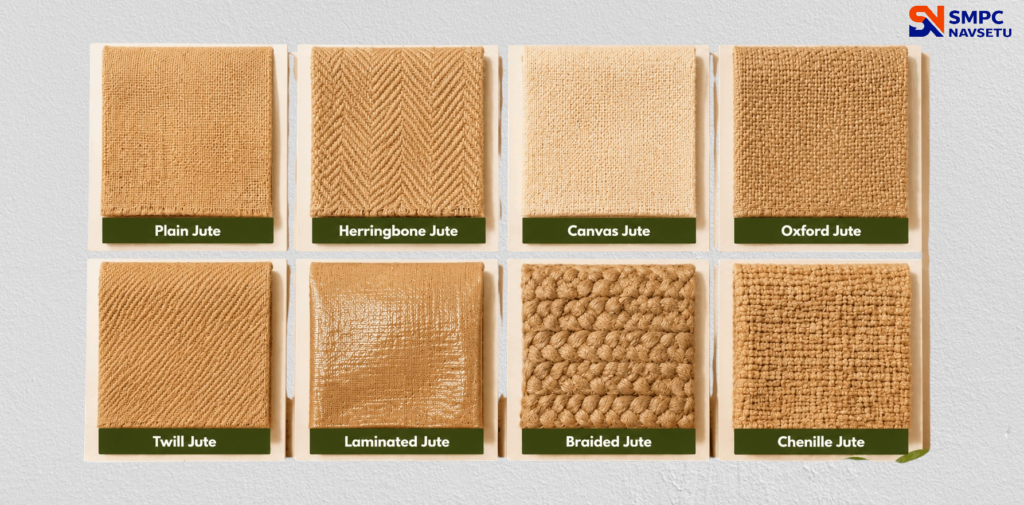
A premium retail tote doesn’t need the same weave as a promotional giveaway, and a grocery bag has different durability requirements than a wine bag.
1. Plain Jute
Plain jute is the most widely used weave in jute bag manufacturing. Its simple over-and-under construction creates a natural, rustic appearance while keeping production economical.
Best for
- Promotional bags
- Grocery bags
- High-volume retail orders
Key advantages
- Economical for bulk production.
- Natural texture supports eco-conscious branding.
- Suitable for a wide range of bag styles.
Things to consider
- The coarse surface may reduce the sharpness of detailed artwork and fine typography.
2. Herringbone Jute
Herringbone jute features a distinctive V-shaped weave that creates a textured, premium finish. The pattern adds visual appeal without relying on additional embellishments.
Best for
- Boutique shopping bags
- Lifestyle brands
- Premium retail collections
Key advantages
- Creates a more refined appearance.
- Adds texture and depth to the finished bag.
- Helps products stand out in retail environments.
Things to consider
- Fine printing may appear slightly softer because of the patterned weave.
3. Canvas Jute
Canvas jute uses a tighter, denser construction that produces a smoother surface and a more structured finish. It is often selected when branding and appearance are equally important.
Best for
- Fashion tote bags
- Corporate gifting
- Premium promotional bags
Key advantages
- Smooth surface improves print clarity.
- Holds its shape well during daily use.
- Creates a cleaner, more polished appearance.
Things to consider
- Usually carries a higher material cost than plain woven jute.
4. Oxford Jute
Oxford jute features a closely woven construction that offers greater structure and durability. It is commonly used for bags that require a more professional and premium look.
Best for
- Corporate bags
- Business conferences
- Structured retail bags
Key advantages
- Excellent shape retention.
- Neater overall finish.
- Suitable for premium branding.
Things to consider
- Better suited to structured bag designs than soft, flexible styles.
5. Twill Jute
Twill jute is recognised by its diagonal weave pattern, which improves strength and resistance to everyday wear. It performs well in bags expected to carry heavier loads.
Best for
- Grocery bags
- Utility bags
- Shopping bags for daily use
Key advantages
- Better abrasion resistance.
- Maintains its shape under heavier weight.
- Suitable for repeated use.
Things to consider
- Strength takes priority over decorative appearance.
6. Laminated Jute
Laminated jute includes a thin protective coating applied to the inner or outer surface. This improves moisture resistance while enhancing print quality and colour vibrancy.
Best for
- Food retail
- Luxury shopping bags
- Reusable promotional bags
Key advantages
- Easier to wipe clean.
- Better resistance to moisture and stains.
- Produces brighter, sharper printed graphics.
Things to consider
- Lamination changes the natural feel of raw jute and should be selected based on the intended application.
7. Braided Jute
Braided jute is created by weaving multiple jute strands together to form thicker decorative patterns. It is valued more for craftsmanship than for high-volume utility.
Best for
- Artisan collections
- Decorative bags
- Premium gifting
Key advantages
- Distinct handcrafted appearance.
- Strong visual texture.
- Adds uniqueness to specialty products.
Things to consider
- Less suitable for intricate printing because the braid becomes a design feature itself.
8. Chenille Jute
Chenille jute combines natural jute with a soft, textured finish to create a richer and more luxurious appearance. It is primarily selected where presentation is the priority.
Best for
- Luxury gift bags
- Designer collections
- Premium retail packaging
Key advantages
- Soft, premium surface texture.
- Creates a distinctive high-end finish.
- Enhances the perceived value of the product.
Things to consider
- Best reserved for premium collections where presentation outweighs heavy-duty performance.
| Insider Tip: Don’t choose a weave based on appearance alone. Ask how the bag will be used, how much weight it needs to carry, and how important print quality is. The right fabric should support your product’s purpose, not just its design. |
Understanding GSM in Jute Bags: Why It Matters
GSM (Grams per Square Meter) measures the weight and density of jute fabric. In simple terms, it indicates how much a square metre of fabric weighs.
While GSM doesn’t determine quality on its own, it plays a major role in how the finished bag performs. The right GSM should always match the bag’s purpose, expected load, and customer expectations.
Here’s a comparison table to help you choose better:
| GSM Range | Common Applications | Advantages |
| 220–280 GSM | Promotional bags, exhibition bags, lightweight giveaways | Lightweight, economical, easy to carry |
| 300–350 GSM | Shopping bags, tote bags, everyday retail use | Good balance of strength, appearance, and cost |
| 380–450 GSM | Grocery bags, wine bags, premium shopping bags | Better shape retention, improved durability, higher load-bearing capacity |
A common misconception is that a higher GSM always means a better bag. That’s rarely true.
Think of GSM as the foundation of the bag. It influences how the bag feels, carries weight, holds its shape, and performs after repeated use.
Choose a Lower GSM When…
- The bag is intended for exhibitions or promotional giveaways.
- Weight and cost are key priorities.
- Customers are unlikely to carry heavy items.
Choose a Medium GSM When…
- The bag is designed for everyday retail use.
- You need a balance between durability and appearance.
- The bag will be printed with branding and reused regularly.
Choose a Higher GSM When…
- The bag is expected to carry groceries, bottles, or heavier products.
- A structured, premium look is important.
- Long-term durability is a priority for your customers.
One Question Every Buyer Should Ask:
Instead of asking, “What’s your highest GSM?”, ask: “Which GSM would you recommend for my product, and why?”
| Buyer’s Insight: Always compare quotations using the same GSM. A supplier quoting a lower GSM may appear more competitive on price, but you’re not comparing the same product. |
How Jute Bags Are Manufactured: From Fabric Roll to Finished Product
A well-made jute bag is the result of a controlled manufacturing process, not just skilled stitching. Every stage affects the bag’s appearance, strength, consistency, and overall quality.
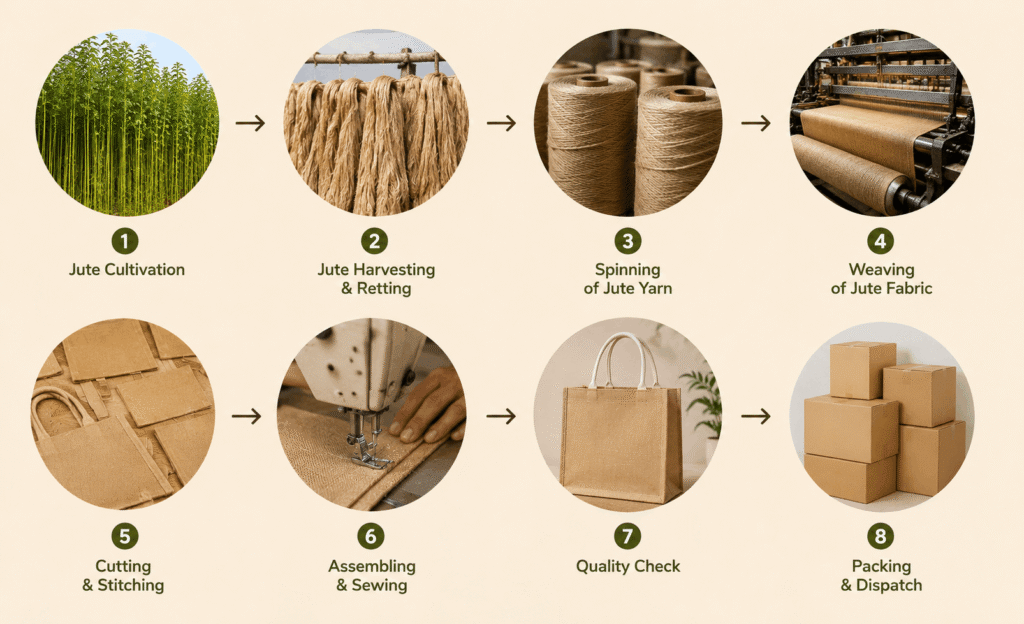
Here’s what happens inside a professional manufacturing facility.
Step 1: Fabric Inspection & Preparation
Production starts with inspecting every roll of jute fabric before it enters the cutting room.
What happens
- Fabric rolls are checked for weave consistency, GSM, colour variation, stains, holes, and weaving defects.
- The selected weave and GSM are matched with the approved product specifications.
- If required, the fabric is laminated before further processing.
- Coloured fabrics are dyed using approved dyes before production begins.
Machines & materials used
- Fabric inspection table
- GSM cutter and weighing scale
- Lamination machine (for laminated bags)
- Dyeing and drying equipment (for coloured fabrics)
Why it matters
Defects found at this stage are removed before production. This prevents the same issue from appearing across the entire shipment.
Step 2: Pattern Development & Fabric Cutting
Once the fabric is approved, production patterns are prepared.
What happens
- CAD software or physical patterns are used to create accurate cutting layouts.
- Patterns include seam allowances, handle positions, gussets, and reinforcement areas.
- Fabric is layered and cut according to the production marker to minimise wastage.
Machines used
- CAD pattern software
- Plotter (for pattern printing)
- Straight knife cutting machine
- Die-cutting press (for repetitive designs)
Why it matters
Precise cutting ensures every bag has identical dimensions, reducing assembly errors during stitching.
Step 3: Printing & Branding
Most branding is completed before the bag is assembled.
What happens
- Artwork is colour-separated and prepared for production.
- The printing method is selected based on design complexity and order volume.
- Printed fabric is dried or cured before moving to stitching.
Common printing methods
- Screen printing for bulk production
- Digital printing for complex artwork and smaller runs
- Heat transfer printing for selected applications
Materials used
- Water-based inks
- Pigment inks
- AZO-free inks for export orders where specified
Why it matters
Printing on flat fabric produces sharper graphics and better colour registration than printing on a finished bag.
Step 4: Stitching & Assembly
This is where individual fabric panels become a finished bag.
What happens
- Front, back, side, and base panels are stitched together.
- Handles are attached and reinforced.
- Gussets, pockets, zippers, magnetic buttons, velcro, and inner linings are added where required.
- Loose threads are trimmed throughout production.
Machines used
- Single-needle lockstitch machine
- Double-needle stitching machine
- Bartack machine for handle reinforcement
- Edge-folding and binding machines (when required)
Why it matters
Most product failures occur at stitched areas, especially around handles and the base. Proper reinforcement greatly improves durability.
Step 5: Lamination & Finishing
Not every jute bag is laminated, but many retail and grocery bags benefit from this additional process.
What happens
- A thin PP or LDPE film is bonded to the fabric when moisture resistance or improved print quality is required.
- Labels, woven tags, hang tags, buttons, eyelets, and other accessories are attached.
- Every bag is cleaned and checked before inspection.
Why it matters
Lamination improves moisture resistance, enhances colour vibrancy, and helps the bag retain its shape during repeated use.
Step 6: Quality Control Throughout Production
Quality inspection doesn’t happen only at the end. It takes place throughout the manufacturing process.
Typical quality checks include
- Fabric GSM verification
- Stitch density and seam consistency
- Handle attachment strength
- Print alignment and colour consistency
- Bag dimensions and symmetry
- Lamination adhesion
- Thread trimming and overall workmanship
The best jute bag manufacturer in India will also conduct random in-line inspections during production to identify issues before the entire batch is completed.
Step 7: Packing & Export Preparation
Once approved, the bags are prepared according to the buyer’s packaging specifications.
Common export packing options
- Individual poly bags or paper sleeves
- Barcode labels and hang tags
- Bundling by quantity or colour
- Moisture-protection liners when required
- Export cartons with shipping marks
Proper packing protects the bags during international transit while ensuring they arrive ready for retail shelves or warehouse distribution.
Jute Bag Customization Options: Build a Product That Reflects Your Brand
Customization goes beyond adding a logo. Every design choice influences how the bag performs, how customers perceive your brand, and even how much it costs to manufacture.
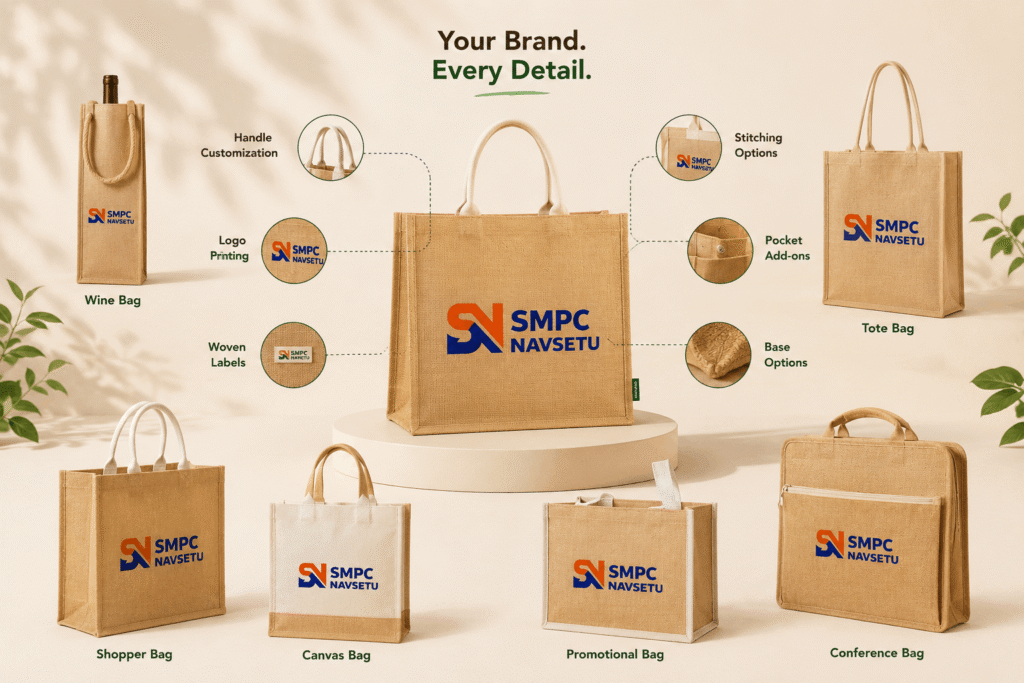
1. Branding & Decoration
Your branding should match both your design and production volume.
Popular options
- Screen printing for bold, cost-effective artwork.
- Digital printing for multi-colour or photographic designs.
- Embroidery for a premium handcrafted finish.
- Woven labels for long-term brand visibility.
- Hang tags for retail-ready presentation.
Best practice
Avoid placing logos too close to seams, gussets, or handles, as these areas can affect print alignment.
2. Size & Construction
Small structural changes can completely change how the bag functions.
You can customise:
- Bag dimensions
- Gusset width
- Bottom board
- Open-top or zip closure
- Internal pockets
- Bottle dividers
- Document compartments
Best practice
Design the bag around the product it will carry, not the other way around.
3. Handle Options
Handles influence comfort, durability, and perceived value.
Common choices include:
- Self-fabric handles
- Cotton webbing handles
- Cotton rope handles
- Bamboo handles
- Leather handles
- Padded shoulder straps
Best practice
Specify the expected carrying weight before choosing a handle. A premium handle isn’t always the strongest option.
4. Material Enhancements
Additional materials can improve both functionality and product life.
Popular upgrades include:
- Cotton lining
- Water-resistant lamination
- Foam padding
- Reinforced base panels
- Velcro or magnetic closures
Best practice
Only add features that improve usability. Unnecessary additions increase both production costs and shipping weight.
5. Premium Finishing Details
The smallest details often create the biggest difference in retail presentation.
Consider adding:
- Metal eyelets
- Rivets
- Decorative piping
- Contrast stitching
- Printed inner lining
- Branded zipper pullers
- Ribbon or gift accessories
These finishing touches help position the bag for premium retail and corporate gifting.
Whether you’re developing OEM jute bags or private label jute bags, finalizing these details with your jute bag manufacturer in India before sampling leads to a faster and more efficient production process.
How Export-Quality Jute Bags Are Packed for International Shipping?
The right packaging protects the bags during international transit, simplifies warehouse handling, and ensures products arrive ready for retail shelves.
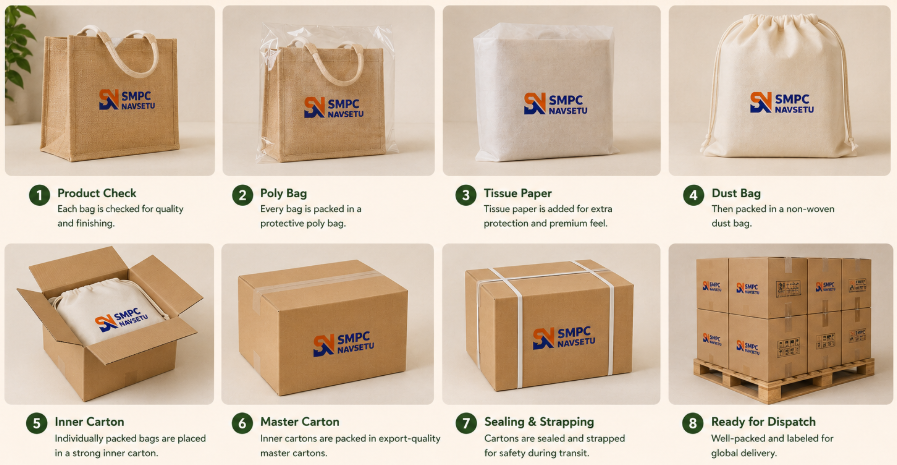
The level of packaging depends on your sales channel, order quantity, and destination market.
1. Individual Product Packaging
Each bag can be packed separately to protect it from dust, moisture, and scratches during storage and transportation.
Common options include
- Individual poly bags
- Paper sleeves
- Tissue paper wrapping
- Non-woven dust bags
- Retail gift boxes for premium collections
Best suited for
- Retail brands
- E-commerce businesses
- Luxury gifting
- Premium product lines
2. Retail-Ready Packaging
Many retailers require products to arrive ready for display without additional warehouse preparation.
Common additions include:
- Hang tags
- Barcode labels
- QR codes
- Product information cards
- Care instruction labels
- Brand story inserts
Why it matters
Retail-ready packaging reduces handling time and allows products to move directly from the warehouse to store shelves.
3. Export Carton Packaging
Once individual bags are packed, they are grouped into export cartons designed for international shipping.
A typical export carton may include:
- Master cartons with appropriate bursting strength
- Moisture-resistant inner liners where required
- Carton labels showing SKU, quantity, colour, size, and destination
- Shipping marks based on buyer specifications
The carton dimensions are planned to maximise container space while preventing excessive compression during stacking.
4. Additional Packaging Options
Depending on the order, manufacturers can also provide:
- Flat-packed or folded packing
- Bundling by colour or SKU
- Assorted size packing
- Palletised shipments
- Desiccant packets for humid shipping routes
| Buyer’s Insight: Ask your manufacturer to pack products by SKU, colour, or collection instead of mixed cartons. It makes warehouse receiving, inventory management, and retail distribution significantly faster once the shipment arrives. |
Common Mistakes Buyers Make When Sourcing Jute Bags
Even experienced buyers make sourcing mistakes. Avoiding these common oversights can save time, reduce costs, and improve product consistency.
1. Choosing Fabric Based on Appearance Alone
A fabric that looks premium may not be suitable for heavy-duty use. Always select the weave and GSM based on how the bag will be used, not just how it looks.
2. Treating Every Jute Bag as the Same Product
A promotional giveaway, grocery bag, and luxury gift bag have completely different performance requirements. Choosing a standard specification for every product often leads to unnecessary compromises.
3. Approving a Sample Without Load Testing
A sample may look perfect on a table but perform differently in everyday use. Test the handles, stitching, base, and overall carrying comfort before giving final approval.
4. Comparing Quotations Without Matching Specifications
Two quotations are only comparable if they use the same fabric, GSM, printing method, handle construction, accessories, and packaging. Otherwise, you’re comparing two different products.
5. Finalising Artwork After Production Begins
Even small changes to logos, colours, or print placement after production starts can delay schedules and increase costs. Lock the artwork before fabric printing begins.
6. Ignoring Packaging Requirements Until the End
Retail-ready packaging, barcode labels, hang tags, and carton markings should be planned before production. Last-minute changes often require additional labour and repacking.
7. Choosing the Lowest Price Instead of the Best Value
The cheapest quotation may exclude reinforcements, stronger handles, better printing, or stricter quality inspections. Focus on the complete product specification, not just the final price.
Why Global Buyers Choose SMPC Navsetu
West Bengal sits at the heart of India’s jute industry. The state produces over 80% of the country’s raw jute, with cultivation spread across approximately 403,000 hectares and an annual output exceeding 7.6 million tonnes.
SMPC Navsetu helps international buyers tap into this well-established manufacturing ecosystem with confidence.
Here’s what you can expect when you work with us:
- Access to experienced manufacturing with expertise across shopping bags, tote bags, wine bags, conference bags, promotional bags, and custom retail packaging.
- End-to-end sourcing support, from product development and sampling to quality inspections, packaging, and export coordination.
- OEM and private-label manufacturing tailored to your brand, specifications, and target market.
- Consistent quality management through defined inspection checkpoints during production, not just before shipment.
- Flexible customization across fabrics, GSM, printing, handles, labels, packaging, and finishing details.
- Export-ready documentation and packaging to support smooth international shipments.
- Clear communication and transparent project management from enquiry to final dispatch.
Whether you’re launching a new product range or expanding an existing collection, our focus is simple: helping you source reliable, export-quality jute bags without the complexity of managing multiple suppliers.
Have questions before requesting a quotation? We’d be happy to help. No sales pressure—just practical guidance to help you make the right sourcing decision. Contact us today.
Frequently Asked Questions (FAQs)
1. What file format should I send for logo printing?
Vector files such as AI, EPS, PDF, or CDR produce the sharpest prints. If unavailable, send a high-resolution PNG (300 DPI minimum). Low-resolution images often result in blurred or pixelated artwork.
2. Do I need to approve a physical sample before bulk production?
Yes. Digital mockups only show artwork placement. A physical sample lets you verify fabric texture, colour, stitching, handle comfort, print quality, and overall construction before production begins.
3. Which Incoterm is best for first-time importers?
Many first-time buyers choose CIF because the supplier arranges freight and insurance to the destination port. Experienced importers often prefer FOB for greater control over shipping costs and logistics.
4. What payment terms are common for export orders?
Most manufacturers request 30–50% advance payment, with the balance before shipment. For larger orders, Letters of Credit (LCs) are commonly used to provide additional security for both parties.
5. Should I use sea freight or air freight?
Sea freight is usually the most economical option for bulk orders. Air freight is generally reserved for urgent replenishment orders, product launches, or sample shipments because of its significantly higher cost.
6. Can one manufacturer produce different types of jute bags?
Yes, but not every manufacturer specialises in every category. Some focus on promotional bags, while others excel at premium retail collections. At SMPC NAVSETU, we help brands source a wide range of customized jute bags, with sampling before bulk production.
7. Is it better to source jute bags from India or Bangladesh?
India generally offers broader customization, diversified product ranges, and stronger OEM capabilities. Bangladesh is often preferred for very large commodity-style orders.
8. What documents should I request before confirming my first order?
Request a Proforma Invoice, detailed product specification sheet, approved artwork, packaging specifications, agreed payment terms, and a production timeline.
9. Should I visit the factory before placing a large order?
For high-value or long-term sourcing relationships, yes. If visiting isn’t practical, arrange a live factory walkthrough or an independent third-party inspection before production begins.
10. What’s one question buyers rarely ask but should?
Ask, “What happens if the finished shipment doesn’t match the approved sample?” A professional manufacturer should already have a documented process for handling quality claims, corrective actions, or replacement discussions.