
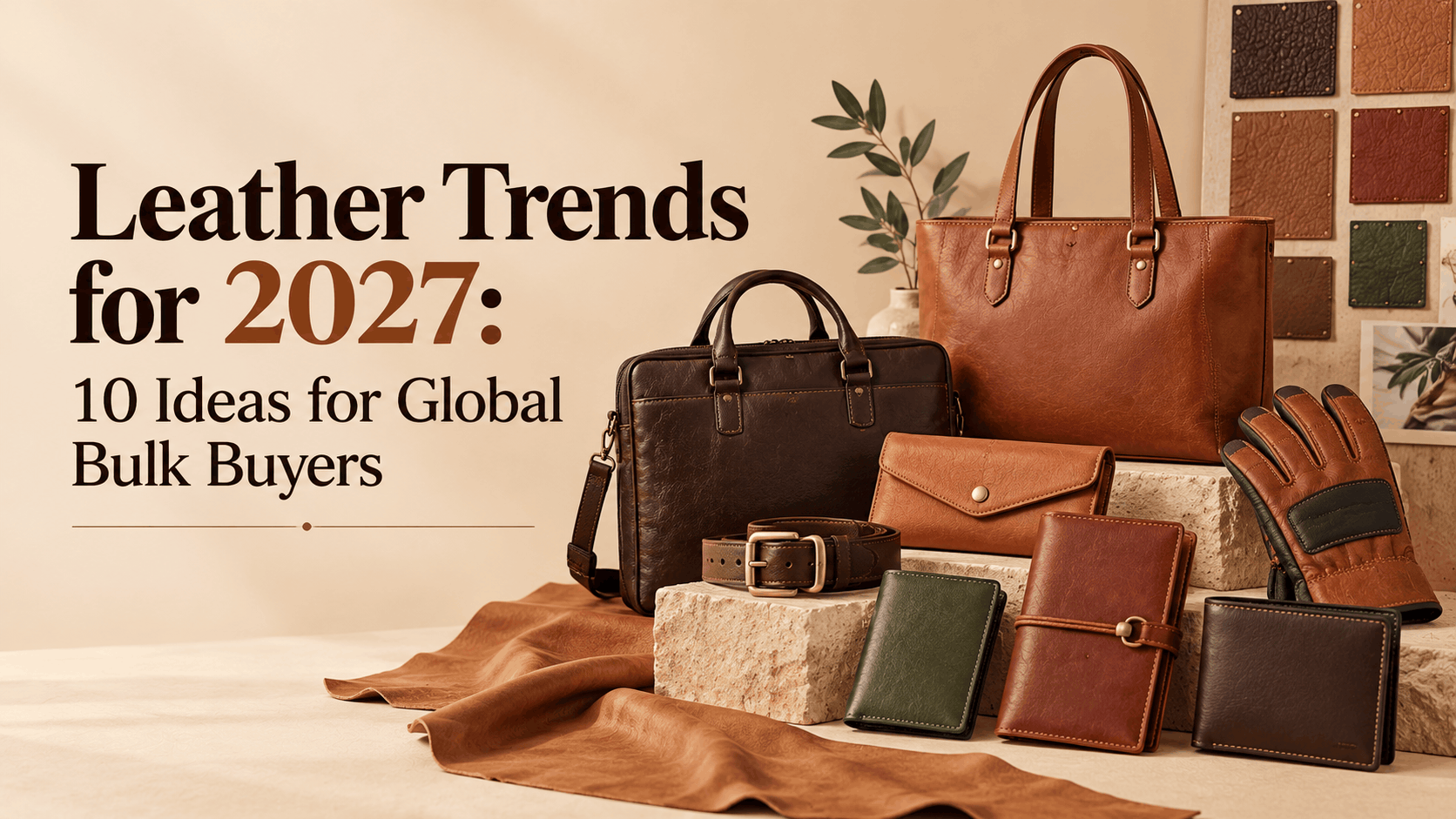
If you buy leather goods for retail, private label, corporate gifting or distribution, a trend matters only if customers want it and your supplier can reproduce it at the right cost. That is the practical test for leather trends 2027.
Runway images can start a conversation, but bulk orders depend on material availability, consistency, usefulness and delivery dates. APLF’s 2027 forecast highlights several of these material directions.
Here are 10 leather trends worth evaluating before you commit to your next bulk order.
Top 10 Leather Trends for 2027 For Serious Bulk Buyers
1. Soft Nubuck and Tactile Grain
Soft nubuck, supple nappa, and pronounced grain add tactile character. These leather trends can refresh a proven product without changing its shape.
Buyer move: Specify leather type, thickness, temper, and finish. Compare several hides and agree on acceptable grain and shade variation. Check whether the surface marks easily during handling.
2. Pearlescent, Patent, and Mirror Finishes
Glossy leather trends, including metallic and pearlescent finishes, can refresh small bags, cardholders, and seasonal accessories. Watch for scratches, cracking, peeling, and color transfer.
Buyer move: Approve finished leather, not an untreated swatch. Request relevant dry and wet rubbing tests, plus flex or finish-adhesion checks where suitable. ISO 20433:2024 describes a method for testing color transfer by rubbing. Agree on pass criteria before bulk approval.
3. Earth Tones, Oiled Leather, and Patina
Cognac, saddle brown, tobacco, and muted olive suit wallets, belts, journals, and desk accessories. Vegetable-tanned and oiled leathers may develop patina through light, handling, and oils. For leather trends built around natural aging, decide whether patina is desirable or a color-control concern.
Buyer move: Approve a physical color reference and define acceptable variation. Keep a signed sample for repeat orders. Vegetable tanning describes a process, not proof of lower environmental impact.
Also Read: 8 Women’s Leather Wallets Global Retailers, Wholesalers & Private-Label Brands Can Source from India
4. Saturated Colors and Color Blocking
Color-led leather trends, including bright greens, reds, blues, pastels, and color blocking, can refresh a range. Avoid splitting an order across untested shades.
Buyer move: Keep proven shades in the core range, trial a few seasonal colors, and limit untested shades to pilot quantities. Check leather, thread, edge paint, lining, and hardware against one standard. Set colorfastness criteria for products that rub against clothing.
5. Braided Leather and Woven Details
Braided panels, woven constructions, twisted cords, and basket-inspired textures add visible craft to bags, belts, and small accessories. These leather trends can distinguish a familiar silhouette without a large logo.
Buyer move: Request a sample showing the final weave, edges, and attachment method. Check loose ends, tension, and repeatability. Compare added labor cost with a simpler panel or embossed effect before choosing the bulk version.
6. Contrast Stitching and Workwear Details
Saddle stitching, contrast thread, graphic zippers, and sturdy hardware give leather goods a practical look, but uneven execution stands out.
Buyer move: Specify thread color, stitch spacing, seam location, zipper size, and hardware finish. Inspect corners, zipper ends, strap anchors, and panel joins. Test one detail on a proven design, then compare cost and quality with the standard version.
Also Read: Sourcing Leather Belts From India: Choosing the Right Belt for Fashion, Uniform & Retail Markets
7. Geometric Embossing and Architectural Cutouts
Geometric embossing, raised patterns, and cutout panels add surface interest without changing the product shape.
Buyer move: Confirm pattern scale, depth, placement, and repeatability. Inspect narrow bridges and seam allowances around cutouts, where removed material can weaken the product. Confirm die ownership, setup charges, and repeat-order costs before approval.
8. Microperforation and Sport-Inspired Details
Fine perforations, technical bands, and elastic inserts bring a sport-inspired look to selected bags and accessories. These leather trends make most sense when the detail suits the product’s use.
Buyer move: Check hole spacing, edge quality, and distance from stress points. Confirm the item retains the required strength and shape. Do not claim extra breathability or comfort unless construction and testing support it.
9. Lightweight and Mixed-Material Construction
Leather paired with canvas, webbing, or technical textiles can reduce weight or add contrast to bags, organizers, and travel accessories. Inspect joins for puckered seams, fraying, color transfer, and weak attachments.
Buyer move: Define expected loads for handles and straps, then inspect a production-representative sample. Keep suitable reinforcement. Compare total construction cost, including lining, fittings, and labor, rather than judging savings by leather weight alone.
Also Read: Leather Wallet Buyer’s Guide: How to Choose the Right Wallet for Your Brand
10. Sculpted Closures and Functional Hardware
Square rings, oversized zippers, distinctive buckles, and sculpted wood or metal closures can give a product a recognizable detail. They also affect weight, cost, comfort, and assembly.
Buyer move: Specify dimensions, finish, material, and attachment method. Check for sharp edges, poor plating, loose fittings, and interference with normal use. For custom hardware, approve the drawing and pre-production sample and confirm tooling costs before committing to volume.
How to Source Leather Responsibly From India (With Evidence)?
Procurement teams may need original records from their leather manufacturing partner in India. And it should cover leather origin, tannery, chemical management, and certification.
General claims such as “eco-friendly” do not establish what a product or facility meets.
Request documents tied to the material or facility in your order and verify scope and validity. The Leather Working Group says it plans to replace Protocol 7 with its Sustainability System in 2027.
The FTC Green Guides caution against broad, unqualified environmental claims. For EU shipments, check REACH, including the 3 mg/kg chromium VI limit for leather articles that contact skin (EU Regulation 301/2014).
Also Read: How to Choose an OEM Leather Goods Manufacturer for Your Brand
What to Lock Before the Purchase Order
| Area | Confirm in writing |
| Material and color | Leather type, thickness, finish, shade reference, and accepted variation |
| Construction | Dimensions, stitching, reinforcement, lining, and hardware |
| Testing and compliance | Relevant tests, destination requirements, and documentation |
| Production | Approved sample, inspection points, packaging, and delivery date |
Whether you are comparing leather exporters in India or commissioning custom leather manufacturing in Kolkata, ask how the approved sample becomes the production standard and how you will control material substitutions. Record changes before manufacturing begins.
Source Leather Goods for Your Next Bulk Order
Looking for a leather manufacturer in India for your next wholesale, private-label, or corporate gifting order? At SMPC NavSetu LLP, we welcome enquiries from international importers, wholesalers, retailers, and purchasing teams looking for leather goods for their markets.
Share your product requirements, including category, target quantity, preferred leather, specifications, branding, packaging, destination country, and expected delivery timeline. This will help us understand your requirements and discuss the next steps.
Ready to discuss your next order? Email your sourcing brief to info@smpcnavsetu.com or WhatsApp us at +91 8981348316 to start a conversation about your bulk leather goods requirements.
Frequently Asked Questions
1. Do I need a tech pack to get a quotation for custom leather goods?
No. Reference images and a basic product brief can start the quotation process.
2. What is a realistic first order quantity for custom leather goods?
It depends on the product, design complexity, customization, and supplier’s MOQ.
3. How many suppliers should I contact before placing a bulk leather goods order?
Compare two or three qualified suppliers using the same product specifications and order quantity.
4. How can I protect my designs when working with a private-label leather goods manufacturer?
Use a written agreement covering confidentiality, design ownership, tooling, and reproduction rights.
5. Can I visit a leather manufacturer in India before placing an order?
Yes, ask for a facility visit or live video walkthrough and verify the production site’s identity.
6. Can leather goods suppliers provide custom retail packaging and branded labels?
Many can. Confirm artwork, labeling, packaging costs, and minimum quantities before production.
7. How should overseas buyers compare quotations from a leather supplier in Kolkata?
Compare unit prices, tooling, packaging, payment terms, shipping, and inspection costs.
8. What documents are commonly required to import leather goods into the US, EU, UK, or Australia?
Common documents include a commercial invoice, packing list, and transport document. Other requirements depend on the product and destination.
9. How are import duties calculated on leather bags and accessories?
Duties depend on tariff classification, customs value, and country of origin.
10. What is the difference between FOB and CIF when importing leather goods?
Under FOB, the buyer generally arranges main sea freight. Under CIF, the seller pays freight and minimum insurance to the named destination port. Under both terms, risk transfers on board.