
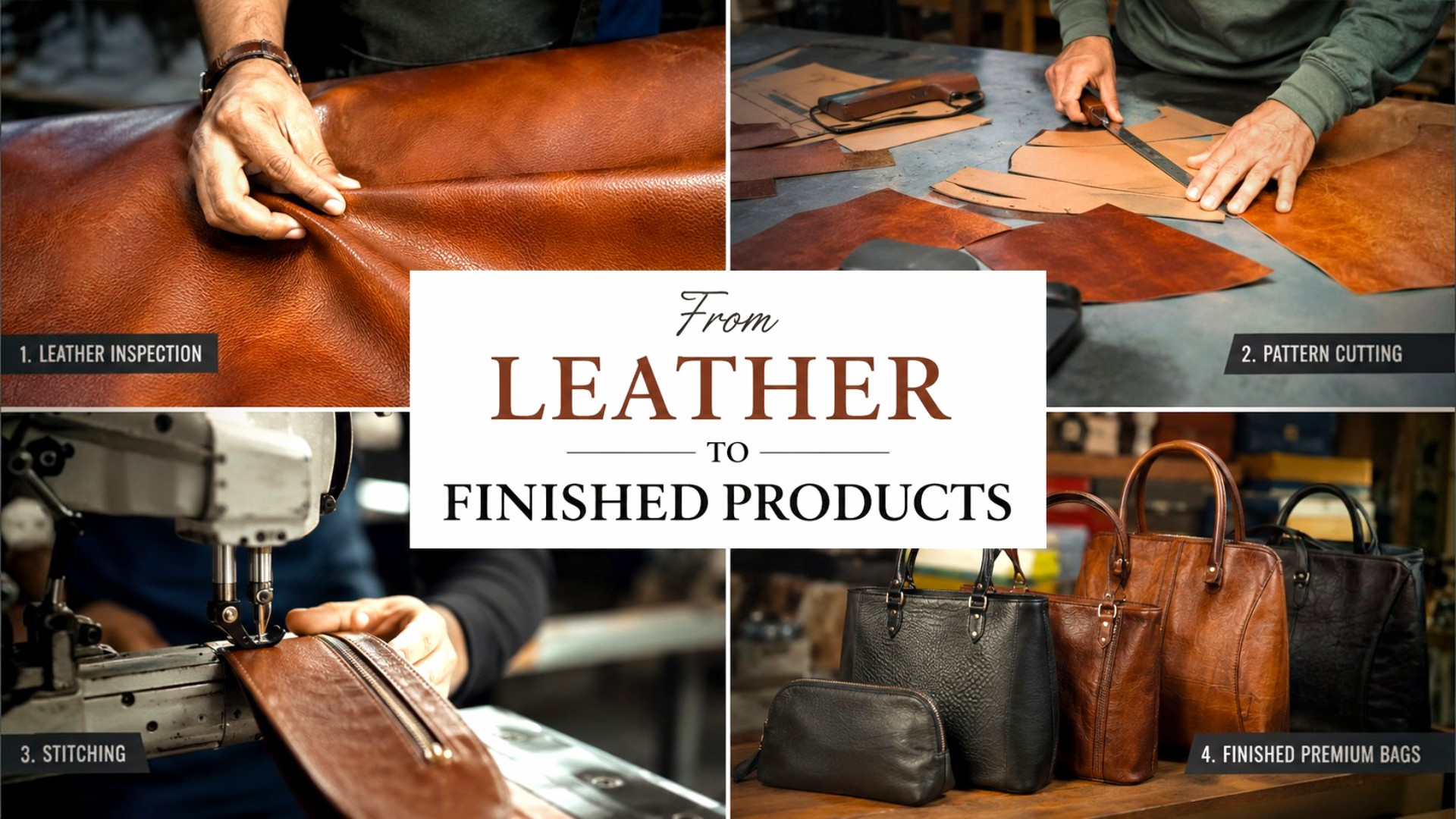
Your next leather supplier can either strengthen your brand or become your biggest sourcing mistake.
That’s why buyers don’t choose a manufacturer based on product photos or the lowest quotation. They look for proven manufacturing capability, consistent quality, and a partner they can rely on for every shipment.
India has earned that trust over decades.
- It is the 2nd-largest global exporter of leather garments
- The 5th-largest global exporter of leather goods.
- The country also produces more than 2 billion square feet of leather every year, meeting nearly 10% of global demand.
If you’re looking for a leather goods manufacturer in India, this guide will help you choose the right OEM or private-label partner.
Why Buyers Around the World Source Leather Goods from India?
The Indian leather goods industry isn’t just growing. It’s becoming one of the world’s most trusted manufacturing destinations.
| Valued at USD 14.0 billion in 2025, the market is projected to reach USD 20.6 billion by 2034, reflecting steady global demand for Indian-made leather products, according to research from IMARC Group. |
That growth is backed by a strong export ecosystem.
- India exports leather and leather products to more than 50 countries.
- The top 15 importing countries accounted for 78.72% of India’s leather and leather products exports during April to June FY26, with exports worth US$947.46 million.
- The United States remains India’s largest export market, importing US$259.47 million worth of leather products during the same period, followed by Germany (US$136.93 million) and the United Kingdom (US$108.65 million).
So, why do global buyers continue to source from a leather goods manufacturer in India?
- Access to experienced manufacturers with decades of craftsmanship.
- A complete manufacturing ecosystem, from tanneries to finished leather goods.
- Strong capabilities in OEM, private label, and custom leather goods manufacturing.
- Competitive production costs without compromising quality.
- Skilled artisans capable of handling both handcrafted and large-scale production.
- An established export network with experience serving leading global markets.
- A diverse product portfolio, including leather bags, wallets, belts, jackets, accessories, travel goods, and industrial leather products.
Also Read: 10 Mistakes Importers Make When Sourcing Leather Goods from India (And How to Avoid Them)
Why Kolkata Is India’s Leading Leather Manufacturing Hub?
The search for the most reliable leather goods manufacturer in India passes through Kolkata. The city sits at the heart of one of the country’s largest leather manufacturing ecosystems, giving buyers access to skilled craftsmanship, established supply chains, and export-ready production.
Here’s why global buyers continue to source leather goods from West Bengal:
- India’s leading leather goods export hub: West Bengal contributes around 50% of India’s total leather goods exports, making it the country’s strongest leather manufacturing cluster.
- One of India’s largest tanning bases: The state is home to 538 tanneries, accounting for 26.6% of all tanneries in India, ensuring a steady supply of quality processed leather.
- Strong manufacturing network: With around 436 leather goods units and 230 footwear manufacturing units, buyers have access to manufacturers across different product categories.
- Premium Nappa leather: West Bengal is known for producing exceptionally soft cow Nappa leather, widely preferred by several German brands due to its smooth finish and premium feel.
- Complete supplier ecosystem: Leather chemicals, metal fittings, hardware, zippers, linings, and other ancillary suppliers are located within the same manufacturing cluster, reducing sourcing complexity and production delays.
- Skilled workforce: Generations of artisans and trained professionals bring extensive experience in leather cutting, stitching, finishing, and quality control.
- Export-ready infrastructure: Well-connected ports, airports, and road networks support efficient global shipments, while many factories comply with international requirements such as SA8000, BSCI, and REACH.
- Focus on sustainability: Modern leather processing facilities continue to strengthen environmental compliance while investing in cleaner production practices and improved manufacturing technologies.
| Bonus Tip: For importers and brands looking for an OEM leather goods manufacturer or a reliable private label partner, Kolkata offers something few manufacturing clusters can match: a mature leather ecosystem where raw materials, skilled labour, supporting industries, and export infrastructure come together in one place. |
Types of Leather Goods You Can Source from India
A reliable leather products supplier in India should be able to manufacture across multiple product categories while supporting custom specifications, OEM production, and private label requirements.
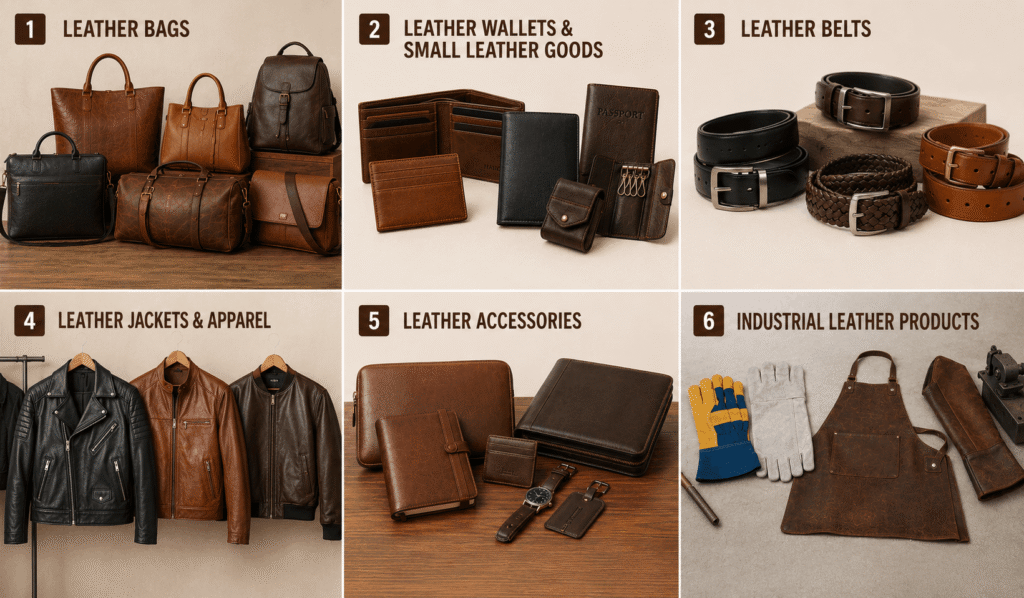
1. Leather Bags
- Products: Tote bags, handbags, backpacks, laptop bags, messenger bags, duffel bags, travel bags, office bags
- Ideal for: Fashion brands, retailers, corporate gifting companies, travel brands
- Customization: Leather type, hardware, lining, logo embossing, dimensions, colours, packaging
2. Leather Wallets & Small Leather Goods
- Products: Wallets, card holders, passport holders, key holders, coin pouches, organizers
- Ideal for: Retail brands, promotional companies, private label businesses
- Customization: RFID protection, multiple layouts, leather finish, stitching, branding, gift boxes
3. Leather Belts
- Products: Formal belts, casual belts, reversible belts, braided belts
- Ideal for: Apparel brands, fashion retailers, wholesalers
- Customization: Buckles, belt width, edge finishing, embossing, sizing, packaging
4. Leather Jackets & Apparel
- Products: Men’s jackets, women’s jackets, biker jackets, bomber jackets, fashion outerwear
- Ideal for: Fashion labels and apparel retailers
- Customization: Leather grade, lining, trims, zippers, sizing, branding labels
5. Leather Accessories
- Products: Laptop sleeves, document folders, portfolios, diaries, watch straps, luggage tags
- Ideal for: Corporate gifting companies, lifestyle brands, premium retailers
- Customization: Logo branding, colours, leather texture, accessories, presentation packaging
6. Industrial Leather Products
- Products: Welding gloves, safety gloves, aprons, sleeves and industrial protective gear
- Ideal for: PPE distributors, industrial suppliers, safety equipment companies
- Customization: Leather thickness, reinforcement, stitching, safety requirements, bulk packaging
| Important Note: Most custom leather goods manufacturers also support OEM development, allowing you to create products based on your own designs, technical specifications, or reference samples while maintaining consistent quality across bulk production. |
Also Read: How to Choose the Best Leather for Bags, Wallets & Accessories: A Complete Buyer’s Guide
Leather Grades Explained
The type of leather you choose directly affects the product’s appearance, durability, cost, and target market. Before placing a bulk order, make sure you and your manufacturer are aligned on the leather grade.
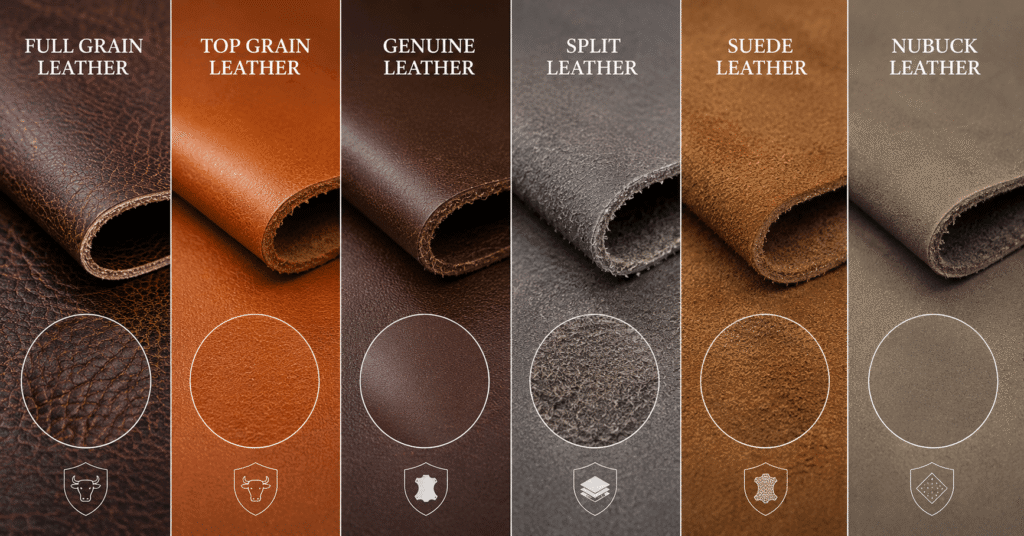
1. Full Grain Leather
Best for: Premium bags, wallets, belts, luxury accessories
- Made from the top layer of the hide with the natural grain intact.
- Offers the highest durability and develops a rich patina over time.
- Natural markings remain visible, making every piece unique.
- Preferred for premium and luxury product lines.
2. Top Grain Leather
Best for: Fashion bags, office bags, wallets, accessories
- The surface is lightly sanded to remove natural imperfections.
- Smoother and more uniform in appearance than full grain leather.
- Balances quality, durability, and cost.
- One of the most widely used leathers for export markets.
3. Genuine Leather
Best for: Mid-range leather goods
- Produced from layers below the top grain.
- More affordable than full grain and top grain leather.
- Suitable for products where cost is a key consideration.
- Quality can vary depending on the manufacturing process.
4. Split Leather
Best for: Industrial products, suede items, selected accessories
- Produced from the lower layers of the hide.
- Softer texture but lower strength than top grain leather.
- Often finished with coatings or used to produce suede.
5. Suede & Nubuck
Best for: Fashion products and lifestyle accessories
- Suede: Soft, velvety finish created from the flesh side of split leather.
- Nubuck: Sanded from the grain side, offering a finer texture and better durability than suede.
- Popular for premium fashion collections but require additional care.
| Bonus Tip: The right leather grade depends on your product positioning, target price, and customer expectations. An experienced manufacturer should be able to help you select the most suitable leather instead of recommending the most expensive option. |
Inside the Leather Goods Manufacturing Process
Consistent quality starts with a consistent manufacturing process. Every stage, from material selection to final inspection, affects the finished product.
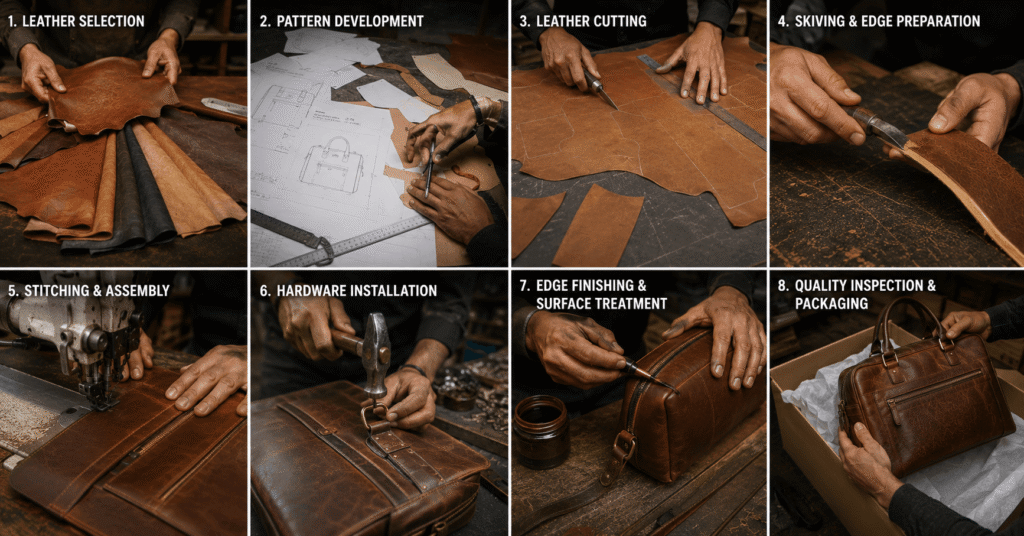
Step 1: Leather Selection
The process begins by selecting the right leather based on your product, budget, and performance requirements. The top leather goods manufacturers in India typically offer full grain, top grain, genuine leather, suede, nubuck, and specialty leathers such as Nappa.
Step 2: Pattern Development
Patterns are created from your design, technical drawing, or reference sample. Measurements, panel layouts, and material consumption are finalized before production begins.
Step 3: Leather Cutting
Leather is inspected before cutting to avoid defects, scars, or colour variations in visible panels. Precision cutting also helps minimise material wastage and maintain consistency.
Step 4: Skiving & Edge Preparation
Leather edges are thinned where panels overlap. This reduces bulk, improves stitching quality, and creates a cleaner finish.
Step 5: Stitching & Assembly
Individual components are stitched together using industrial machines and reinforced at high-stress areas such as handles, straps, corners, and closures.
Step 6: Hardware Installation
Zippers, buckles, rivets, magnetic snaps, hooks, and other metal fittings are installed and checked for proper alignment and functionality.
Step 7: Edge Finishing & Surface Treatment
Edges are painted, folded, or burnished depending on the product. The leather is then cleaned, conditioned, and polished to achieve the required finish.
Step 8: Quality Inspection & Packaging
Each product is inspected for workmanship, measurements, stitching, hardware performance, colour consistency, and finishing before it is packed for export.
OEM Leather Goods Manufacturing in India
If you already have a product design, an OEM leather goods manufacturer in India can produce it under your specifications while maintaining your brand’s quality standards.
An OEM project typically includes:
- Product Development: Manufacturing based on your technical drawings, samples, or product specifications.
- Material Selection: Choice of leather grade, colour, texture, lining, hardware, thread, and accessories.
- Prototype Sampling: A sample is developed for review before bulk production begins.
- Design Refinements: Adjustments are made to dimensions, construction, functionality, or finishing based on your feedback.
- Bulk Manufacturing: Production starts only after the final sample receives approval.
- Quality Control: Products are inspected throughout production to maintain consistency across the entire order.
| Important Note: OEM manufacturing is well suited for established brands, retailers, wholesalers, and distributors that already have product designs and want complete control over specifications while outsourcing production to an experienced manufacturing partner. |
Also Read: How to Choose an OEM Leather Goods Manufacturer for Your Brand
Private Label Leather Goods Manufacturing in India
Private label manufacturing is ideal if you want to launch your own leather brand without setting up a manufacturing facility. Instead of developing a product from scratch, you select from proven product designs and customise them to match your brand identity.
A typical private label process includes:
- Product Selection: Choose from the manufacturer’s existing range of bags, wallets, belts, accessories, or other leather goods.
- Branding: Add your logo through embossing, debossing, laser engraving, metal plates, woven labels, or printed labels.
- Material & Colour Selection: Select the leather grade, colour, lining, hardware, thread, and finishing based on your brand requirements.
- Packaging Customisation: Personalise gift boxes, dust bags, swing tags, care cards, barcode labels, and shipping cartons.
- Sample Approval: Review and approve the branded sample before production begins.
- Bulk Production: Manufacturing starts after final approval, followed by quality inspection and export-ready packaging.
| Important Note: Private label manufacturing is widely used by retailers, eCommerce brands, wholesalers, fashion labels, and corporate gifting companies looking to introduce leather products under their own brand while reducing product development time and cost. |
Behind every successful leather product is the right manufacturing partner. Get to know ours here.
OEM vs. Private Label Leather Goods Manufacturing
While both OEM and private label manufacturing allow you to sell products under your own brand, they follow different approaches. The right choice depends on how much control you want over product design and development.
| Feature | OEM Manufacturing | Private Label Manufacturing |
| Product Design | Developed from your design, technical drawing, or sample | Based on the manufacturer’s existing product designs |
| Customization | Complete control over dimensions, construction, materials, and features | Limited to branding, colours, leather, hardware, packaging, and minor modifications |
| Branding | Your logo and brand identity | Your logo and brand identity |
| Development Time | Longer due to product development and sampling | Faster since the base product is already developed |
| Initial Investment | Higher | Lower |
| Best For | Established brands with unique product concepts | Startups, retailers, wholesalers, distributors, and eCommerce brands |
| Production Process | Design → Prototype → Revisions → Production | Product Selection → Branding → Sample Approval → Production |
- Choose OEM if you want to develop an exclusive product with complete control over its design and specifications.
- Choose Private Label if you want to launch your own leather brand quickly by customizing proven products with your branding.
Leather Quality Inspection: What Buyers Should Expect
A reliable manufacturer doesn’t wait until production is complete to check quality. Inspections should occur at every critical stage to identify issues early and maintain consistency throughout the order.
1. Raw Material Inspection
- Verify leather grade, thickness, colour, texture, and finish.
- Check hardware, lining, thread, and other accessories against approved specifications.
2. In-Process Inspection
- Monitor cutting accuracy and stitching quality.
- Check edge finishing, reinforcement, and hardware installation.
- Identify defects before products move to the next production stage.
3. Final Product Inspection
- Verify product dimensions and workmanship.
- Inspect stitching, edge paint, embossing, logos, and overall finishing.
- Test zippers, buckles, magnetic closures, snaps, and other hardware for functionality.
4. Packaging Inspection
- Confirm correct labels, barcodes, care cards, and branded packaging.
- Ensure export cartons meet shipping and customer requirements.
- Verify product quantity and packing list before dispatch.
Many international buyers also request inspections based on AQL (Acceptable Quality Limit) standards before shipment. This provides an additional layer of quality assurance, especially for high-volume orders and private-label manufacturing.
Also Read: How to Compare Leather Samples Before Approving Production: A Buyer’s Checklist
How Leather Goods Are Packed for Global Shipments?
Proper packaging protects your products during storage, handling, and international transit while ensuring they arrive in the same condition they left the factory.
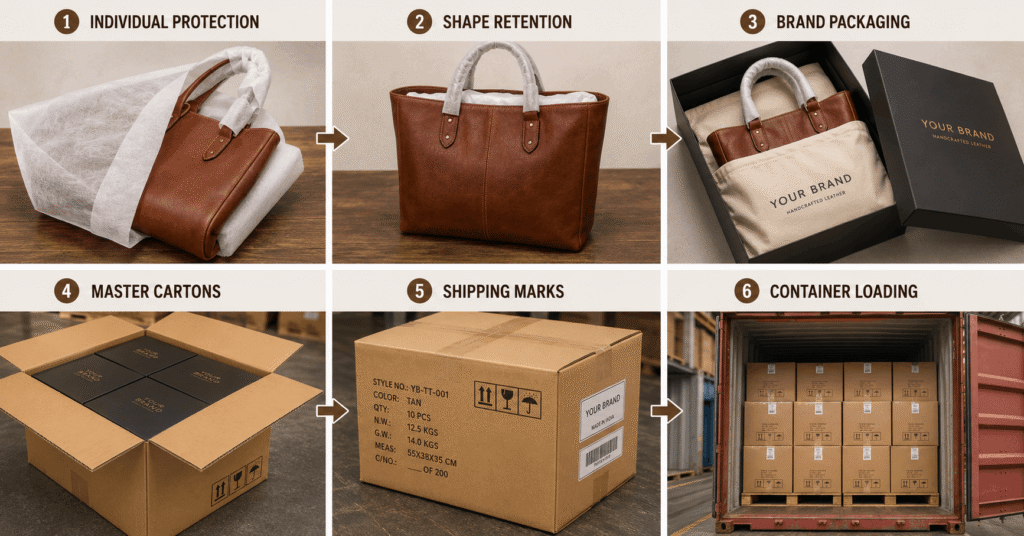
A standard export packaging process typically includes:
- Individual Protection: Products are packed in poly bags, dust bags, or non-woven covers to prevent scratches, dust, and moisture.
- Shape Retention: Tissue paper, foam inserts, or air pillows are used where required to help products maintain their shape during transit.
- Brand Packaging: Custom gift boxes, swing tags, care cards, barcode labels, and branded packaging can be added for private label orders.
- Master Cartons: Products are packed in export-grade corrugated cartons with proper cushioning to minimise movement during shipping.
- Shipping Marks: Cartons are labelled with carton numbers, product codes, quantities, destination details, and handling instructions based on buyer requirements.
- Container Loading: Cartons are stacked to maximise container space while reducing the risk of damage during transportation.
| Insider Tip: To avoid delays, finalize product specifications, artwork, packaging details, and approvals before bulk production begins. Clear communication throughout the process helps keep manufacturing and shipment on schedule. |
Certifications to Look for in a Leather Goods Manufacturer
If you’re sourcing leather goods for international markets, certifications can help you assess a manufacturer’s commitment to quality, social compliance, environmental responsibility, and product safety.
Here are some of the most widely recognised certifications and standards:
| Certification | Why It Matters |
| BSCI (Business Social Compliance Initiative) | Confirms responsible working conditions and ethical business practices within the manufacturing facility. |
| SA8000 | Demonstrates compliance with internationally recognised social accountability standards, including worker welfare and workplace safety. |
| REACH Compliance | Ensures restricted chemicals used in leather processing meet European Union safety requirements. |
| ISO 9001 | Indicates that the manufacturer follows a structured quality management system to maintain consistent production standards. |
| LWG (Leather Working Group) | Recognises tanneries that follow responsible environmental practices, efficient resource management, and sustainable leather processing. |
| OEKO-TEX® (where applicable) | Verifies that finished products or materials have been tested for harmful substances, depending on the certification scope. |
Questions to Ask Before Choosing a Leather Goods Manufacturer in India
Before placing a bulk order, ask these questions to evaluate a manufacturer’s capabilities, production standards, and long-term reliability.
1. Manufacturing & Product Capabilities
- Which leather grades do you work with?
- Can you manufacture products based on my designs or technical specifications?
- Do you offer both OEM and private label manufacturing?
- What product categories do you specialise in?
2. Quality Control
- How is quality inspected during production?
- Do you follow AQL or any other inspection standards?
- Can you share photos or reports from previous quality inspections?
3. Production & Order Management
- What is your typical MOQ for my product category?
- What is the estimated lead time from sample approval to shipment?
- How do you handle repeat orders to maintain consistency?
4. Compliance & Certifications
- Which certifications does your factory or manufacturing partner hold?
- Can you meet my market’s compliance requirements, such as REACH or BSCI?
5. Packaging & Shipping
- Do you provide custom packaging and private label branding?
- Can you support international shipping documentation and export packaging requirements?
Why SMPC Navsetu Is the Right Manufacturing Partner?
Your next best-selling leather product starts with the right manufacturing partner. At SMPC Navsetu, we help global buyers source leather goods with a strong focus on quality, consistency, and reliable execution.
What you can expect:
- OEM and private label manufacturing support
- Genuine leather bags, wallets, belts, accessories, jackets, and industrial leather products
- Product development from drawings, samples, or technical specifications
- Access to West Bengal’s established leather manufacturing ecosystem
- Strict quality checks throughout the production process
- Custom branding, packaging, and labeling solutions
- Export-ready packaging and documentation support
- Clear communication from sampling to shipment
- Flexible manufacturing for wholesalers, retailers, distributors, and private label brands
- A sourcing partner committed to building long-term business relationships, not just fulfilling individual orders
Whether you’re launching a new product line or expanding an existing collection, our team works closely with you to deliver leather goods that meet your quality standards, branding requirements, and delivery timelines.
Have a product idea or sourcing question? Let’s Connect. No sales pressure. No obligation. Just honest advice.
Frequently Asked Questions (FAQs)
1. Can you manufacture leather products based on my own design?
Yes. Most manufacturers support production from technical drawings, reference samples, or detailed product specifications. Before bulk production, a prototype is usually developed for review and approval.
2. Can I order multiple leather products in a single shipment?
Yes. Many buyers combine products such as bags, wallets, belts, and accessories into one shipment, provided the order meets the manufacturer’s production requirements.
3. Can you match the leather colour to my brand requirements?
In most cases, yes. Manufacturers can source or develop leather in specific colours, subject to leather availability and minimum production quantities.
4. Do manufacturers sign Non-Disclosure Agreements (NDAs)?
Many OEM manufacturers are willing to sign NDAs before reviewing proprietary designs or product concepts. If confidentiality is important, discuss it before sharing technical files.
5. What information should I prepare before requesting a quotation?
Providing product dimensions, leather preference, estimated order quantity, branding requirements, packaging details, and reference images helps the manufacturer prepare a more accurate quotation.
6. How many samples should I request before approving production?
One sample is often enough for straightforward products. For customised designs or premium collections, reviewing multiple revisions helps finalise construction, finishing, and branding details.
7. Can manufacturers help improve my existing product design?
Yes. Experienced manufacturers often recommend practical improvements that simplify production, improve durability, reduce material waste, or optimise manufacturing costs without changing the product’s intended look.
8. Is it possible to reorder the same product later?
Yes. Once production specifications are approved and documented, repeat orders are generally easier to manage while maintaining consistency across future batches.
9. What causes delays in leather goods production?
The most common reasons include delayed sample approvals, changes to product specifications after production begins, custom hardware sourcing, and late artwork or packaging confirmation.
10. How do I know if a manufacturer is the right long-term partner?
Look beyond pricing. Evaluate communication, sampling quality, technical knowledge, production consistency, transparency, and their ability to support your business as your order volumes grow.

Pingback: Sourcing Leather Goods from India? Avoid These 10 Mistakes