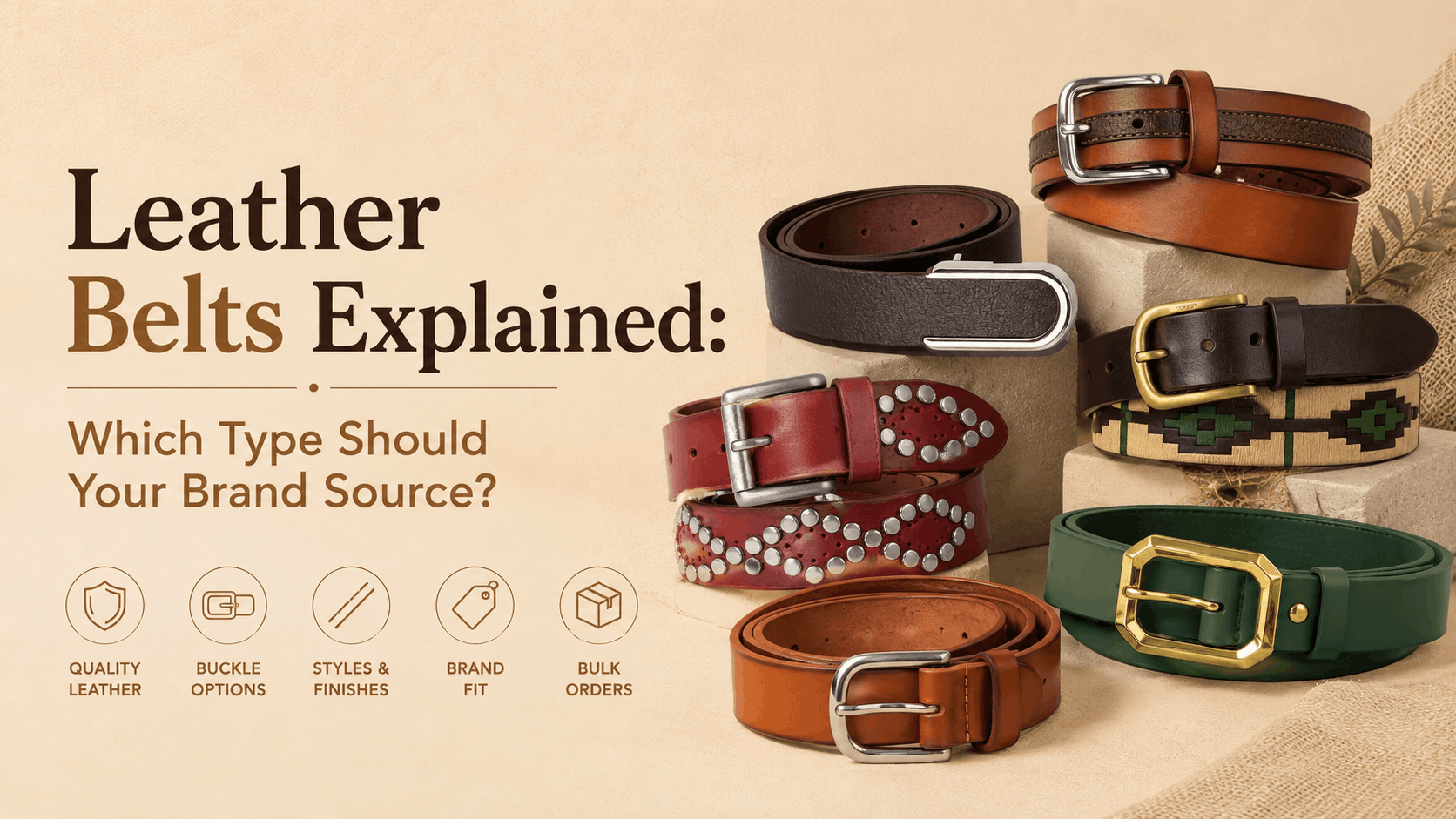
Sourcing leather belts from India in bulk sounds simple until the samples arrive.
One is 35 mm. Another feels too stiff. A third has the right look but the wrong buckle.
Then come questions about sizing, edge finishing, branding, and repeat-order consistency.
For global buyers, leather belts need more than a good appearance. They need a specification that fits the market, survives production, and makes sense at wholesale scale.
This guide helps you choose the right belt construction before comparing wholesale leather belts, suppliers, samples, or bulk quotations.
Which Leather Belt Is Right for Your Target Market?
A belt for a fashion label should not be specified like a uniform belt. The customer, sales channel, and expected use change the requirements before leather even enters the discussion.
1. Fashion Retail
Think beyond a simple black belt. Fashion collections often need seasonal colors, distinctive buckle finishes, and more design flexibility.
Best fits: Fashion leather belts, waist belts, reversible belts.
Buyer priorities: Width, color, finish, buckle identity, and seasonal SKU planning.
2. Formal and Office Retail
Dress belts typically need a clean edge, controlled thickness, understated hardware, and consistent sizing. A 35 mm belt can sit very differently from a 30 mm belt, especially with formal trousers.
Buyer priorities: Width, edge finish, buckle, sizing, and surface consistency.
3. Uniform Programs
Uniform buyers usually value consistency over novelty.
The same belt may need to serve hundreds or thousands of employees. That makes repeat availability, standardized sizing, buckle consistency, and reliable construction more important than decorative details.
Buyer priorities: Durability, standardization, replenishment, and repeat-order consistency.
4. Corporate Gifting
A corporate leather belt should look professional without becoming too personal or fashion-specific. Reversible construction, restrained colors, and clean branding can broaden recipient appeal.
Buyer priorities: Branding, presentation, size coverage, packaging, and repeatability.
5. Wholesalers and Retail Distributors
Wholesalers usually need a collection that covers several price points without creating SKU chaos.
A focused mix of formal, casual, and reversible styles often works better than stocking every imaginable design. The goal is easier inventory management and faster replenishment.
Buyer priorities: Price bands, SKU efficiency, color assortment, MOQ, and reorder availability.
| Buyer Insight: Don’t ask, “Which belt is most popular?” Ask, “Which belt gives this customer segment the right combination of price, function, and presentation?” |
Ready to source leather belts from India? Bring us the specification, and let’s make sure the product works before the order does. Email us at info@smpcnavsetu.com
What Leather Belt Width, Thickness and Length Should You Specify?
“Standard size” is not a specification. That phrase can create very different belts across suppliers. For bulk orders, lock the measurements before sampling. Otherwise, your quotation may look comparable while the actual product is not.
1. Belt Width
Width should match the intended use and buckle.
Common commercial ranges include:
- 25–30 mm: Narrow fashion and waist styles
- 32–35 mm: Dress and everyday retail belts
- 38–40 mm: Casual and heavier-use styles
These are practical ranges, not universal standards. Always confirm buckle compatibility and the target market.
2. Thickness
Thickness changes the belt’s feel, flexibility, and construction.
A very thin strap may suit fashion-led designs. A thicker strap can work better for workwear or utility applications. Specify a target thickness and tolerance, not simply “heavy leather.”
3. Length and Size Range
Decide whether you need:
- Fixed finished lengths
- Standard size ranges
- Cut-to-size production
- Custom sizing for specific markets
For international programs, confirm the sizing system before production. US, UK, and EU retail programs do not always use the same labeling conventions.
4. Hole Spacing
Don’t specify only the number of holes. Record the hole diameter, center-to-center spacing, and distance from the buckle end. Small differences can affect fit and alter the belt’s appearance.
That precision becomes especially important when sourcing leather belts wholesale, where small specification differences multiply across thousands of pieces.
Also Read: Understanding Leather Grades: What Buyers Should Know Before Ordering
Which Buckle Type Is Best for Your Leather Belt?
A buckle can change more than the belt’s appearance. It can affect adjustability, production cost, replacement planning, and even how easily the buyer can replenish the same SKU.
1. Pin and Frame Buckles
The classic choice still has a reason to exist.
A pin buckle offers simple adjustment and broad market acceptance. It works especially well for formal and everyday retail belts where buyers want a familiar closure without complicated hardware.
Best for: Dress belts, formal belts, uniforms, and mainstream retail.
Watch out for: Prong alignment, buckle finish, and attachment quality. A polished buckle means little if the pin sits poorly.
2. Automatic Buckles
Automatic buckles suit brands targeting convenience and contemporary styling. The strap slides through a ratchet mechanism, so the wearer can adjust fit without traditional holes.
For buyers, the key issue is not the mechanism itself. It is repeatability.
Specify the buckle system, compatible strap construction, finish, and availability of replacement components before approving bulk production.
Best for: Fashion retail, executive collections, and modern casual belts.
3. Reversible Buckles
Reversible construction can give one belt two usable sides.
That creates a genuine commercial advantage when your collection needs black and brown options without doubling the physical SKU count.
The mechanism, however, needs precise compatibility with the strap and buckle assembly.
Best for: Corporate gifting, travel collections, and versatile retail programs.
Watch out for: Mechanism durability and replacement availability.
4. Roller and Utility Buckles
Roller buckles suit products where function matters more than formal presentation.
They work well with thicker straps and casual or work-oriented belt constructions. Their visual language also makes them easier to position outside traditional dresswear.
Best for: Work belts, utility belts, casual collections, and outdoor applications.
Watch out for: Match the buckle’s weight and finish to the strap. Oversized hardware can distort a lighter belt.
5. Custom Buckles
Custom buckles make sense when the hardware itself carries the brand.
Think engraved logos, custom shapes, proprietary finishes, or signature motifs. But remember the commercial side: tooling, development, minimum quantities, finish approval, and future replacement all enter the equation.
Best for: Fashion labels, private-label collections, and premium corporate programs.
| Buyer Insight: Don’t ask only, “Which buckle looks best?” Ask, “Can this buckle be sourced, reproduced, inspected, and replaced consistently across future orders?” That question matters far more when you’re buying leather belts in volume. |
Also Read: How to Compare Leather Samples Before Approving Production: A Buyer’s Checklist
What Leather Construction Works Best for Different Belt Applications?
Here is where a common sourcing mistake shows up: a leather that performs well on a handbag may not behave well as a belt.
A belt bends around the waist, returns to shape, and takes repeated stress near the buckle and holes. That makes belt-specific leather construction far more important than simply choosing a higher-sounding leather grade.
1. Dress and Formal Belts
These need controlled thickness, a clean surface, and enough flexibility to bend without looking collapsed. A rigid strap can feel awkward quickly. Edge finishing also matters because the belt sits in clear view.
Priority: Consistent thickness, clean edges, controlled flexibility.
2. Casual and Fashion Belts
These allow more freedom in surface character and finish. Embossed textures, distressed finishes, and softer constructions can work well when the look supports the collection.
Priority: Surface finish, flex behavior, and visual consistency.
3. Uniform and Work Belts
Here, repeated bending and daily use matter more than decorative finish. The strap should recover well after flexing and resist premature cracking around holes and the buckle area.
Priority: Flex resistance, construction consistency, and long-term wear.
4. Reversible Belts
These need a different construction logic. Both faces contribute to the finished product. So thickness, flexibility, surface finish, and edge treatment must work together on both sides.
Priority: Balanced construction across both faces.
| Buyer Insight: Don’t specify leather for a belt using only grain type or grade. Specify how the finished strap must bend, recover, finish, and perform under repeated use. |
Also Read: 10 Mistakes Importers Make When Sourcing Leather Goods from India
What Should Fashion Brands, Uniform Buyers and Wholesalers Specify?
A belt brief changes with the business model.
- A fashion buyer may change colors every season.
- A uniform buyer may reorder the same belt for years.
- A wholesaler needs enough variety without creating an inventory headache.
So, don’t send one generic brief to every leather belt supplier.
1. Fashion Brands
Fashion collections need more than a style name.
Specify:
- Finished width
- Leather color and surface finish
- Buckle shape and finish
- Seasonal colorways
- Edge treatment
- Logo placement
- Sample reference
Also define which details can change by season. That prevents a simple color update from becoming a complete product redevelopment.
2. Uniform Buyers
Uniform programs need repeatability above all else.
Lock:
- Standard width
- Approved buckle
- Size range
- Hole spacing
- Construction
- Durability requirement
- Replacement availability
A uniform belt should still be orderable twelve months later. A slightly cheaper first order means little if the same specification cannot be reproduced.
3. Wholesalers
Wholesale buyers usually need several price points and styles.
Define:
- Core styles
- Width options
- Color assortment
- Target cost bands
- MOQ by SKU
- Packaging and labeling
- Replenishment expectations
The goal is not the biggest catalog. It is a manageable assortment with clear commercial roles.
4. Corporate Gifting
Corporate programs need broad recipient appeal.
Specify:
- Conservative color options
- Flexible sizing
- Restrained branding
- Presentation requirements
- Gift packaging
- Consistent buckle finishes
A belt carrying a company logo should feel like a useful gift, not a walking advertisement.
Also Read: How to Choose an OEM Leather Goods Manufacturer for Your Brand
What Should a Production-Ready Leather Belt RFQ Include?
For leather belts, don’t send only a photo and quantity. Give the manufacturer enough detail to cost the exact product.
A simple production brief could read:
| Application: Corporate uniform Style: Formal leather belt Width: 35 mm Thickness: 3.5–3.8 mm Leather: Approved specification and physical reference Buckle: Pin buckle, brushed nickel Sizing: 32–44 inches Hole spacing: 25 mm center-to-center Edge: Painted Branding: Blind embossed logo Quantity: 3,000 pieces Packaging: Individual polybag, export carton Reference: Approved pre-production sample |
How SMPC Navsetu Support Bulk Leather Belt Production and Export?
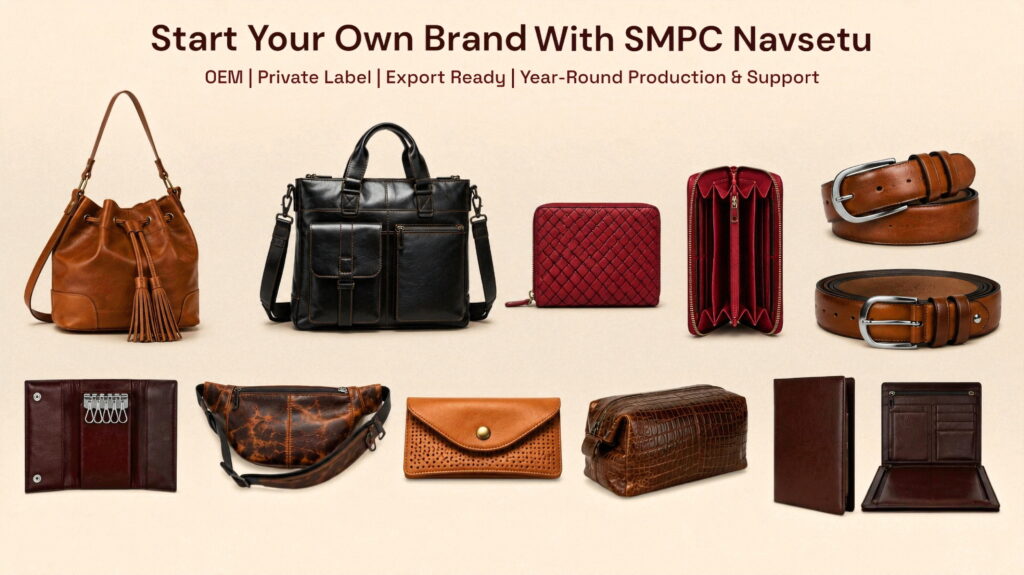
At SMPC Navsetu LLP, we manage the execution of export orders through our established manufacturing network and production controls. We work around the buyer’s approved specifications rather than pushing a fixed product.
That includes:
- Product and material specifications aligned before production
- Sample development and approval before bulk execution
- Production coordination and quality checks against the approved standard
- Branding, finishing, and packaging handled as part of the order requirements
- Export documentation and shipment coordination through dispatch
The point isn’t to add another layer between you and production.
It’s to give you one accountable India-side partner who manages the moving parts and keeps the order aligned from approved sample to shipment.
Planning your next belt order? Let’s make sure the specification works commercially before you commit to production. Contact us for any sourcing assistance.
Frequently Asked Questions
1. What are the standard leather belt widths?
There is no single universal width. 30–35 mm commonly suits dress and mainstream retail belts, while 38–40 mm fits broader casual and utility styles.
2. What type of leather belt is best for formal wear?
Slimmer dress belts with clean edges and understated pin buckles usually fit formalwear better than wide straps or oversized hardware.
3. What type of leather belt is best for work uniforms?
Uniform programs usually prioritize standardized width, durable construction, reliable buckle attachment, consistent sizing, and long-term replenishment over decorative finishes.
4. Which buckle is best for a leather belt?
Pin buckles suit formal and uniform programs, while automatic buckles suit contemporary collections; choose based on use, positioning, and replacement requirements.
5. Are full-grain leather belts better?
Full grain can support premium positioning, but belt performance also depends on thickness, flexibility, finish, and resistance to repeated bending.
6. Can leather belts be custom made?
Yes. Buyers can customize leather, width, length, buckle, finish, stitching, branding, sizing, and packaging for private-label programs.
7. What should buyers specify when ordering leather belts in bulk?
Specify application, width, thickness, length range, hole spacing, leather, color, finish, buckle, branding, quantity, packaging, and approved sample.
8. How should buyers compare leather belt quotations?
Give every supplier the same specification and compare materials, dimensions, buckle, branding, MOQ, packaging, lead time, and terms.
9. What causes leather belts to fail during production?
Common failures include cracking at bends, stretched holes, weak buckle attachments, peeling edges, inconsistent sizing, and uncontrolled production changes.
10. Can one leather belt specification work across different markets?
Not always. Fashion, formal, uniform, corporate, and wholesale programs can require different widths, sizing, hardware, finishes, and replenishment strategies.