“A-grade leather” sounds reassuring until you ask, “According to whose grading system?” That question can change the quotation, cutting yield, and even the leather you receive.
Leather grade is not the same as full grain, top grain, or tanning quality. For importers and bulk buyers, that distinction matters.
This guide shows you how to evaluate leather grades, question A1 or TR claims, and specify leather properly before approving samples or placing bulk orders.
What Does “Leather Grade” Actually Mean?
In leather manufacturing, grade is not a universal scorecard where A always beats B and D always means poor leather.
In practice, the grader looks at:
- Where defects occur, how large they are
- How many appear
- How much of the hide remains commercially usable
ISO has separate grading guidance for cattle hides and goat/sheep skins based on visible defects.
A “Grade A” hide may offer more clean cutting area.
A “Grade B” hide may still work perfectly for smaller components.
Your leather grading requirement should therefore reflect the product’s cutting pattern, not simply the highest available letter.
| For example, a scar in the middle of a large handbag panel costs more than the same scar near an edge. A small hole may barely matter when cutting wallet components. A long belt strip has different requirements again. |
Also Read: How to Choose the Best Leather for Bags, Wallets & Accessories
Leather Type vs. Leather Grade: They Are Not the Same
A supplier can quote full-grain, Grade A leather. Another can offer top-grain, Grade A leather. Those descriptions answer two different questions.
- Leather type tells you what happened to the hide’s grain and structure.
- Leather grade tells you how the hide was classified within a particular grading system.
Think of it this way:
- Full grain: The original grain surface remains substantially intact.
- Top grain: Refers to the grain-side portion; commercial usage can include leather that has received some surface correction.
- Corrected grain: The surface has been mechanically altered to reduce or disguise natural marks.
- Split leather: Comes from the lower layer after the grain portion has been separated.
Now add Grade A, B, or C to the specification. That introduces another variable: how the tannery classifies the hide based on defects, usable area, or its own grading criteria.
A Grade B full-grain hide isn’t automatically unsuitable. If your wallet pattern uses small components, the manufacturer may cut around its natural marks with relatively little waste. A large handbag panel tells a different story.
Comparing leather grades for your next order? Let’s make sure you’re comparing the right specifications. Send us your queries at info@smpcnavsetu.com
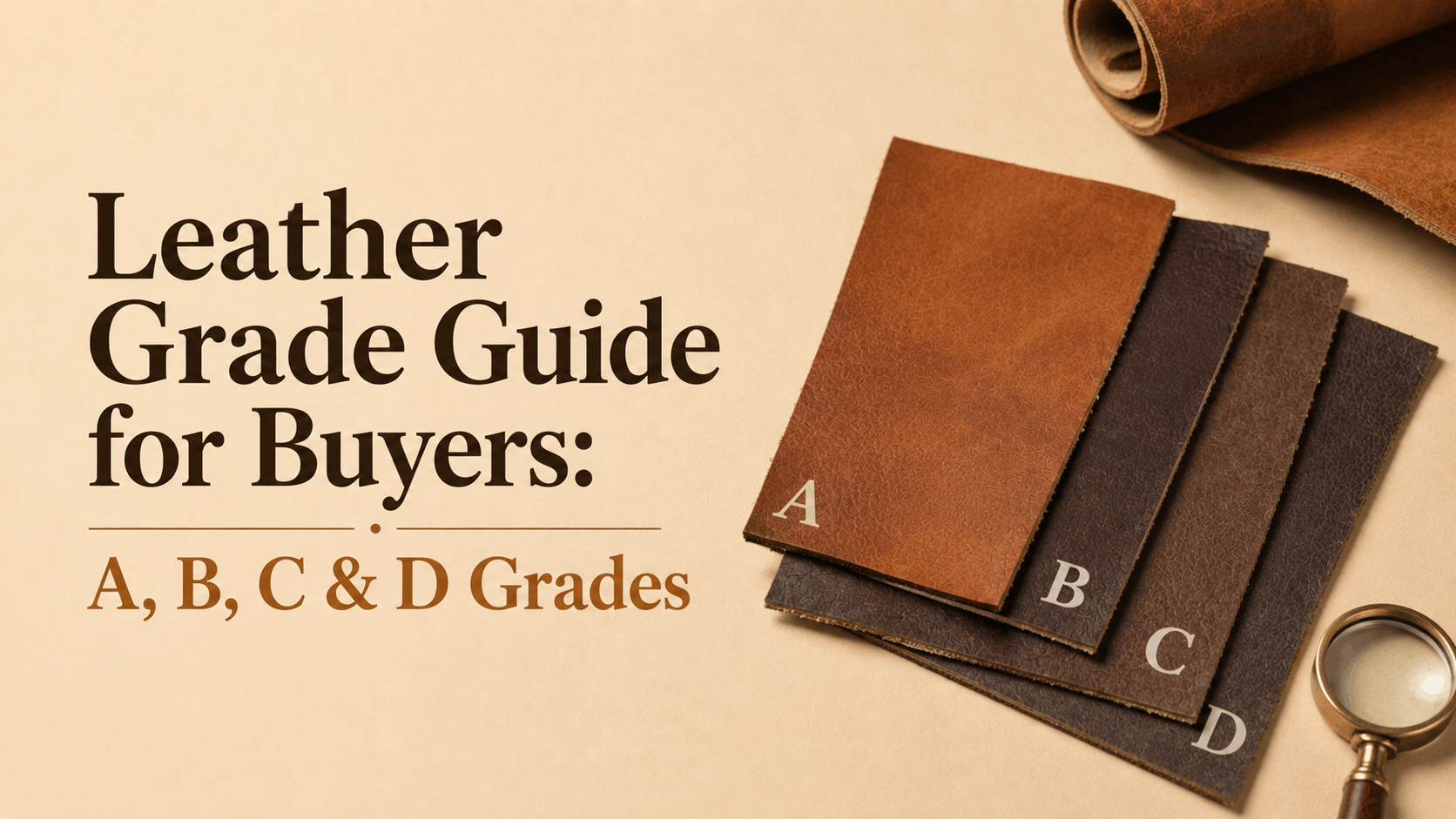
What Do A, B, C and D Leather Grades Actually Tell Buyers?
Think of A, B, C, and D as sorting buckets.
The exact criteria depend on the tannery. But commercially, the grades generally reflect how much of the hide can be used efficiently for a particular cutting requirement.
A Grade:
Best suited to products needing cleaner, more visible panels. Handbags, briefcases, and premium laptop bags can justify the higher selection.
B Grade:
Often a sensible middle ground. More natural marks may be present, but manufacturers can work around them when patterns use smaller or strategically placed components.
C Grade:
More suitable where visible variation is acceptable or components are smaller. It can make commercial sense for selected accessories and less exposed parts.
D Grade:
Generally offers the least predictable cutting area. Its economics depend heavily on the product design and how much of the hide can actually be utilized.
So the right grade is the one that meets your appearance requirement without paying for usable leather your cutting plan doesn’t need.
That is a much more useful purchasing decision than simply asking, “Is Grade A leather better than Grade B?”
Also Read: 10 Mistakes Importers Make When Sourcing Leather Goods from India
What Does A1 Leather Mean? Ask Before You Pay the Premium
A1 leather sounds precise. It isn’t, unless the supplier defines it.
There is no universal A1 designation that lets an importer compare one tannery’s A1 directly with another’s.
Again, the tannery grading systems can use different letter or numerical scales, with their own defect and yield criteria.
So if a quotation says “A1 full-grain leather,” don’t assume A1 means one level above Grade A.
Ask the supplier:
- Who assigned the A1 grade?
- What defects are permitted?
- What usable yield does the grade represent?
- What thickness and finish are included?
- Can the grading criteria be shared in writing?
This matters when comparing suppliers. One seller’s A1 may simply be an internal premium selection. Another may use A1 as part of a completely different grading scale.
| For bulk buyers, the safest approach is simple: Treat “A1” as a supplier-defined term until its grading criteria are documented. |
What Is Tannery Run (TR) Leather?
Tannery Run (TR) usually means buying leather across the normal grade distribution rather than selecting only the cleanest hides. But don’t assume every supplier uses “TR” to mean exactly the same mix. Some suppliers define a specific grade composition; others simply mean unsorted production.
When sourcing leather from India in bulk, that distinction can materially affect costing.
TR can make sense when:
- Your products use small or varied components
- Natural marks can be avoided during cutting
- You run several SKUs with different panel sizes
- You want to reduce the premium paid for hand-selected hides
- Your production team can allocate cleaner areas to visible components
| Here is an example to understand better: A handbag with large front panels has a different requirement from a wallet with multiple small pieces. TR can work well for the latter because the cutting team has more freedom to work around marks. |
Before accepting a TR quotation, ask for:
| Grade Distribution → Defect Tolerance → Expected Usable Yield → Sorting Method → Approved Reference |
One supplier may offer a defined A/B/C mix. Another may ship the normal production spread. Those are not necessarily equivalent purchasing propositions.
So the smart question isn’t: “Is TR cheaper than Grade A?”
It’s: “Can our cutting plan use the grade mix efficiently enough to justify the lower material cost?”
Also Read: How to Compare Leather Samples Before Approving Production
Why the Cheapest Leather Quote Can Cost More
A supplier quoting $4.50 per square foot may look cheaper than one quoting $5.20.
But that comparison is incomplete.
Suppose the first leather gives your cutting team 85% usable area, while the second gives 95%.
The cheaper material may require more leather to produce the same quantity of finished components.
That is why experienced buyers look beyond the quoted rate and ask: How much usable leather will this specification actually deliver?
The answer depends on the tannery’s grading criteria, defect distribution, and your cutting layout. A hide with marks concentrated around areas you can avoid may perform better than one with fewer defects sitting across your main cutting zones.
Which Leather Grade Makes Sense for Your Product?
A leather grade should be selected around the largest and most visible components your product requires.
The smarter approach is to map the cutting pattern before deciding the grade.
1. Handbags:
Large front and back panels make cleaner hides more valuable. A defect across the center panel can create far more waste than several small marks near the edges.
2. Laptop bags and briefcases:
Large uninterrupted panels often justify tighter grade requirements, especially for minimalist designs with limited seams.
3. Belts:
Long strap cuts need consistent, usable sections. A hide with scattered defects may create more cutting loss than its quoted price suggests.
4. Wallets:
Smaller components give the cutter more flexibility. A slightly lower grade can make commercial sense when marks can be positioned outside visible areas.
5. Jackets:
Large panels, matching requirements, and visible grain make defect location particularly important. Grade should be evaluated alongside thickness, temper, and finish.
Also Read: How to Choose an OEM Leather Goods Manufacturer for Your Brand
What Buyers Should Specify When Ordering Leather?
“Grade A” is not a complete leather specification. Neither is “full grain.” If either appears alone on a purchase order, your supplier still has plenty of room to interpret the requirement differently.
For bulk orders, specify the leather itself, not just its label:
- Leather type: Full grain, top grain, corrected grain, or split.
- Tannery grade: State the supplier’s grading system and acceptance criteria.
- Thickness: Give the target range and tolerance.
- Finish: Define the required surface, sheen, color, and texture.
- Defects: Identify which natural marks are acceptable and where.
- Usable yield: State the expected cutting yield where the product requires large panels.
- Color consistency: Approve a physical reference, especially for repeat orders.
- Testing: Define any required colorfastness, tensile, flex, or chemical tests based on the end use.
Here is a Buyer-ready example that will help you:
| Leather Specification for a Premium Handbag Leather: Full-grain cowhide Tannery Grade: Grade A, according to supplier’s documented grading criteria Thickness: 1.2–1.4 mm Finish: Smooth semi-aniline finish Color: Dark Brown, matched to approved physical reference Grain: Natural grain retained; no artificial heavy embossing Visible Defects: No holes, open scars, deep scratches, or prominent defects within primary cutting areas Natural Marks: Minor wrinkles and small natural marks acceptable outside visible panels Usable Yield: Target minimum 80% against the approved cutting layout Color Fastness: Test according to applicable ISO leather color-fastness method Tensile Strength: Test according to ISO 3376; acceptance value to be agreed for the finished application Surface Coating: If applicable, measure according to ISO 17186 Reference: Production leather must match the approved pre-production sample Inspection: Supplier to provide batch inspection records before bulk shipment |
The important detail is “80% usable yield against the approved cutting layout.” That is not a universal industry threshold. It is a commercial acceptance target you can negotiate with the supplier.
Likewise, don’t write something like “Leather must have a tensile strength of X MPa because that is the international standard.” ISO 3376 standardizes the test method, not one universal pass/fail value for every leather application.
For colorfastness, ISO 7906 provides the general principles for leather colorfastness testing, while individual methods address specific exposures.
- For a wallet, you might specify a thinner leather because the construction uses smaller panels and multiple layers.
- For a belt, thickness, tensile performance, and long continuous cutting areas become more important.
- For a handbag, large visible panels make defect distribution and usable yield much more important.
Also Read: Leather Bag Manufacturing Cost: What Determines Bulk Pricing for Different Types of Leather Bags
How to Inspect Leather Grade Before Approving Bulk Production?
Bulk approval should always be based on measurable checks, not a quick visual inspection.
Step 1: Check thickness across the hide
Leather thickness can vary across the hide. ISO 2589 provides the standardized method for measuring leather thickness.
For a handbag specification calling for 1.2–1.4 mm, check multiple locations and record the results against the agreed tolerance.
Step 2: Inspect the actual cutting areas
This is more useful than simply counting defects.
Mark the locations of:
- Open scars
- Holes
- Deep scratches
- Loose grain
- Wrinkles
- Color variation
- Finish inconsistencies
Then place your actual production pattern over the hide.
Step 3: Test performance when the application demands it
ISO 3376:2020 provides a standardized method for measuring leather tensile strength and elongation.
For colored leather, relevant colorfastness testing can also be specified. ISO 7906:2022 provides general principles for leather colorfastness evaluation, while ISO 11640 covers rubbing fastness.
Step 4: Compare the bulk batch against the approved reference
The approved sample should become the physical benchmark for:
Color → finish → grain appearance → thickness → hand feel → defect tolerance
If the supplier proposes a different tannery, finish, or leather grade after approval, treat it as a specification change.
How SMPC Navsetu Helps Maintain Leather Specifications From Production to Export
At SMPC Navsetu LLP, we work with manufacturing partners to execute leather goods against the buyer’s approved product specification.
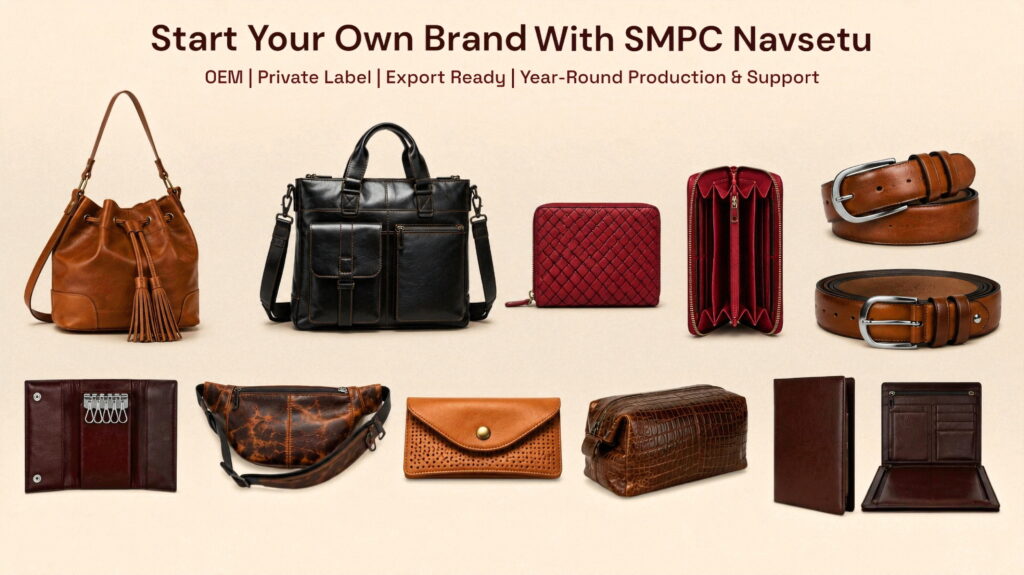
Our focus is on keeping the agreed material, construction, finish, and quality requirements consistent through production and export.
For bulk leather goods, we coordinate key checkpoints such as:
- Approved leather grade and physical reference
- Thickness, finish, color, and construction requirements
- Pre-production sample approval
- Production-stage quality checks
- Finished-goods inspection
- Export-ready packaging and shipment coordination
This matters when you’re placing repeat orders. The goal isn’t simply to source leather at a quoted rate. It is to ensure the approved product remains the production standard through the order.
You specify the product. We manage the execution from manufacturing coordination through export.
Ready to turn your approved leather specification into a repeatable bulk order? Let’s discuss the production.
Frequently Asked Questions
1. What are the grades of leather?
A, B, C, and D are commonly used tannery grades, but their criteria vary; buyers should verify each supplier’s defect and yield standards.
2. What is A-grade leather?
A-grade generally offers cleaner cutting areas and fewer significant defects, but the exact acceptance criteria depend on the tannery.
3. Is A-grade leather better than B-grade leather?
Not automatically; A-grade can improve cutting yield, while B-grade may be more economical when your patterns tolerate natural marks.
4. What does A1 leather mean?
A1 is not a universal designation, so buyers should ask the supplier for its specific grading criteria before paying a premium.
5. What is TR leather?
TR means Tannery Run and generally refers to leather sold according to the tannery’s normal production mix rather than only selected premium grades.
6. Is full-grain leather the highest grade?
Full grain describes retained grain surface, not tannery grade; a full-grain hide can still receive different grades based on defects and yield.
7. How should importers compare leather grades from different tanneries?
Compare each tannery’s grading criteria, defect tolerance, usable yield, thickness, finish, and approved physical reference rather than comparing grade letters alone.
8. Does leather grade affect bulk pricing?
Yes, because cleaner hides can provide higher cutting yield, reducing material wastage and potentially lowering the leather cost per finished component.
9. Which leather grade is best for handbags?
Choose the grade that provides enough clean area for your largest visible panels; paying for the highest grade is unnecessary if your cutting plan does not need it.
10. What should buyers ask a leather supplier about Grade A?
Ask for the tannery’s Grade A definition, allowable defects, thickness range, expected yield, finish, and physical reference before approving bulk leather.