
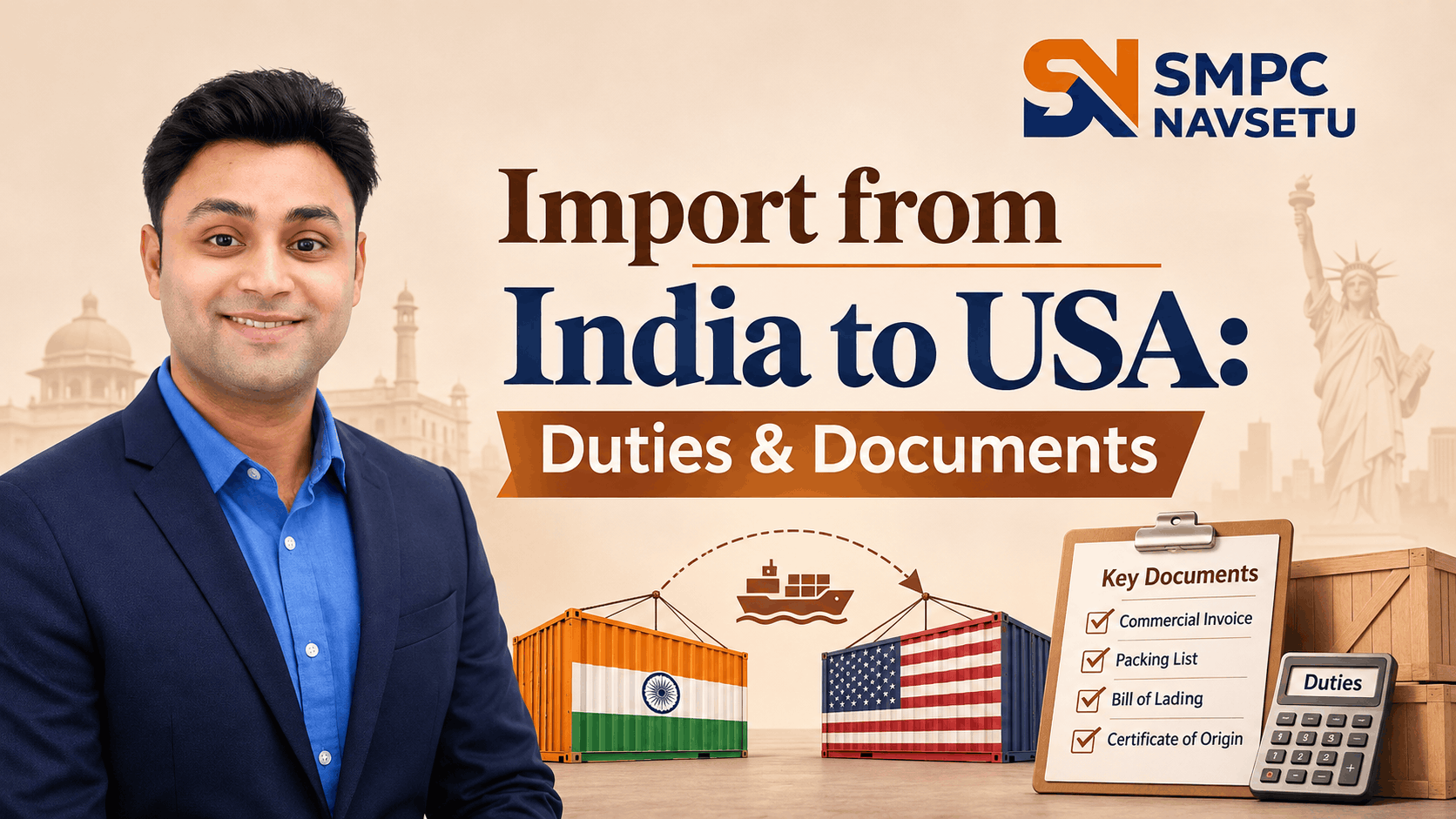
A low factory price can quickly become an expensive import. When you bring leather goods, jute bags or Indian handicrafts into the United States, duties, freight, insurance, brokerage fees and port charges all affect your landed cost.
You also need the right HTSUS classification, complete customs paperwork and a clear understanding of importer responsibilities. One missing filing or poor lead-time estimate can disrupt delivery and sales plans.
So, how do you import from India to USA without costly surprises? This guide explains the key duties, documents and shipping timelines to check before you place a bulk order.
At a Glance: What Do You Need to Import from India into the USA?
A US business importing commercial goods from India generally needs to:
- Finalize the product description, material composition and intended use.
- Confirm the correct 10-digit US Harmonized Tariff Schedule classification.
- Check ordinary customs duty and additional tariff measures.
- Determine the customs value and estimate landed cost.
- Prepare Indian export documents and US entry information.
- Arrange the customs bond and customs broker, where required.
- Complete applicable advance cargo filings, including ISF for ocean shipments.
- Meet relevant country-of-origin marking and product compliance requirements.
- Coordinate production, inspection, freight booking and final delivery.
The US importer of record remains responsible for accurate entry information and applicable duties, even when a customs broker handles the filing.
One detail deserves attention before you request a quotation: your product specifications can affect both classification and duty.
Start with the Product, Not the Supplier’s Price
Before you request quotations, define exactly what you want to import. This sounds obvious, but vague descriptions cause expensive confusion.
A customs officer cannot classify “premium handmade bag” from its marketing description alone. Your broker needs facts about its construction, materials and function.
The same information also helps your Indian supplier prepare an accurate quotation.
What Product Information Should You Provide?
| Information | Why it matters |
| Product name and intended use | Helps establish the correct tariff classification |
| Main material | Different materials can attract different tariff treatment |
| Material composition | Supports classification and product labeling |
| Dimensions and weight | Helps calculate shipping volume and freight |
| Construction and design | May affect the classification of bags and accessories |
| Surface finish | Helps distinguish different product specifications |
| Branding requirements | Determines labels, embossing and packaging work |
| Quantity and order frequency | Affects production planning and unit costs |
| Packaging specifications | Helps control shipping volume and transit damage |
How Specifications Differ by Product Category
Leather goods:
When sourcing handbags, wallets, laptop bags or belts, specify:
- Full-grain, top-grain, split or other leather type.
- Leather species, where relevant.
- Outer surface material.
- Lining and reinforcement materials.
- Hardware, zippers and metal fittings.
- Product dimensions and construction.
- Private-label branding and packaging requirements.
A leather handbag with a different outer surface may receive a different customs classification. A bag made from textile fabric with leather trim should not automatically receive the same classification.
Jute products:
For jute shopping bags, promotional bags and retail totes, specify:
- Jute fabric construction and fibre composition.
- Fabric GSM, where applicable.
- Lamination or coating.
- Handle material and reinforcement.
- Bag dimensions and gusset depth.
- Printing and branding method.
- Intended carrying capacity.
- Packaging and carton dimensions.
Your fabric choice should match the bag’s intended use. A promotional giveaway and a reusable retail tote do not need identical construction.
Read our guide on choosing the right jute fabric for bags. It explains how different weaves suit different retail applications.
Indian handicrafts:
For Dhokra brass pieces, Bankura terracotta and other decorative products, provide:
- Main material and material composition.
- Manufacturing method.
- Product dimensions and weight.
- Intended use.
- Surface treatment and finish.
- Fragile components, if any.
- Individual and outer-carton packaging details.
The word “handicraft” does not identify a customs classification. A brass figurine and a terracotta ornament may fall under entirely different tariff provisions.
You can also review SMPC Navsetu’s Indian handicraft sourcing range before preparing your product shortlist.
Need help converting a product idea into a clear production brief? Email SMPC Navsetu at info@smpcnavsetu.com with your reference images, material requirements, quantities and branding details.
How Much Is US Import Duty on Products from India?
The US determines customs duties through product classification. The applicable ordinary tariff depends on the exact tariff line. Any additional trade measures must be checked separately.
Step 1: Find the correct HTSUS code
The US uses the Harmonized Tariff Schedule of the United States (HTSUS) to classify imported merchandise.
The international Harmonized System provides the common six-digit foundation. The US schedule extends this classification to ten digits.
Your classification determines:
- The applicable ordinary customs duty.
- The statistical reporting category.
- Any additional tariff provisions.
- Certain product-specific import requirements.
For example, leather handbags, textile shopping bags and decorative metal articles do not share one tariff classification.
Even two bags that look similar may require different classifications. Their outer materials, construction and intended functions can change the outcome.
Note: Do not rely on an Indian supplier’s six-digit HS code as your final US import classification. Ask your US customs broker to confirm the complete HTSUS code.
For products with uncertain classification, you can also review previous CBP rulings or request a binding ruling from CBP.
Step 2: Check additional tariffs on Indian-origin goods
US tariff announcements have changed considerably during 2026. Older articles may still quote rates announced earlier in the year.
Here is the relevant distinction.
The February 2026 US-India joint statement announced an 18% reciprocal tariff framework. That announcement should not be used as the current applicable rate. On 20 February 2026, the US ended the additional IEEPA duties following the Supreme Court’s ruling on that authority.
A later Section 301 action introduced an additional 10% duty on Indian-origin products, effective from 24 July 2026. The measure contains specified product exclusions.
For covered goods, the additional duty is generally applied alongside the ordinary HTSUS duty. The relevant additional tariff provision is HTSUS heading 9903.05.44. Its exceptions include products covered by headings 9903.05.85–9903.05.92.
| Duty component | What you need to check |
| Ordinary HTSUS duty | Rate under the product’s tariff classification |
| Section 301 additional duty | Whether the Indian-origin product is covered |
| Product exclusions | Whether the product qualifies for a stated exclusion |
| Other trade measures | Whether another product-specific measure applies |
Note: The 10% additional duty is not a substitute for the ordinary customs duty. Nor should you assume that every Indian product will receive identical treatment. The final result depends on the product classification, origin and applicable exclusions.
For the legal notice, see the Federal Register Section 301 determination.
Step 3: Calculate the financial impact before placing an order
Consider a hypothetical bulk order with a customs value of $20,000.
Assume the relevant Indian-origin product is covered by the 10% Section 301 measure and does not qualify for an exclusion.
| Cost component | Amount |
| Customs value | $20,000 |
| Additional Section 301 duty at 10% | $2,000 |
| Ordinary HTSUS duty | To be confirmed |
| Other applicable fees | Calculated separately |
The additional Section 301 duty alone would add $2,000 to this example.
The ordinary tariff still needs to be added. This is not a complete landed-cost quotation.
Now consider what a small tariff difference can mean.
On a $20,000 customs value, each additional percentage point of duty adds $200.
Step 4: Include US customs processing and port fees
Customs duty is not the only payment due at import.
Two fees deserve attention when comparing freight options.
1. Merchandise Processing Fee (MPF)
For formal entries, CBP applies an ad valorem MPF of 0.3464%.
For fiscal year 2027, running from 1 October 2026 through 30 September 2027, the minimum is $34.58 and the maximum is $670.86. The fee is calculated on the applicable merchandise value, subject to CBP rules.
2. Harbor Maintenance Fee (HMF)
Commercial cargo transported by vessel through covered ports is generally subject to an HMF of 0.125% of the applicable cargo value.
Note:Air cargo is not subject to this HMF.
Here is what those charges can look like on a $20,000 merchandise value.
| Fee | Calculation | Illustrative amount |
| MPF | $20,000 × 0.3464% | $69.28 |
| HMF | $20,000 × 0.125% | $25.00 |
| Combined | MPF + HMF | $94.28 |
Note: These are illustrative fee calculations. They exclude customs duty, brokerage, transportation and other charges.
Check the CBP customs user fee guidance and Harbor Maintenance Fee guidance.
See CBP guidance on customs invoice value.
Read our guide to leather bag manufacturing costs to understand how material, construction, hardware, customisation, and order quantity affect bulk pricing.
What Documents Do US Importers Need When Buying from India?
You do not need a mountain of paperwork for every import. You do need the correct documents, prepared by the right parties.
It helps to divide the paperwork into two groups: Indian export documents and US import documents.
1. Documents prepared in India
India’s Foreign Trade Policy identifies three basic mandatory export documents:
| Document | Who usually prepares it | Purpose |
| Commercial Invoice cum Packing List | Indian exporter | Declares goods, quantities, values and package details |
| Shipping Bill | Indian exporter or authorised customs filing representative | Records the export customs declaration |
| Bill of Lading or Airway Bill | Shipping line or airline | Records the international carriage |
A separate commercial invoice and packing list may also be used. The exporter generally needs an Importer-Exporter Code (IEC), unless a specified exemption applies.
You can check the DGFT Foreign Trade Policy 2023 and ICEGATE documentation guidance.
2. Documents and Information Needed on the US side
The importer or its appointed broker generally needs:
- Importer of Record identification details.
- Complete commercial invoice.
- Packing list.
- Bill of Lading or Airway Bill.
- Correct HTSUS classification.
- Customs valuation information.
- Country-of-origin details.
- Customs entry declaration and entry summary.
- Customs bond, where required.
- Applicable permits, certificates or agency filings.
The exact requirements depend on the product, entry type and applicable regulations.
This is where communication can save considerable time.
| Task | Indian exporter | US importer / broker |
| Product specification | Prepares and confirms | Reviews and approves |
| Commercial invoice | Prepares | Checks values and descriptions |
| Packing list | Prepares | Checks package and quantity details |
| Shipping Bill | Arranges export filing | No direct filing responsibility |
| Bill of Lading | Coordinates with forwarder | Checks shipment details |
| HTSUS classification | Supplies product information | Confirms US classification |
| US customs entry | Supplies supporting documents | Importer or broker arranges filing |
| Import duty payment | As contractually agreed | Importer of Record remains responsible to CBP |
| Product compliance | Supplies relevant evidence | Confirms US requirements are met |
Do Your Goods Need a Country-of-Origin Label?
In most cases, foreign-origin articles imported into the United States must show their country of origin.
Under 19 U.S.C. Section 1304, the marking must generally appear in English, in a conspicuous location, and in a manner that is legible, indelible and permanent as the nature of the article permits.
For Indian-origin products, the approved marking may identify India as the country of origin.
Private-label branding does not remove this requirement. Your brand name and the country-of-origin declaration serve different purposes.
Discuss the exact marking location with your US broker before final production. A label that covers or obscures origin information can create problems during import.
What Is ISF 10+2, and When Must You File It?
If your shipment travels by ocean, you need to understand Importer Security Filing (ISF), commonly called 10+2.
This is an advance cargo information requirement administered by US Customs and Border Protection.
The filing helps CBP assess security risks before the vessel reaches the United States.
When is ISF Required?
The ISF requirement applies to applicable ocean shipments destined for the United States.
It does not apply to ordinary air freight shipments.
For the eight importer-provided data elements, the filing deadline is generally no later than 24 hours before the cargo is loaded onto the vessel at the foreign port.
The two carrier-provided elements must be submitted as early as possible and no later than 24 hours before arrival.
The information includes:
- Seller.
- Buyer.
- Importer of Record number.
- Consignee number.
- Manufacturer or supplier.
- Ship-to party.
- Country of origin.
- Commodity HTSUS number.
- Container stuffing location.
- Consolidator.
Your customs broker or ISF agent may handle the electronic submission. The importer must still provide accurate information and file on time.
What Happens if ISF is Late or Inaccurate?
CBP may assess liquidated damages of up to $5,000 per violation for inaccurate, incomplete or untimely submissions.
Consider what this means for a bulk order.
A delay in sharing manufacturer information, origin details or the correct commodity number can become an avoidable compliance expense.
The sensible approach is to give your broker the necessary shipment information before the cargo reaches the port-loading deadline.
Check the official CBP Importer Security Filing guidance.
Product-Specific Requirements for Leather, Jute and Handicrafts
Customs clearance does not automatically mean that every product is ready for sale.
Your goods may also need to satisfy product labeling, safety or material-specific requirements.
These checks depend on the item, its intended use and its material composition.
1. Leather Goods
When you import leather goods from India to USA, confirm the following:
- Accurate leather species and material descriptions.
- Country-of-origin marking.
- Correct product classification.
- Applicable requirements for textile components and labels.
- Any wildlife-related permits for regulated animal materials.
Ordinary leather and exotic leather should not be treated as identical.
For example, products made using regulated reptile skins or other wildlife-derived materials may require permits and documentation under US wildlife laws and CITES.
The US Fish and Wildlife Service regulates the commercial importation of wildlife and wildlife products. Check its import and export permit guidance before placing an order involving such materials.
Our leather sample approval checklist explains the checkpoints buyers should follow before approving bulk production
2. Jute Bags and Textile Products
Jute bags may need attention in two different areas.
Fibre-content labeling:
The US Textile Fiber Products Identification Act sets labeling and identification requirements for covered textile fibre products.
Where the law applies, labels and related product information must accurately identify the constituent fibres. Consider applicable exemptions and product definitions before deciding on the final label.
Lacey Act declaration:
The Lacey Act prohibits importing illegally harvested plants and plant products. Certain covered products also require an import declaration.
Do not assume that every jute tote automatically requires a Lacey Act declaration.
APHIS requires a declaration when the relevant conditions are met. These include plant material in the finished product, an APHIS-listed HTS code, the relevant entry type and a qualifying formal entry.
This creates a useful question for your supplier: can they identify the plant material and provide supporting sourcing details where required?
Since January 2026, APHIS has required electronic rather than paper submission of Lacey Act declarations. Importers or their agents can use CBP’s ACE system or APHIS’s LAWGS.
Check the APHIS Lacey Act declaration requirementsand itsproduct coverage rules.
3. Brass and Terracotta Handicrafts
A decorative brass figurine does not automatically need the same documentation as a food-contact article. A decorative product intended for children may face different safety requirements from an adult home décor item.
If a product falls under a CPSC rule requiring a General Certificate of Conformity or Children’s Product Certificate, the applicable certificate and filing requirements must be met.
| A current development deserves attention: since 8 July 2026, importers of covered consumer products subject to CPSC certification requirements have had to electronically file certificate data with CBP. |
This does not mean every brass or terracotta handicraft needs a CPSC certificate. Check the exact product and its intended market use.
See CPSC certification and eFiling guidance.
Planning to import from India to USA in multiple product categories? Share the materials, intended uses, and product descriptions with SMPC Navsetu LLP at info@smpcnavsetu.com, and we’ll handle all your documentation needs for hassle-free customs clearance in the US.
Connect with Subhankar Mukherjee, the founder of SMPC Navsetu LLP, via LinkedIn and share your sourcing requirements.
Who Is Responsible for Customs Clearance in the USA?
The US Importer of Record is responsible for exercising reasonable care and meeting applicable customs requirements. That includes accurate product descriptions, classification, valuation, origin information and duty payment.
Here is how the main parties generally fit together.
| Party | Main responsibility |
| US Importer of Record | Ensures compliant entry and payment of applicable duties |
| Licensed US customs broker | Handles customs filings under the importer’s authority |
| Indian exporter | Prepares export documents and supplies product information |
| Freight forwarder | Coordinates cargo booking and transport |
| Shipping line or airline | Carries the cargo and provides transport documentation |
| Indian sourcing partner | Coordinates agreed production, quality, packing and export activities |
Confirm these points in writing:
- Who appoints the customs broker?
- Who arranges the customs bond?
- Who submits the ISF?
- Who checks the HTSUS classification?
- Who pays the import duties and customs fees?
- Who handles customs queries?
- Who pays destination port and inland delivery charges?
- Who bears storage or demurrage costs when delays occur?
Your Incoterm also matters.
FOB, CIF, FCA and DDP allocate different commercial responsibilities between seller and buyer. They do not replace US customs law or automatically determine the customs classification and valuation.
Note: Read the agreed Incoterm carefully. Confirm whether the quotation includes export clearance, freight, insurance, destination charges or import duties.
How SMPC Navsetu Supports US Importers
When you source products from India, you may need several manufacturing partners, material suppliers and artisan clusters.
Based in Kolkata, India, SMPC Navsetu LLP is a manufacturing and export partner for US importers, wholesalers, retailers and private-label brands.
From leather handbags and wallets to belts, office bags and accessories, we support OEM and private-label production. We also supply wholesale and private-label jute bags, shopping totes, promotional bags, wine bags and packaging products. We work with skilled artisan clusters in West Bengal for Dhokra brass, Bankura terracotta and other traditional crafts.
What Makes Our Production Approach Different?
- Specification-led manufacturing: Production follows agreed materials, dimensions, finishes and approved samples.
- Material checks: Leather, jute fabrics, hardware and other inputs are checked against product requirements.
- Production-stage quality checks: Workmanship, construction and finishing receive attention before final packing.
- OEM and private-label development: Products can be developed around your designs, branding and retail requirements.
- Export-focused packaging: Cartons and internal protection are selected according to product weight, fragility and transit conditions.
- Repeat-order consistency: Approved specifications provide a reference for subsequent production batches.
Ready to import from India to USA? Share your product brief with SMPC Navsetu at info@smpcnavsetu.com and let us discuss your next manufacturing requirement.
Frequently Asked Questions
1. Can SMPC Navsetu help US buyers import from India to USA?
Yes, SMPC Navsetu coordinates bulk sourcing, production, quality checks, export packing and shipment preparation for leather, jute and handicraft orders.
2. What products can US importers source from SMPC Navsetu?
US buyers can source leather bags and accessories, jute bags and packaging, and Indian handicrafts, including Dhokra and terracotta products.
3. Does SMPC Navsetu offer OEM and private-label manufacturing?
Yes, SMPC Navsetu coordinates OEM and private-label production with custom designs, branding, product specifications and packaging.
4. Can I develop a product using my own sample or technical specifications?
Yes, you can share a reference sample, technical drawing or product brief for a feasibility review and production quotation.
5. What is the minimum order quantity for bulk orders?
MOQ varies by product, materials, customization and production requirements, so SMPC Navsetu confirms it for each order.
6. How does SMPC Navsetu manage quality before shipment?
Quality checks can cover materials, construction, dimensions, finishing and packaging, with third-party inspection arranged against an agreed scope.
7. How does SMPC Navsetu maintain consistency in handmade handicrafts?
Artisan-cluster sourcing, agreed product references and finishing checks help manage variation across handmade production batches.
8. Can I source leather, jute and handicrafts through one Indian export partner?
Yes, SMPC Navsetu coordinates all three categories through manufacturing partners and artisan networks, subject to production and shipment feasibility.
9. Does SMPC Navsetu provide custom branding and export packaging?
Yes, buyers can discuss custom labels, branding and packaging based on product specifications and wholesale or retail requirements.
10. How can I request a quotation to import from India to USA?
Email your product specifications, target quantity, reference images, branding needs, packaging requirements and US delivery ZIP code to info@smpcnavsetu.com.