
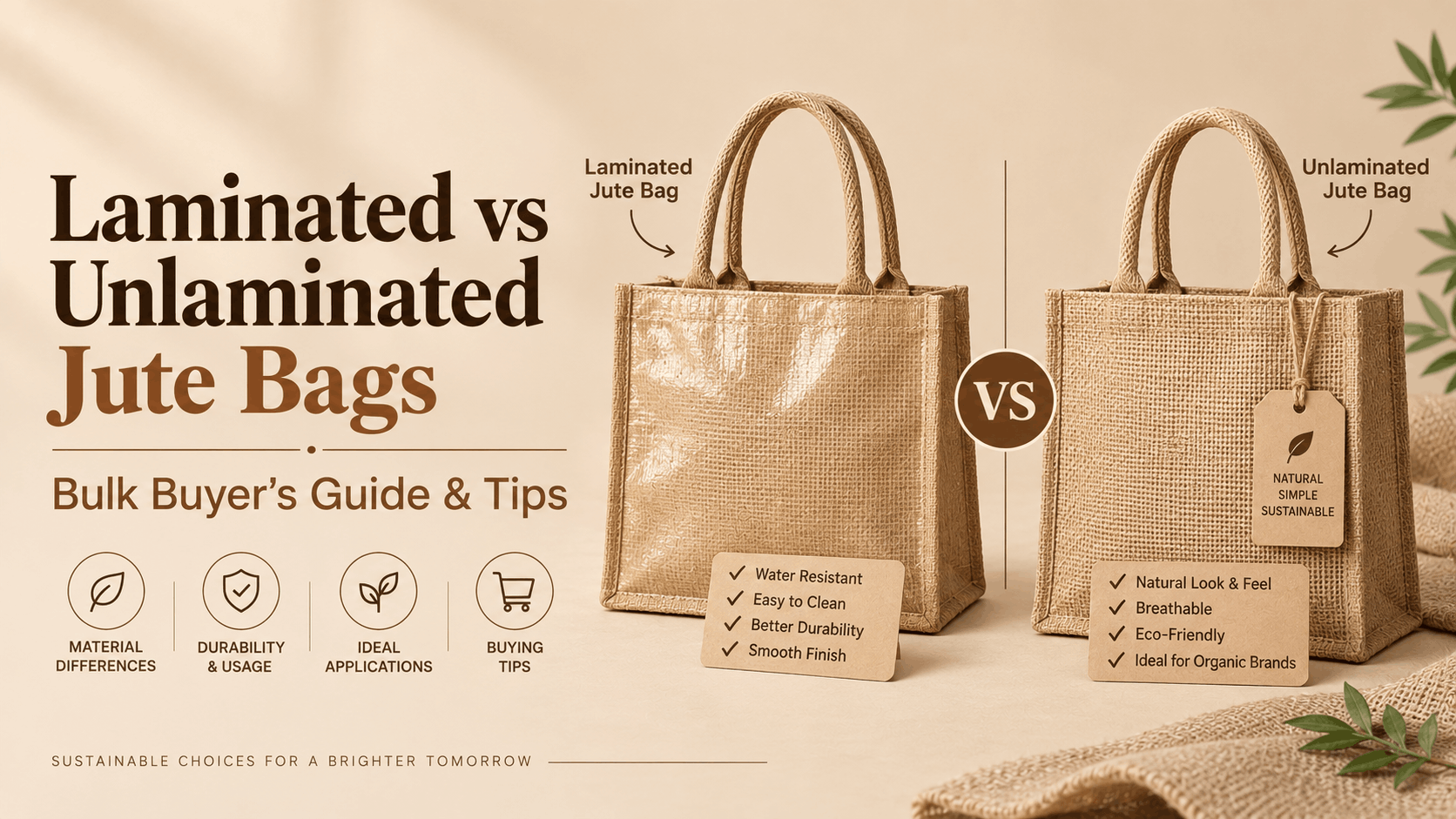
When you compare laminated vs unlaminated jute bags, the wrong choice can affect moisture handling, printing, stiffness, and packing. That matters more when you are buying thousands of units.
India’s jute industry operates at significant commercial scale, producing 12.80 lakh MT of jute goods in FY 2025–26 and exporting 1,71,300 MT worth about US$330.27 million.
For global buyers, that scale means more sourcing options, but also more room for specifications to drift. So which construction fits your market, shipment, and product? Let’s compare the two.
Laminated vs Unlaminated Jute Bags: What Actually Changes?
The difference is not simply a plastic layer versus a natural surface. Lamination changes how the fabric behaves during use, printing, storage, and transport.
| Factor | Laminated jute bags | Unlaminated jute bags |
| Moisture resistance | Better surface protection | More exposed to moisture |
| Surface | Smoother and more uniform | More textured |
| Printing | Better suited to finer graphics | More visible fabric texture |
| Structure | Usually firmer | More natural drape |
| Breathability | Lower | Higher |
| Folding | Can feel stiffer | Easier to fold naturally |
| Surface cleaning | Easier to wipe | More difficult |
| Natural appearance | Slightly reduced | Stronger rustic look |
For wholesale jute bags, that distinction becomes commercial rather than cosmetic. A retail tote exposed to damp warehouse conditions may benefit from lamination. A premium gift bag may be better left unlaminated.
So when comparing laminated vs unlaminated jute bags, start with the job the bag has to perform.
Also Read: What Makes a Jute Bag Export-Ready? Specifications Global Buyers Should Check
What Does Lamination Actually Do to a Jute Bag?
Lamination adds a bonded film layer to the jute fabric. That extra layer changes several physical characteristics at once. It is why two bags made from similar jute can feel completely different.
1. Moisture protection
A laminated surface reduces direct moisture contact with the fabric. That can help during storage, handling, and occasional exposure to damp conditions.
But remember: Moisture resistant does not mean waterproof.
Seams, stitching, openings, and unsealed areas can still allow moisture inside.
2. Printing surface
The laminated face is generally smoother than raw jute. That can help with cleaner logos, sharper graphics, and more consistent print coverage.
For custom jute bags, approve the artwork on the actual production fabric. A digital proof cannot show how ink will behave on the final surface.
3. Stiffness and shape
Lamination can add body and reduce the fabric’s loose drape. That can be useful for structured jute shopping bags or retail packaging where the bag needs to stand more neatly.
The trade-off is simple: more structure can mean less natural flexibility.
4. Folding and packing
A laminated jute bag may develop different fold lines and occupy slightly different packing volume than an unlaminated one. That matters when you order bulk jute bags by carton and plan container utilization.
5. Sustainability considerations
Lamination also changes the material composition. If your buyer specification calls for a natural-fiber or plastic-conscious product, declare the exact film material and construction. Do not just assume the word “jute” answers the question.
| Note: For export programs, keep sustainability claims tied to the actual material specification and any supporting certification. |
When Should You Choose Laminated Jute Bags?
Choose a laminated construction when your jute bag needs the added film for a practical reason. That usually means moisture exposure, easier cleaning, more structure, or detailed branding.
For global retail and wholesale orders, laminated jute bags can make sense for:
- Grocery and food-related retail, where condensation or occasional spills are possible
- Structured jute tote bags that need a firmer body
- Printed retail bags carrying detailed logos or graphics
- Repeated-use shopping bags that benefit from a wipeable interior
- Products moving through humid storage or transit conditions
| Lamination can also give the print surface a cleaner, more uniform base, particularly when the artwork contains finer details. |
When Are Unlaminated Jute Bags the Better Choice?
Choose unlaminated when the natural jute surface adds value and the application doesn’t justify a protective film.
This construction works particularly well for:
- Corporate and event gifting
- Wine and gift bags
- Rustic retail packaging
- Artisan and heritage-led brands
- Dry goods
- Programs where a natural-fiber appearance matters
The exposed weave gives the bag its characteristic texture and keeps the material construction simpler. It also avoids adding a polymer film to the fabric, which can matter when your sustainability brief places limits on added plastics.
| A laminated jute bag is a composite construction, so environmental claims should reflect the complete material rather than just the jute content. |
For custom jute bags, consider another trade-off. Raw jute generally suits bold, uncomplicated artwork better. Fine detail can be harder to reproduce cleanly on its textured surface.
Still deciding between laminated vs unlaminated jute bags? Share your jute bag requirements with info@smpcnavsetu.com or WhatsApp +91 8981348316. We will help you choose the right specification before you place your bulk order.
Does Lamination Affect Jute Bag Printing?
It can. Consider the artwork before the fabric construction is locked, especially for branded retail orders.
For custom jute bags in bulk, specify:
- Print method: screen, transfer, digital, or another agreed process
- Number of colors: single-color and four-color artwork behave very differently
- Print coverage: logo, front panel, full panel or wraparound
- Artwork position: keep clear of seams, gussets and handles
- Color reference: Pantone or approved physical strike-off
- Registration tolerance: important for multi-color graphics
- Print substrate: approve the strike-off on the actual laminated or unlaminated fabric
A coarse jute weave can soften fine lettering and thin lines. A laminated surface may give you a more uniform printing face.
For wholesale jute bags, approve a production strike-off, not just artwork on a screen. That catches color, texture, and registration differences before you print thousands of customized jute bags
Also Read: How to Choose the Right Jute Fabric for Bags?
What Specifications Should You Give a Jute Bag Manufacturer?
A supplier cannot price a vague brief accurately. For custom jute bags, give the specifications in the same order the bag will be produced.
Your RFQ should state:
- Fabric: weave, construction, and GSM
- Lamination: film type, side and coverage, if required
- Size: finished width × height × gusset
- Handles: material, width or diameter, drop and attachment
- Printing: method, colors, artwork size and position
- Stitching: construction, thread and reinforcement requirements
- Color: approved physical or Pantone reference
- Packing: folding method, inner packing and pieces per carton
- Carton: dimensions, net and gross weight
- Application: retail, gifting, grocery, promotion or another defined use
| One detail worth adding is tolerance. A bag measuring 40 × 35 × 12 cm should not be assumed to mean exactly those numbers on every piece. State the acceptable variation for dimensions, GSM, and other critical measurements. |
That gives a jute bag manufacturer in India something to quote against the same product you intend to receive.
For example, here is how to provide an RFQ to your jute bag supplier for this Floral Emossed Crossbody Jute Bag
| Product: Herringbone Jute Crossbody Bag Size: 28 × 20 × 8 cm Fabric: Natural jute herringbone, 300 GSM Lining: Polyester Trim: Tan leather piping and strap tabs Front detail: Hand-braided jute flower with leather centre Strap: Adjustable woven strap with metal hardware Closure: Top zipper Branding: Buyer logo as approved Quantity: 1000 pcs Packing: Individual protection, 25 pcs/carton QC: Match approved sample, dimensions, colour, stitching and applique placement |
Buyer note: Attach the approved physical sample or detailed product photos with the RFQ. This removes most of the guesswork before bulk production.
Also Read: Jute Bag Manufacturer in India: The Complete Guide for Importers and Retail Brands
How SMPC Navsetu Helps Global Buyers Source Jute Bags from India
SMPC Navsetu LLP is an FIEO-registered Indian export company based in Kolkata, India. We work with buyers on wholesale, custom, and contract manufacturing programs. We also support corporate gifting programs within and outside of India.
| Why us? Situated in the heartland of jute production, we can supply the best quality jute without adding unnecessary layers to the overall pricing. That matters during bulk sourcing. |
We go beyond laminated vs unlaminated jute bags. We can develop our jute range around the buyer’s requirements, not a standard construction.
You can customize the following:
- Fabric
- GSM
- Weave
- Lamination
- Handles
- Printing
- Packing
For overseas buyers, the process can cover:
- Product development from a sample, drawing or specification
- Custom jute bags for retail, gifting and sustainable packaging
- Contract manufacturing against approved production requirements
- Buyer-specific packing and export preparation
- Bulk production for wholesalers, retailers and importers
Looking to source custom jute bags from India? Send your specifications to info@smpcnavsetu.com. Let’s work out the right construction before production.
Frequently Asked Questions
1. Do laminated jute bags contain plastic?
Usually, yes. PP or LDPE film is commonly used as the laminate layer.
2. Can laminated jute bags be recycled?
It depends on the complete bag construction and local recycling facilities. The jute and laminate may need separate treatment.
3. Are unlaminated jute bags more sustainable?
Not automatically, but they avoid the added polymer film. Sustainability claims should match the complete material specification.
4. Can laminated jute bags be wiped clean?
Yes, a laminated surface is generally easier to wipe than exposed jute fabric.
5. Does lamination make jute bags stronger?
Not by itself. Fabric construction, GSM, stitching, and handle attachment still influence structural strength.
6. What type of lamination is used on jute bags?
PP and LDPE are common options. Specify the film material, thickness and coverage in the RFQ.
7. Can laminated jute bags be customized for retail brands?
Yes. Size, GSM, lamination, handles, printing, color and packaging can be specified for private-label programs.
8. How do I compare suppliers for laminated jute bags?
Compare the same fabric, laminate, printing, dimensions, handles, packaging and order quantity before comparing price.
9. What is the MOQ for jute bags at SMPC Navsetu?
MOQ generally starts at 150-200 pieces for designer jute handbags and 500 pieces for other custom jute bag programs, depending on construction.
10. Does SMPC Navsetu handle corporate gifting orders?
Yes. We develop custom jute bags for corporate gifting, events, and branded programs, including printing, handles, sizing, and packaging.