
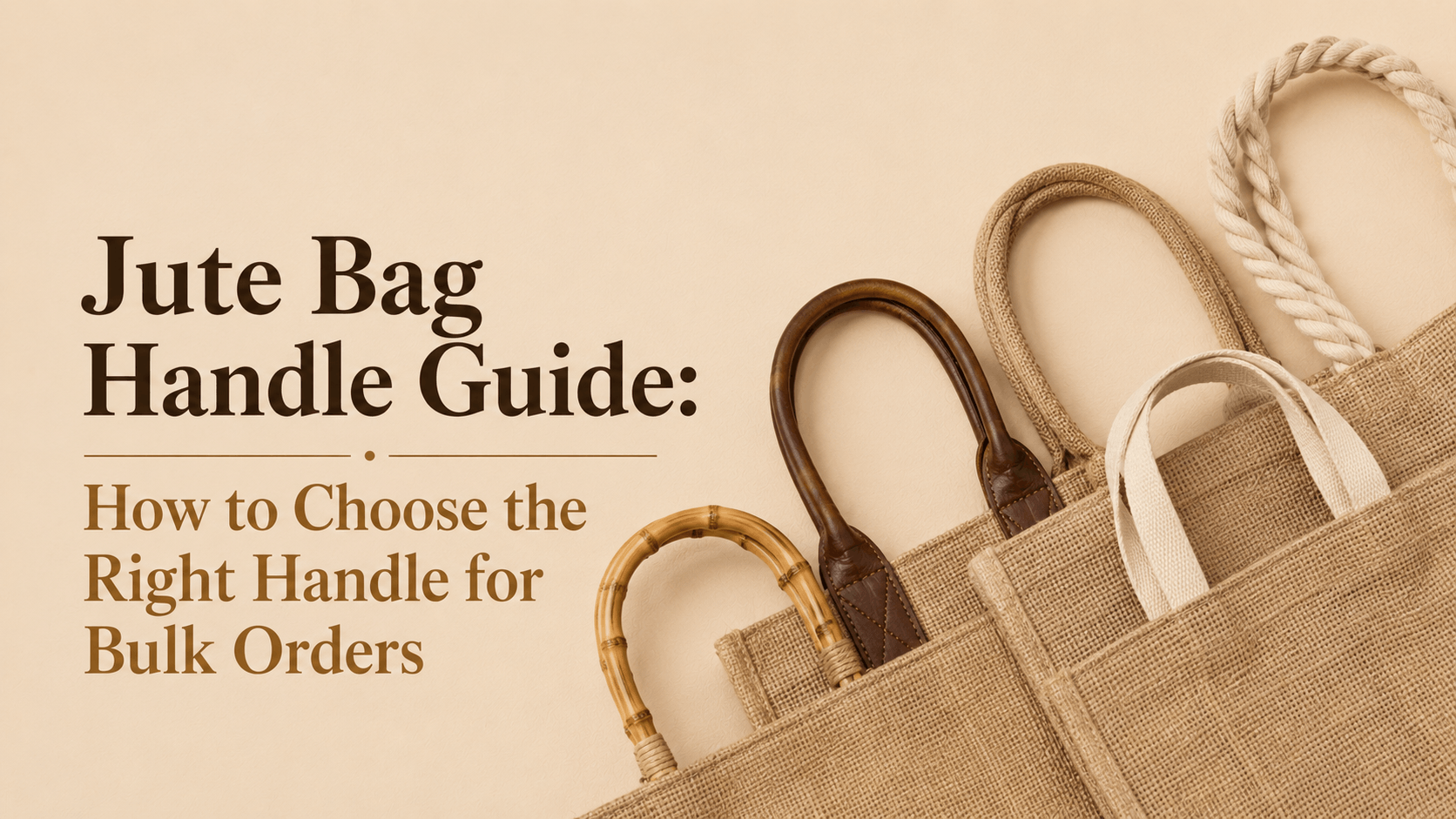
A handle can quietly ruin an otherwise good jute bag. It can add cost, fail under load, feel uncomfortable, or look wrong beside the rest of your collection. Worse, the problem may only appear after thousands of bags reach customers.
The right jute bag handle types depend on the load, carrying frequency, retail positioning, and attachment method.
This guide breaks down jute bag handles by those practical factors, helping importers specify the right handle before samples, quotations, and bulk production are approved.
Why Does Handle Selection Become a Procurement Issue?
A buyer approves a cotton tape handle at 3 kg. The same bag later carries 6 kg of groceries. The stitching holds on some units, stretches on others, and suddenly the supplier is explaining “production variation.”
That’s not a handle problem alone. It’s a specification problem.
1. Start With the Actual Load, Not the Handle Material
Don’t tell a supplier, “We need a strong handle.”
Give them a target.
A grocery bag carrying 6–8 kg needs a different handle specification from a promotional bag carrying brochures and samples. Wine bags create another challenge because the load concentrates around the bottle base and handle attachment points.
Your RFQ should define:
- Expected working load
- Approximate peak load
- Bag dimensions
- Handle drop length
- Carrying frequency
- Intended reuse
That gives the manufacturer something measurable to engineer against.
2. Then Specify How the Handle Attaches
This is where many specifications become vague. “Rope handle” tells a manufacturer very little.
Ask whether the handle will use box stitching, cross stitching, reinforcement patches, rivets, or a combination. The attachment method should match the expected load and the bag’s construction.
For repeat orders, document the approved attachment method. Otherwise, a cheaper production shortcut can quietly appear in the next batch.
3. Don’t Judge Strength From the Sample Alone
Pulling a handle once proves almost nothing.
For bulk production, buyers should compare multiple samples and inspect:
- Stitch density and placement
- Reinforcement area
- Handle symmetry
- Attachment alignment
- Handle-to-body transition
- Visible distortion under load
The goal isn’t simply to find a handle that survives testing. It’s to establish a construction that can be reproduced consistently across the order.
4. Cost Belongs in the Decisions Too
A premium handle can improve presentation. It can also add material, labor, hardware, and packaging complexity.
That makes jute bag handle selection a commercial decision, not merely a design decision.
For a 300-piece boutique order, that premium may make sense. For 20,000 promotional bags, it may add cost without creating enough customer value to justify it.
The right question isn’t “Which handle is best?”
It’s: “Which handle specification gives this SKU the required performance without paying for features the customer won’t value?”
Jute Bag Handle Types: Which One Fits Your Application?
There is no universal jute bag handle that works across every SKU. So don’t choose by appearance alone. Choose by application, expected load, carrying comfort, and target price point.
1. Cotton Tape Handles
Cotton tape remains a sensible choice when cost control and consistency matter more than decorative appeal.
Its flat profile distributes pressure better than narrow cord. It also gives buyers plenty of options for width, color and handle length.
Best for:
- Promotional bags
- Trade-show bags
- Grocery totes
- Large retail programs
Watch out for:
- Very heavy applications. The tape itself may be adequate while the attachment point becomes the weak link.
2. Cotton Rope Handles
A cotton rope handle gives a jute bag a softer, more traditional retail appearance. It also feels more comfortable than narrow flat tape during regular carrying.
Buyers often choose it when the bag needs to look natural without moving into premium hardware.
Best for:
- Shopping bags
- Jute totes
- Corporate gifting
- Wine bags
- Lifestyle collections
Watch out for:
- Rope diameter, knot construction, end finishing, and attachment method. “Cotton rope” alone isn’t a complete specification.
3. Braided Rope Handles
Braiding changes the visual character of the bag immediately. It adds texture and gives a more crafted appearance without requiring a rigid handle.
That’s useful when you’re selling the bag as part of the product experience rather than simply as packaging.
Best for:
- Fashion retail
- Boutique collections
- Premium gifting
- Lifestyle products
Watch out for:
- Don’t assume a decorative braid automatically means higher strength. Specify the construction and attachment separately.
4. Flat Webbing Handles
Webbing is the practical choice when repeated handling takes priority over decorative appeal.
Its wider surface can distribute pressure effectively. It also works well when buyers need consistent dimensions across large production runs.
Best for:
- Grocery bags
- Utility totes
- Reusable shopping bags
- Heavier retail applications
Watch out for:
- Width and attachment design. A wider webbing handle still fails if the bag body or stitching cannot handle the load.
5. Bamboo and Wooden Handles
Rigid handles change the entire character of a jute bag. Bamboo and wooden handles can create the boutique appearance buyers want, but they also add weight, handling considerations, and packaging requirements.
Best for:
- Gift bags
- Boutique retail
- Home décor
- Premium collections
Watch out for:
- Handle-to-body attachment and transit protection. A beautiful rigid handle is not much use if it arrives scratched or detached.
6. PU-Wrapped Handles
PU-wrapped handles offer a smoother, more refined hand feel than basic tape or rope. They work particularly well when the bag needs to sit closer to a fashion or premium accessory category.
Best for:
- Premium gifting
- Fashion retail
- Executive collections
- Higher-value custom jute bags
Watch out for:
- Material compatibility and finish consistency across large batches. Color and surface appearance should form part of the approved sample standard.
7. Die-Cut Handles
A die-cut handle uses the bag body itself rather than adding a separate handle. That reduces components and simplifies production.
It makes sense when the bag needs to remain lightweight and economical.
Best for:
- Promotional bags
- Event giveaways
- Lightweight retail packaging
- High-volume campaigns
Watch out for:
- Reinforcement around the cut-out. The handle opening removes material from the bag body, so load distribution deserves careful attention.
| Have a bulk requirement in mind? Let’s turn the details into a workable specification. Contact a jute bag manufacturer in India today! |
How to Specify a Jute Bag Handle for Bulk Production?
This is where we stop discussing handle types and explain what a buying team should actually put into the specification.
1. Define the Working Load
Don’t write: Strong handle required.
Write: Designed to carry 5 kg during normal use.
If the bag may occasionally carry more, specify the expected peak load separately. This gives the manufacturer a measurable requirement.
2. Specify the Finished Handle Dimensions
“Long cotton handle” isn’t production-ready.
Specify:
- Width or diameter
- Finished length
- Handle drop
- Color
- Construction
- Surface finish
This becomes especially important when you reorder the same bag months later.
3. Define the Attachment Construction
Document whether the approved sample uses box stitching, cross stitching, rivets, reinforcement patches, or a combination. The attachment should remain consistent across production runs.
4. Approve the Handle With the Actual Bag
Test it on the final jute fabric, bag dimensions, gusset, lining, and reinforcement. A handle can perform perfectly on one construction and poorly on another.
5. Specify the Color Properly
For brand-sensitive orders, don’t rely only on a digital color code.
Approve a physical handle reference alongside the fabric and print sample. Cotton tape, rope, and webbing can reproduce the same color differently because their surfaces and dye absorption vary.
6. Define What Must Not Change
This is the part many buyers miss.
Your approved specification should identify the non-negotiables:
Handle material → dimensions → color → attachment → reinforcement → approved reference
That gives your supplier a fixed production standard rather than a vague visual target.
Here is an example of the RFQ you should send to a jute bag manufacturer:
| Product: Reusable Jute Shopping Bag Bag Size: 40 × 35 × 12 cm Fabric: 14 oz natural jute Application: Grocery and everyday retail Target Working Load: 6 kg Handle Material: Cotton rope Rope Diameter: 10 mm Handle Drop: 28 cm Handle Color: Natural Attachment: Cross-stitched with reinforcement patch Branding: 1-color screen print, front panel Expected Quantity: 5,000 pieces Packaging: 50 pieces per export carton Destination: USA (NY Port) Requirement: Handle must remain securely attached during repeated carrying at the specified working load. |
How SMPC Navsetu Helps Global Buyers Manage Jute Bag Sourcing From India?
For international buyers, the headache usually starts when the approved jute bag sample and production batch stop speaking the same language.
At SMPC Navsetu LLP, we help buyers/importers lock the important details before bulk jute bag manufacturing:
- handle material
- Dimensions
- Attachment method
- Reinforcement
- Color
- Approved sample references
We then coordinate these specifications during manufacturing process and quality checks before export.
That matters when you’re ordering 500 or 20,000 bags. A small handle variation can become a large commercial problem at that scale.
Need to discuss a custom jute bag requirement? Send us the specification at info@smpcnavsetu.com and we will bring the sourcing perspective.
Frequently Asked Questions
1. Which jute bag handle is strongest for bulk orders?
Webbing or rope can both perform well; the attachment and reinforcement determine the actual load capacity.
2. What are jute bag handles made from?
Common options include cotton tape, cotton rope, webbing, bamboo, wood, and PU-wrapped materials.
3. Which handle is best for promotional jute bags?
Cotton tape usually offers the best balance of unit cost, consistency, and easy large-volume production.
4. Are cotton rope handles stronger than cotton tape?
Not necessarily; diameter, width, stitching, reinforcement, and attachment design matter more than the material name.
5. Which jute handle is best for wine bags?
Cotton rope works well for many wine bags, but heavier multi-bottle carriers need reinforced attachments and load testing.
6. Which jute bag handle looks most premium?
Bamboo, wood, braided rope, and PU-wrapped handles can create a stronger premium visual than standard tape.
7. What should I include when specifying a jute bag handle?
Specify material, width or diameter, handle drop, color, attachment, reinforcement, working load, and approved sample reference.
8. How should buyers compare handle quotations from different suppliers?
Compare quotes against identical handle specifications. Otherwise, a cheaper quote may simply reflect a different construction.
9. Can one handle specification work across different jute bag sizes?
Not automatically. Changing bag dimensions or load can require different handle length, reinforcement, or attachment construction.
10. How should I approve a jute bag handle before bulk production?
Test multiple finished samples under the intended load and check attachment, stitching, dimensions, comfort, and consistency.