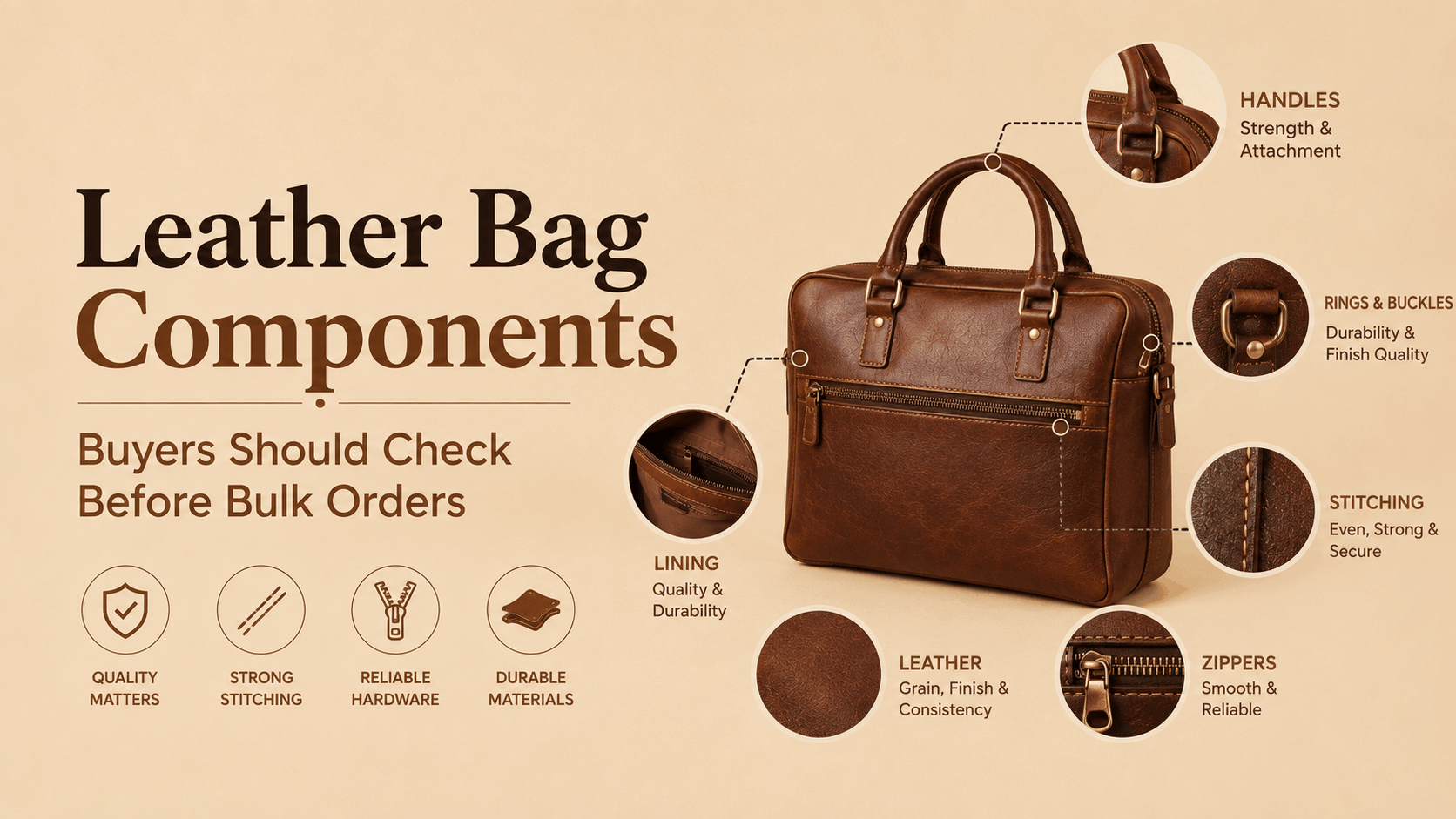
The parts most likely to cause trouble in a leather bag are often not the leather itself. Hardware, lining, thread, reinforcement, zippers, and finishing can affect cost, performance, and production consistency.
What hardware should you specify?
Which lining suits the bag’s actual use?
How should handles be reinforced?
These questions matter when you are buying hundreds or thousands of units.
This guide examines the leather bag components that buyers often overlook. And the details worth locking down before approving custom, private-label, or OEM production.
What Are the Components of a Leather Bag?
At first glance, a leather bag looks like leather, a lining, and some hardware. Your production BOM tells a different story.
Depending on the design, you may also have zippers, thread, reinforcement, interfacing, adhesives, edge finishing, rivets, closures, and multiple internal components.
| For bulk sourcing, the important question is not simply which leather bag components are present. It is which ones need a controlled specification. |
A Textured Leather Shopper Tote, for example, can carry a very different component bill from a simpler tote once you add pockets, shoulder hardware and reinforced carrying points.
A useful way to think about them is by function:
- Structural components: leather panels, reinforcement, interfacing and load-bearing seams
- Functional components: zippers, closures, D-rings, buckles and swivel hooks
- Interior components: lining, pockets, dividers and their attachment points
- Assembly components: thread, adhesives, skiving and edge-finishing materials
- Branding and presentation: labels, embossing, packaging and other approved details
| Buyer’s note: The component list is only the starting point. The bigger sourcing risk comes from leaving the details of those components open to interpretation. That is where “same as sample” can become very different products at scale. |
Curious what these component decisions look like in finished products? Explore our Leather Catalog and inspect the details between the leather, not just the leather itself.
4 Leather Bag Components Deserve the Most Attention in Bulk Sourcing
Not every component needs the same level of scrutiny. A decorative stud and a shoulder-strap anchor may both sit on your BOM, but they do not carry the same commercial risk.
| For buying teams, focus first on specific leather bag components exposed to load, friction, movement and repeated handling. |
1. Hardware
“Antique brass hardware” sounds specific until production starts. It usually describes the finish, not the complete hardware specification.
For load-bearing fittings, lock down:
- Base material: brass, zinc alloy, steel or other approved metal
- Finish: antique, matte, brushed, polished or plated
- Dimensions: outer size, internal opening and material thickness
- Attachment: rivet, stitch, folded tab, screw or other construction
- Approved reference: physical sample or controlled finish reference
A D-ring can remain perfectly intact while the leather loop holding it stretches. That is why hardware should be reviewed together with its attachment point.
This Leather Zip Pocket Messenger Bag is a useful example. The shoulder strap, D-rings, and leather tabs form one working system. Treating the D-ring as a standalone purchase misses the real load-bearing issue.
2. Lining
Do not approve lining with “black polyester” and call it finished.
For bulk production, your specification should address:
- fabric construction
- weight or GSM
- colour
- hand feel
- abrasion exposure
- pocket fabric, where different
- seam attachment
- reinforcement around stressed areas
A Leather Multi-Pocket Tote Bag for Work will see repeated friction from files, laptops, chargers and other contents. Its lining and pocket construction therefore deserve more scrutiny than those of a lightly used fashion bag.
The right lining is neither the softest nor the cheapest option. It is the one suited to the bag’s actual job.
3. Thread
“Strong thread” is another specification that sounds useful but leaves production plenty of room for interpretation.
Thread performance depends on its relationship with:
- leather thickness
- thread size
- needle selection
- stitch length
- stitch density
- seam allowance
- machine setup
- expected seam load
For structural seams, specify the thread material, size, and color. Then distinguish those seams from decorative stitching.
A heavier thread is not automatically better. It can alter stitch appearance, needle penetration, and how thinner leather behaves around the seam.
4. Reinforcement
Do not be satisfied with “reinforced handles.”
Ask where the load enters the bag, where it travels and how it gets distributed.
Critical areas may include:
- handle anchors
- shoulder-strap tabs
- D-ring attachments
- rivet locations
- bag corners
- base panels
- closure points
- heavily loaded internal pockets
A second layer of leather placed in the wrong area is not engineering. It is extra material.
For products such as the Leather Structured Work Satchel, the top handles and shoulder strap create different loading patterns. The reinforcement should reflect those paths rather than follow a single generic construction across all models.
| One sourcing rule worth remembering: When two materials meet, inspect the connection. That is where many otherwise good specifications become vague. Leather meets hardware | Thread meets leather | Lining meets a seam | A handle meets the bag body. |
Those interfaces deserve more attention than a front-facing photograph ever will. Leather bag components can shift the unit cost through both material usage and production time.
Also Read: Leather Bag Manufacturing Cost: What Determines Bulk Pricing for Different Types of Leather Bags?
When Is a “Similar” Component Not Actually Equivalent?
This is one of the questions worth asking before a supplier says, “We can use an equivalent.”
An alternative leather bag hardware item may have the same finish but different dimensions. A replacement leather bag lining may have the same color but a different construction. Even leather bag thread can change when the size or material is different.
For custom leather bags and OEM leather bags, check the component that is actually changing:
- zipper size and construction
- hardware dimensions and finish
- lining construction and weight
- thread material and size
- interfacing thickness or stiffness
- reinforcement material
- edge-finishing system
Take a Leather Hobo Shoulder Bag with Adjustable Strap. Change a strap component without checking the complete assembly, and the adjustment, proportion, or feel of the finished bag can change.
| So do not ask only: “Is it equivalent?” Ask: “Will the finished product still be constructed and behave the same way?” |
That is a much better procurement test.
Also Read: How to Choose the Best Leather for Bags, Wallets & Accessories
What Should You Put in a Leather Bag Component BOM?
A useful BOM should tell the production team exactly what was approved, without forcing them to interpret vague descriptions.
| Instead of: Black polyester lining Specify: 210D polyester, black, approved swatch, body lining and pocket lining Instead of: Antique brass D-ring Specify: 25 mm internal width, approved base material, antique-brass finish |
For leather bag components, also record:
- dimensions
- quantity per bag
- placement
- attachment method
- finish or color
- approved physical reference
This is particularly useful for leather bag manufacturing. Because a component specification can affect cutting, sewing, assembly and finishing, not just purchasing.
A Leather Zip Pocket Messenger Bag, for example, should have its zipper, strap hardware, lining and attachment details separately identified rather than buried under generic headings.
For buyers working with a leather handbag manufacturer in India, keep previous inspection records alongside the current golden sample. That gives your team something better than memory to compare against.
Also Read: How to Choose an OEM Leather Goods Manufacturer for Your Brand
Why Buyers Choose SMPC NAVSETU for Leather Bag Sourcing from India
SMPC Navsetu LLP is an FIEO-registered Indian export business built for buyers who need more than a catalog supplier. You may arrive with a finished product, a rough sketch, a competitor sample, or simply a commercial brief. We build the production route around that requirement.

For custom leather bags and OEM leather bags, our scope can cover:
- Product development and sampling against your reference or brief
- Leather and component specifications, including hardware, lining, thread and reinforcement
- Contract manufacturing for approved designs and production quantities
- Production and quality control against agreed specifications
- Private-label branding and packaging for retail, wholesale and brand programs
- Export documentation and shipment execution through one commercial interface
The important difference is that the product does not have to fit our pre-existing factory catalog. The leather bag components, construction, and finishing are worked around the product you want to sell.
For a buyer, that means fewer handoffs, fewer disconnected vendors, and one team responsible for moving the order from brief → sample → production → export.
Have a leather bag specification, reference sample, or OEM requirement in mind? Send it to info@smpcnavsetu.com. Let’s turn your brief into a production-ready export order.
Frequently Asked Questions
1. Which leather bag components affect the final retail price?
Hardware, lining, construction, finishing and internal details can move the cost noticeably.
2. What should buyers inspect before a bulk leather bag order?
Check stitching, hardware fit, lining, edges, pockets and hidden attachment points.
3. Do all leather bag handles need reinforcement?
Not necessarily. It depends on the handle design, load and attachment method.
4. Why do leather bag zippers fail in production?
Poor sizing, unsuitable construction or incorrect installation can create problems.
5. Can one lining work across different leather bags?
Usually not. Structure, usage and interior load can change the requirement.
6. What should buyers inspect beyond the leather?
Look at component fit, finishing, construction and consistency across the entire sample.
7. What should I send an Indian leather bag manufacturer for an RFQ?
Share the design, dimensions, leather, components, quantity, branding and packaging requirements.
8. How do buyers control quality when sourcing leather bags from India?
Use an approved sample, clear specifications and defined inspection points.
9. What is often missed when sourcing custom leather bags?
Small construction details, component fit and hidden reinforcement.
10. Can Indian manufacturers produce OEM leather bags from a buyer’s design?
Yes. Production can be developed from a sample, tech pack, drawing or product brief.