
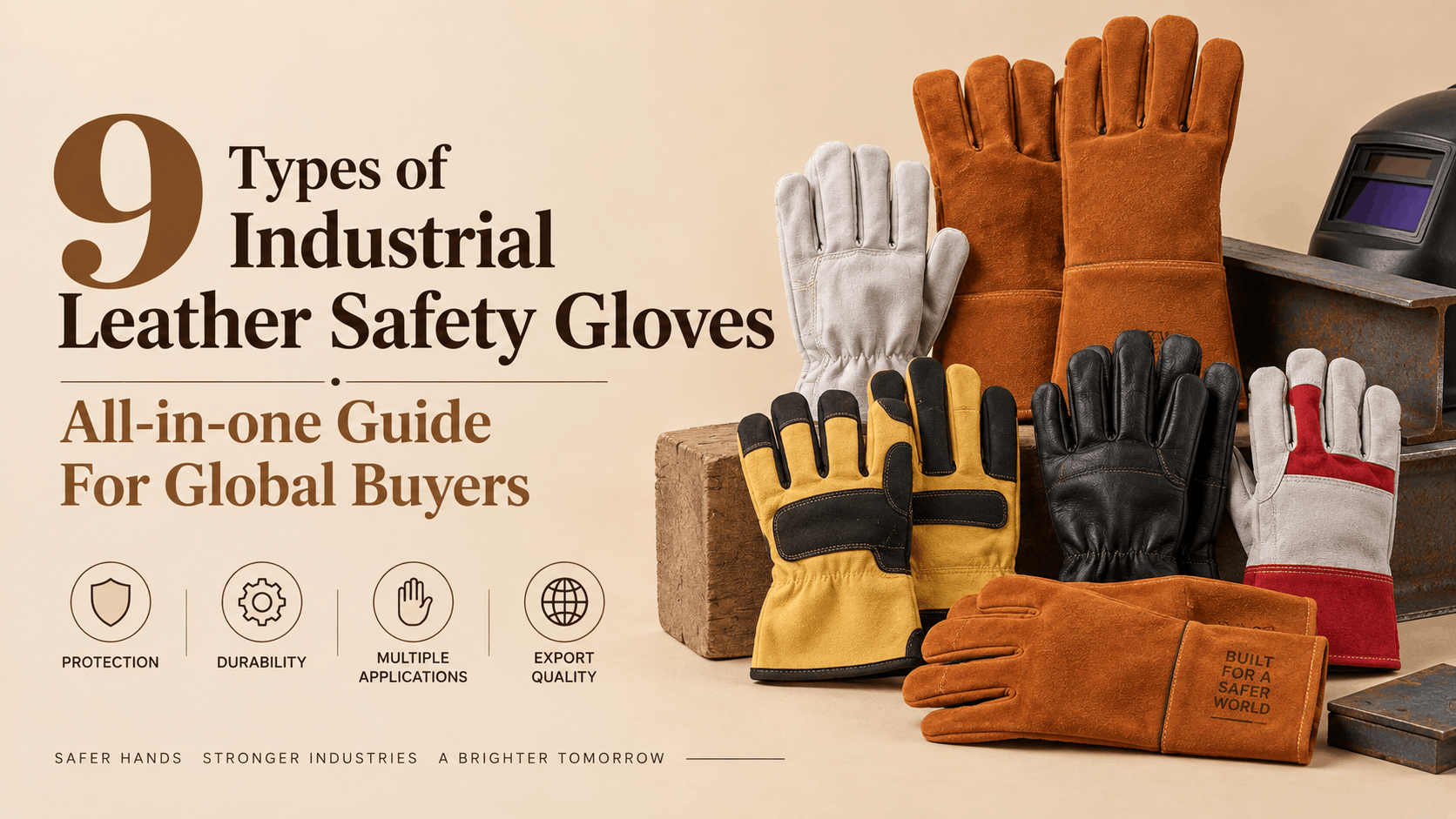
Industrial leather safety gloves are not “one-size-fits-all”. Welding, rigging, driving, and heavy material handling place very different demands on the glove.
A welding glove needs coverage and construction suited to sparks and heat. A rigger glove needs grip and wear resistance. A driver glove needs flexibility without excessive bulk.
For global buyers, the bigger problem is often the RFQ itself: “leather work gloves” says almost nothing about cuff length, leather construction, reinforcement, stitching, or lining.
This guide covers different types of industrial leather safety gloves buyers can source from India, and what to specify for each application.
What Are Industrial Safety Gloves?
Industrial safety gloves or PPE gloves are protective handwear designed around specific workplace hazards. They are not defined simply by being thick, heavy, or made from leather. The right safety glove depends on what the worker handles and what the hand is exposed to.
For buyers, think in terms of the hazard first, glove second:
- Abrasion: rough surfaces, repeated handling and material movement
- Cut: sharp edges, sheet metal, glass and fabrication work
- Puncture: pointed materials and certain handling tasks
- Heat and sparks: welding, foundry and hot-work environments
- Grip: oily, dry, rough or irregular surfaces
- Dexterity: jobs requiring precise hand movement
- Impact: tasks involving knocks or falling objects
However, leather alone does not make a glove compliant with a particular safety standard. Performance depends on the glove’s complete construction, materials, stitching, and tested characteristics.
| For bulk procurement, the useful question is therefore not: “Which leather safety glove is the strongest?”It is: “Which glove construction matches the hazard, task and required level of hand protection?” |
9 Types of Industrial Leather Safety Gloves Global Buyers Can Source
The industrial safety gloves market was valued at USD 9.1 billion in 2025 and is projected to reach USD 14.1 billion by 2035, growing at 4.5% CAGR.
Here are the types of industrial leather safety gloves that you can source for different sectors:
1. Leather Welding Gloves
Leather welding gloves use protective leather panels with a longer cuff or gauntlet to cover the hand, wrist, and part of the forearm. The construction typically combines split or grain leather, reinforced high-wear areas, structural stitching, and an optional lining. The pattern must allow enough finger movement for handling a torch, electrode, or tool.
Key features:
- Extended gauntlet cuff for wrist and forearm coverage
- Split or grain leather construction depending on application
- Reinforced palm and thumb areas
- Lined or unlined construction
- Multi-panel finger pattern for tool handling
- Heat-resistant sewing thread where specified
- Rolled or bound cuff edge for cleaner finishing
Where are they used?
- Welding and fabrication shops
- Metal fabrication
- Shipbuilding and repair
- Automotive workshops
- Foundries and hot-work areas
What should buyers consider?
- Specify the type of thermal exposure, not simply “heat resistant.”
- Check cuff length against the protective sleeves used with the glove.
- Examine palm and thumb reinforcement for repeated tool handling.
- Confirm the lining if prolonged wear or higher heat exposure is expected.
- Request the applicable EN 407 performance classification and test documentation for the exact glove model when certification is required.
2. Leather Rigger Gloves
Leather rigger gloves are built for repeated handling of ropes, tools, metal components, and other rough materials. Their construction usually combines a flexible palm with reinforcement around areas that receive concentrated wear. A gauntlet cuff can extend coverage beyond the wrist.
Key features
- Reinforced palm and thumb
- Flexible finger construction
- Extended cuff options
- Durable leather palm
- Reinforced high-wear seams
- Pattern designed for repeated gripping
Where are they used?
- Rigging and lifting
- Construction
- Oil and gas support work
- Logistics and material handling
- Industrial maintenance
What should buyers consider?
- Check the thumb crotch, a frequent wear point.
- Match palm reinforcement to the material being handled.
- Avoid excessive leather thickness if workers need frequent finger movement.
- Confirm cuff length when wrist coverage is important.
- Test samples around ropes, hooks, tools, or the actual handled material rather than relying on visual inspection alone.
3. Leather Driver Gloves
Leather driver gloves use a closer-fitting pattern designed to preserve hand movement while providing protection during driving and general handling. Softer, more flexible leather is generally preferred over a heavily layered construction. Finger shaping, thumb geometry, and seam placement become particularly important.
Key features
- Flexible leather construction
- Close-fitting finger pattern
- Shaped thumb for natural movement
- Low-bulk palm construction
- Extended or standard cuff options
- Minimal internal seam interference
Where are they used?
- Commercial driving
- Equipment operation
- Agricultural work
- Transport and logistics
- General maintenance
What should buyers consider?
- Check finger mobility, not just overall glove size.
- Examine seams around the thumb and palm for pressure points.
- Specify leather thickness according to the required flexibility.
- Check cuff fit against sleeves and working conditions.
- Test the glove while gripping a steering wheel, handle or tool.
Also Read: Understanding Leather Grades: What Buyers Should Know Before Ordering
4. General-Purpose Leather Work Gloves
General-purpose leather work gloves are the practical choice when one glove must cover several routine handling tasks. They are commonly specified for warehouses, workshops, construction support, maintenance, and material handling where workers face abrasion, rough surfaces, and everyday mechanical contact rather than one highly specific hazard.
Key features
- Full-finger leather construction
- Reinforced palm for repeated contact
- Standard cuff for wrist coverage
- Practical pattern for routine handling
- Construction suited to repetitive industrial work
Where are they used?
- Warehousing and logistics
- Workshops and maintenance
- Construction support
- Material handling
- General industrial operations
What should buyers consider?
- Choose this category when tasks vary across a shift.
- Avoid over-specifying protection the job does not need.
- Check finger pattern and palm fit for repeated handling.
- Match leather construction to the expected wear level.
- For wholesale leather gloves, consistency across sizes often matters more than adding unnecessary features.
5. Heavy-Duty Leather Work Gloves
Heavy-duty leather work gloves are meant for tougher handling, where the palm, fingers, and back of the hand take more sustained wear. The difference is not simply thicker leather. The pattern, reinforcement, and coverage need to work together without making basic hand movement unnecessarily difficult.
Key features
- Full-finger construction
- Reinforced leather panels
- Extended cuff
- Greater hand coverage
- Multi-panel construction for industrial handling
Where are they used?
- Heavy material handling
- Construction support
- Industrial workshops
- Fabrication environments
- General heavy-duty work
What should buyers consider?
- Check where reinforcement is actually placed.
- Match leather thickness to the handling task.
- Review cuff length alongside the workwear used.
- Test finger mobility before approving a heavier construction.
- For bulk leather gloves, confirm that added material improves the intended work function rather than simply increasing weight.
6. Leather Gauntlet Gloves
Leather gauntlet gloves make sense when wrist and lower-forearm coverage matters alongside hand protection. The extended cuff is the defining feature, but cuff length alone doesn’t tell you whether the glove suits the application.
Key features
- Extended gauntlet cuff
- Wrist and lower-forearm coverage
- Full-finger leather construction
- Wide cuff opening
- Suitable for applications needing more coverage than short-cuff designs
Where are they used?
- Material handling
- Fabrication support
- Industrial workshops
- Construction work
- Applications requiring extended wrist coverage
What should buyers consider?
- Measure the cuff against the worker’s protective sleeve.
- Check whether the wider cuff restricts movement.
- Confirm the finished cuff length, not just the glove size.
- Inspect the cuff edge for clean, consistent finishing.
- For industrial leather safety gloves, define the required coverage before choosing the cuff style.
7. Reinforced Leather Safety Gloves
Reinforced leather safety gloves add material where the glove takes concentrated wear or repeated contact. The reinforcement may sit across the palm, thumb, knuckles, or other high-contact areas rather than covering the entire glove. That makes placement more important than simply adding another leather layer.
Key features
- Reinforced palm and thumb zones
- Additional knuckle coverage
- Multi-panel construction
- Extended cuff
- Separate leather sections for targeted protection
Where are they used?
- Material handling
- Fabrication support
- Construction
- Industrial workshops
- Maintenance operations
What should buyers consider?
- Reinforcement should match actual wear zones.
- Excessive buildup can restrict finger movement.
- Check the thumb crotch separately.
- Extra leather can create thicker seam intersections.
- Reinforcement should not compromise grip or hand closure.
Also Read: How to Compare Leather Samples Before Approving Production
8. Leather Gloves with Knitted Safety Cuffs
Knitted-cuff leather gloves solve a different problem: wrist fit. Instead of leaving a wider gauntlet opening, the knitted section sits closer around the wrist. That can make the glove more practical for warehouse work, workshops, and routine material handling.
Key features
- Leather palm and finger construction
- Elastic knitted wrist
- Close-fitting cuff
- Flexible wrist interface
- Reinforced leather hand areas
Where are they used?
- Warehousing
- Workshops
- General material handling
- Maintenance
- Industrial workwear programs
What should buyers consider?
- It should retain its fit after repeated stretching.
- Check whether it sits comfortably under workwear.
- Too tight can hinder donning; too loose defeats the purpose.
- Inspect where the knitted material meets leather.
- Assess hand fit and wrist fit separately.
9. High-Visibility Leather Work Gloves
High-visibility leather work gloves bring a visual identification element into conventional hand protection. The color or contrasting cuff can make the glove easier to distinguish in busy work areas, which may matter for workwear programs with color-coded equipment or visibility requirements.
Key features
- Bright contrasting cuff
- Leather palm and hand sections
- Reinforced thumb construction
- Extended wrist coverage
- Two-tone visual design
Where are they used?
- Material handling
- Construction support
- Industrial workshops
- Warehouse operations
- Workwear and PPE programs
What should buyers consider?
- Do not confuse visibility with certified high-visibility PPE.
- Specify the required color or visual standard separately.
- Check color consistency across production lots.
- Confirm whether reflective elements are actually required.
- Keep the visibility feature compatible with the glove’s working environment.
Also Read: How to Choose an OEM Leather Goods Manufacturer for Your Brand
How Should Global Buyers Choose Between Industrial Leather Glove Types?
Choose a leather safety glove type based on work exposure, not the product name.
For procurement teams, this quick comparison helps narrow the specification before requesting samples.
| Glove type | Best suited for | Priority to specify |
| Welding gloves | Welding and hot work | Cuff, thermal performance, lining |
| Rigger gloves | Rigging and handling | Palm construction, grip, finger movement |
| Driver gloves | Driving and controlled handling | Flexibility, fit, seam placement |
| General work gloves | Routine industrial work | Versatility, fit, wear areas |
| Heavy-duty gloves | Tough material handling | Leather construction, reinforcement |
| Gauntlet gloves | Extended wrist exposure | Cuff length, palm reinforcement |
| Reinforced gloves | High-wear tasks | Reinforcement placement |
| Knitted-cuff gloves | Warehouse and workshop use | Wrist fit, cuff construction |
| High-visibility gloves | Visibility-focused workwear | Color, visibility features, construction |
| Custom OEM gloves | Private-label programs | Application, dimensions, materials |
The distinction is simple: don’t buy a “heavy-duty leather glove” when you need dexterity, and don’t specify a “driver glove” for work that demands extended protection.
For industrial leather safety gloves, the application should determine the construction before the quotation does.
Why Global Buyers Source Industrial Leather Gloves from SMPC Navsetu
SMPC Navsetu LLP is an FIEO-registered Indian exporter of industrial leather safety gloves and PPE, supplying them through contract manufacturing and buyer-specific production programs.
| Working within a long-established leather manufacturing base now centered around the Calcutta Leather Complex helps us develop application-specific and contract-manufactured gloves without adding unnecessary layers to the supply chain. |
The model works well when a standard glove is close, but the specification needs changing. Buyers can define:
- Leather type and thickness
- Palm, thumb, or knuckle reinforcement
- Cuff length and construction
- Lining and stitching
- Sizes and quantity
- Branding and packaging
For global buyers, the practical advantage is simple: local manufacturing depth, tighter production control, and commercially competitive sourcing from one of India’s recognized leather clusters.
Now, you can check our product catalog on the Indian Business Portal.
Read our blogs for sourcing tips and all the latest industry insights.
Have a glove specification or sample? Send it to info@smpcnavsetu.com and let’s build the production around it.
Frequently Asked Questions
What are industrial leather gloves used for?
They are used for welding, rigging, driving, material handling, fabrication and general industrial work.
Are leather gloves suitable for welding?
Yes, specific leather constructions can suit welding. The required thermal performance depends on the actual work exposure.
What is the difference between rigger gloves and driver gloves?
Rigger gloves favor handling and wear resistance. Driver gloves prioritize flexibility and hand movement.
What makes a good industrial leather glove?
The construction should match the hazard, including leather, reinforcement, cuff, stitching, lining and fit.
Are leather gloves waterproof?
Not automatically. Water resistance depends on the leather treatment and complete glove construction.
What should I specify when ordering industrial leather gloves from India?
Give the application, leather, thickness, pattern, reinforcement, cuff, lining, sizes, branding, and packing requirements.
Can I order private-label leather safety gloves from India?
Yes. We can develop custom sizing, construction, branding, and packaging for OEM and private-label programs.
What is the MOQ for industrial leather gloves from SMPC Navsetu?
Our standard MOQ starts at 300 pairs per color and design.
Can SMPC Navsetu develop a glove from my existing sample?
Yes. A reference glove, specification, or technical brief can be used as the starting point for contract manufacturing.